Alexander Mordvintsev is a researcher and artist based in Zurich, who invented Google's DeepDream algorithm in 2015 while working on Deep Neural Network visualization at Google Research.,In his own words, he is “a tinkerer, coder, researcher, and artist” who visualizes things to understand how they work, a curiosity that carried him from neural networks into the study of self-organization, artificial life and circuit design.
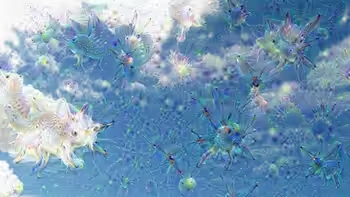
He grew up in the former Soviet Union, where his childhood computers, Z80-based machines and ZX Spectrum clones, were about a decade behind their Western counterparts, and where he got hooked on tinkering with hardware and the demoscene.At Google, he produced DeepDream through experiments begun in May 2015, feeding images back through a convolutional neural network trained on the 2014 ImageNet Challenge and amplifying the patterns it recognized until familiar objects dissolved into dense, hallucinatory detail. He published the technique with colleagues Christopher Olah and Mike Tyka on the Google Research blog in June 2015, and its open-source code, released that July, set off a global wave of psychedelic imagery that made DeepDream a defining early example of AI-generated art.
His work with DeepDream was shown in “DeepDream: The Art of Neural Networks” at Gray Area in 2016 and in “AI: More Than Human” at London's Barbican Centre in 2019. That same year, Kate Vass Galerie included him in “Automat und Mensch”, its survey of seventy years of generative art history, in Zurich. His pre-release DeepDream images, made in May 2015 before the algorithm's public launch, were only cleared for sale in 2024 and were minted as NFTs for the gallery's retrospective “Automat und Mensch 2.0”.His practice turned toward Neural Cellular Automata, a model of self-organizing, life-like systems that grow from simple local rules, which he discussed with fellow artist-engineer Karl Sims in a 2025 conversation on the shared roots of artificial life and generative art.
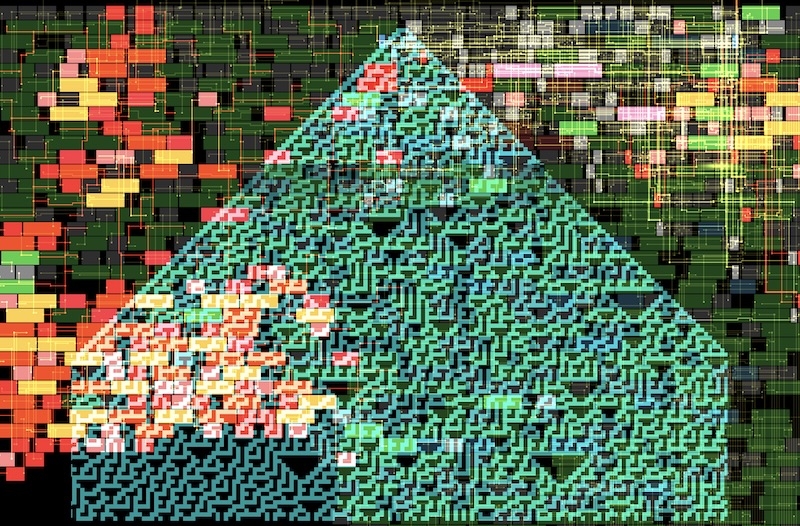
In September 2025 he received the Swiss AI Award, marking DeepDream's tenth anniversary.That same year he began working with Tiny Tapeout, an open silicon chip-design project, submitting an ASIC design that generates a scrolling cellular automata pattern as a VGA video signal.In 2026, at Zurich's After the Algorithm festival, he showed Substrates of (A)Life, an installation comparing the timing of digital signals to the firing of neurons and the feedback loops of computer hardware to cellular energy cycles.That year Kate Vass Galerie also devoted its exhibition “Emergence” to his trajectory from Conway's Game of Life to learning-based artificial life systems.