Agnieszka Kurant is a Polish artist based in New York whose work explores collective intelligence and the invisible labor that underlies digital capitalism.,She collaborates across disciplines with scientists, data specialists and nonhuman collaborators such as termites, treating collective and machine intelligence as a kind of co-author.
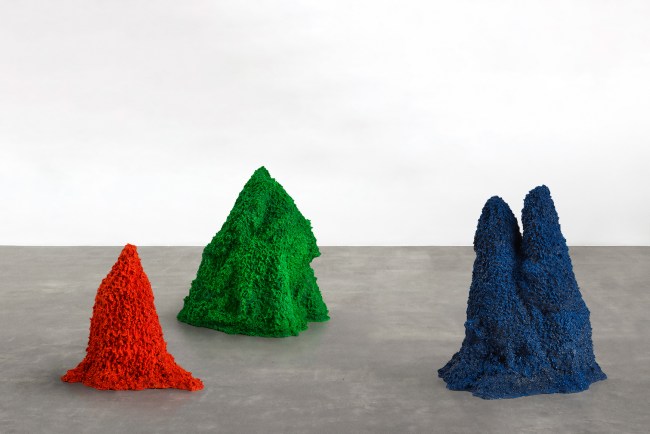
Her 2014 sculpture series A.A.I. — short for “artificial artificial intelligence”, a term for the humans who power Amazon's Mechanical Turk platform — was produced by termites from a University of Florida entomology lab, which she supplied with gold, glitter and colored sand to build with.The resulting towers resemble colorful Minimalist sculptures while pointing to the AI industry's hidden “ghost workers”, a theme she returned to in Aggregated Ghost, a composite portrait giving visible form to data workers in the Global South.,
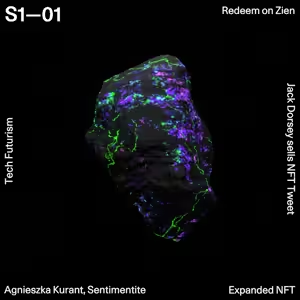
Since 2013 she has developed The End of Signature, which fuses thousands of signatures from communities such as Guggenheim Museum visitors, Cleveland Museum of Art staff and MIT scientists into a single collective mark that cannot be attributed to any individual. In 2026 she developed its iteration REDISTRIBUTION, which fuses signatures from New York's artist community using an AI algorithm and encodes equal profit-sharing into the work's conditions of sale, so that every contributor shares in the proceeds whenever it is sold.Her NFT series Sentimentite (2022) turns social media sentiment data scraped during events such as the 2011 Occupy Wall Street protests into a fictional mineral, which can be cast in materials historically used as informal currencies, including whale teeth and cigarettes.,
Kurant has had solo exhibitions at Castello di Rivoli (2021–22), Kunsthal Gent and Kunstverein Hannover (both 2023), and Mudam Luxembourg (2024), and her work is presented by the gallery Marian Goodman.,In her Risk Landscape series, begun in 2024, she works with data scientists and catastrophe-modeling specialists to turn business risk assessments covering climate, finance, social instability and war into shifting holographic forms.In 2011 she organized a conference on the political economy of social creativity at the Free/Slow University in Warsaw, later published as the essay collection Joy Forever.