Rhea Myers is a British-born artist, hacker, and writer based in British Columbia, Canada, who has used the blockchain as an artistic medium since 2014.,Trained in conceptual art in the 1990s, she treats code as cultural material, using smart contracts, generative systems, and blockchain protocols to extend a conceptualist tradition into technical form.,
In 2011 Myers offered on her blog to draw a Bitcoin for anyone who sent her one, an early gesture toward what would become NFTs. After moving to Vancouver in 2013, she began making token works on Dogeparty, a Counterparty fork running on Bitcoin that predates Ethereum. In 2014, inspired by Komar and Melamid's 1980s project buying New York artists' souls, she tokenized her own soul on Dogeparty and split it into 100 units. The piece was never sold, since her wife objected that the soul belonged to her.
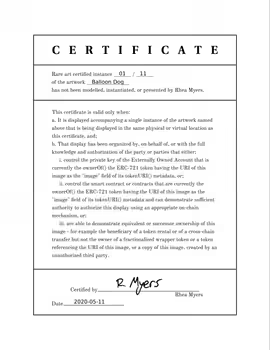
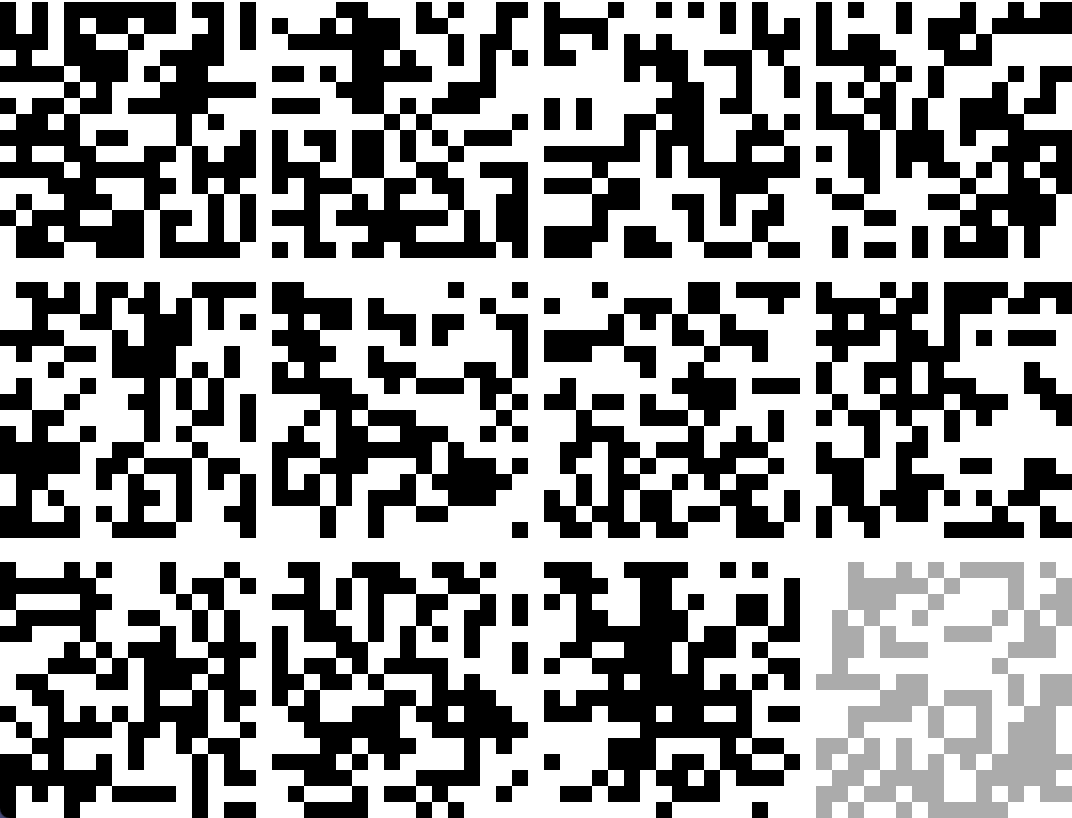
Her project Shareable Readymades, 2011–13, produced parody certificates of authenticity for downloadable 3D-printable objects whose copyright she disclaimed. She revisited that format in Certificate of Inauthenticity, 2020, blockchain certificates for 3D-printed objects — a urinal, a balloon dog — that prove the artist's absence from their making rather than authenticate it.Her Blockchain Aesthetics series renders the transaction-hash data of the Bitcoin blockchain in the visual language of modernist abstraction, and was shown in Kate Vass Galerie's 2018–19 “Perfect and Priceless” in Zürich, later reissued as NFTs on Foundation.,
In draw-something, begun in 2004, she wrote a LISP drawing program modeled on her own understanding of composition, made after Harold Cohen declined to share AARON's source code. The work was shown in the 2023 exhibition “GEN/GEN: Generative Generations” at Gazelli Art House.In Tokens Equal Text, 2019, the structure of the smart contract itself forms the expressive core of the work.
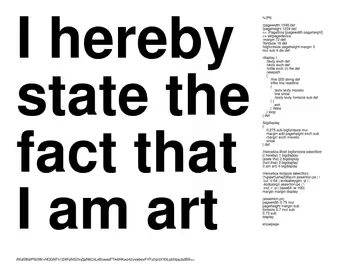
Her series Koala Noosphere, 2026, presents 333 NFTs as museum-style placards whose text, generated on-chain, describes imagined artworks that never existed, defined only through comparison with the other nonexistent works in the series.In Self-Identifying, 2025, PostScript programs generate their own code on the blockchain, linking the self-verifying structure of a quine to the phrase's more common use in describing trans people's relationship to gender.That year she and the artist Linda Dounia were paired for a commission on the Museum of the Moving Image's Media Wall, part of a Tezos Foundation-backed program.She has published the anthology Proof of Work: Blockchain Provocations 2011–2021, collecting over a decade of her essays and fiction on blockchain and art.,