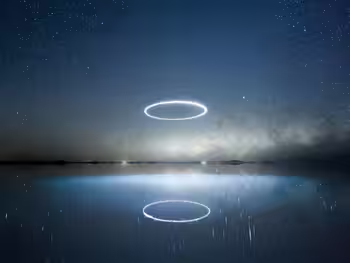
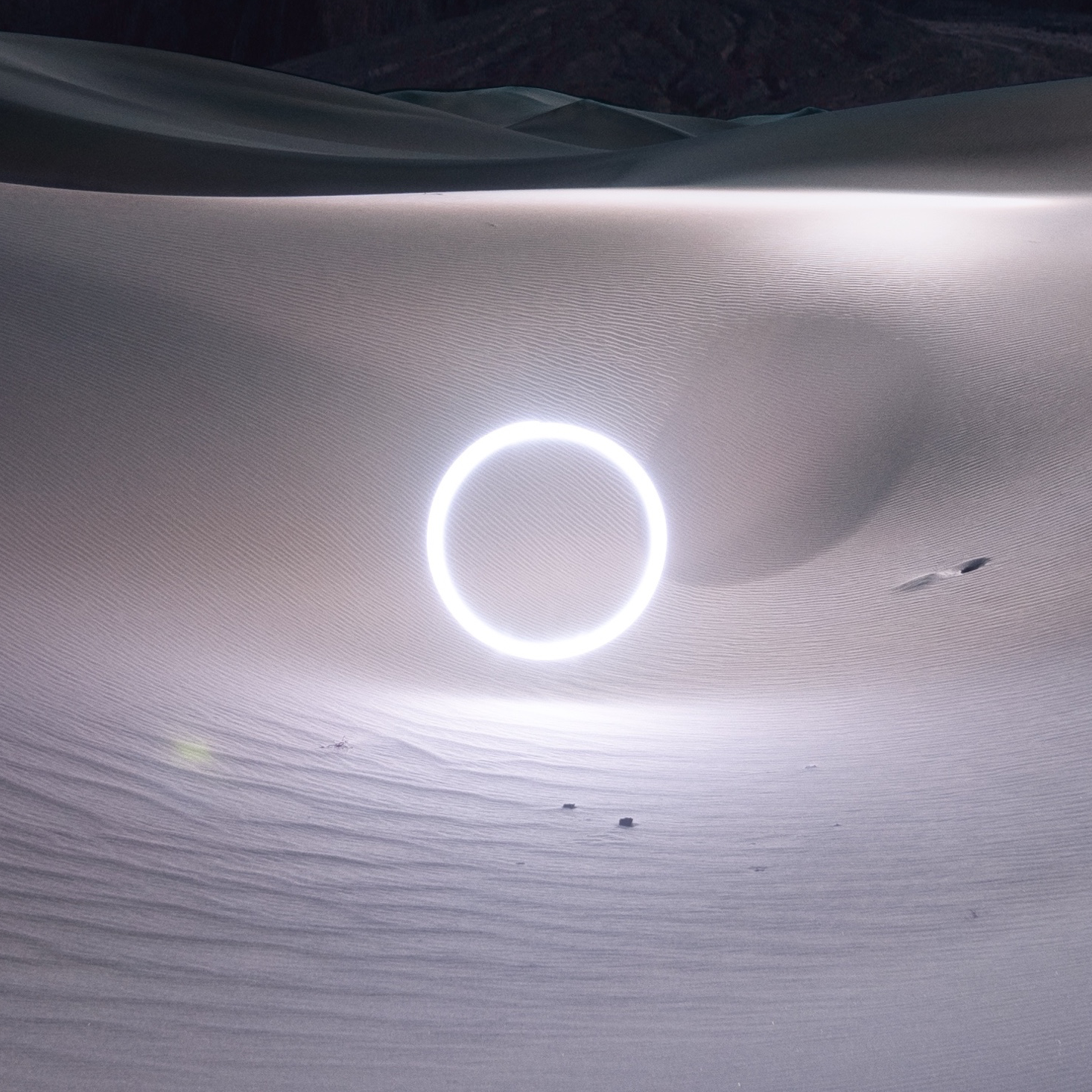
Reuben Wu (British, b. 1975) is a photographer and visual artist who uses drones, artificial light, and long exposures to reimagine landscapes.,,Based in Chicago, he is known for attaching lights to drones to illuminate remote terrain and for tracing their flight paths into geometric light patterns.,
Wu was born in Liverpool in 1975 to parents who had immigrated from Hong Kong. He studied Industrial Design at university while immersed in Sheffield's music scene. In 1999 he formed the band Ladytron with Daniel Hunt, Mira Aroyo, and Helen Marnie, and spent the next decade touring rather than working as a designer. He began photographing the band's travels as a casual tour diary. In 2011 he took his first dedicated photography trip, to Svalbard, producing his first cohesive body of work. When Ladytron went on hiatus, Wu committed to photography as a profession, drawing on his design and music background to develop his own visual approach.
In 2014, a truck's headlights accidentally illuminated the landscape during a night shoot at Trona Pinnacles, inspiring Lux Noctis, a project in which Wu attaches powerful lights to drones to light remote landscapes and blur the line between reality and fiction. That approach developed into Aeroglyphs, geometric light patterns formed by photographing drone flight paths through long exposures, existing only as light drawings with no physical trace on the land.
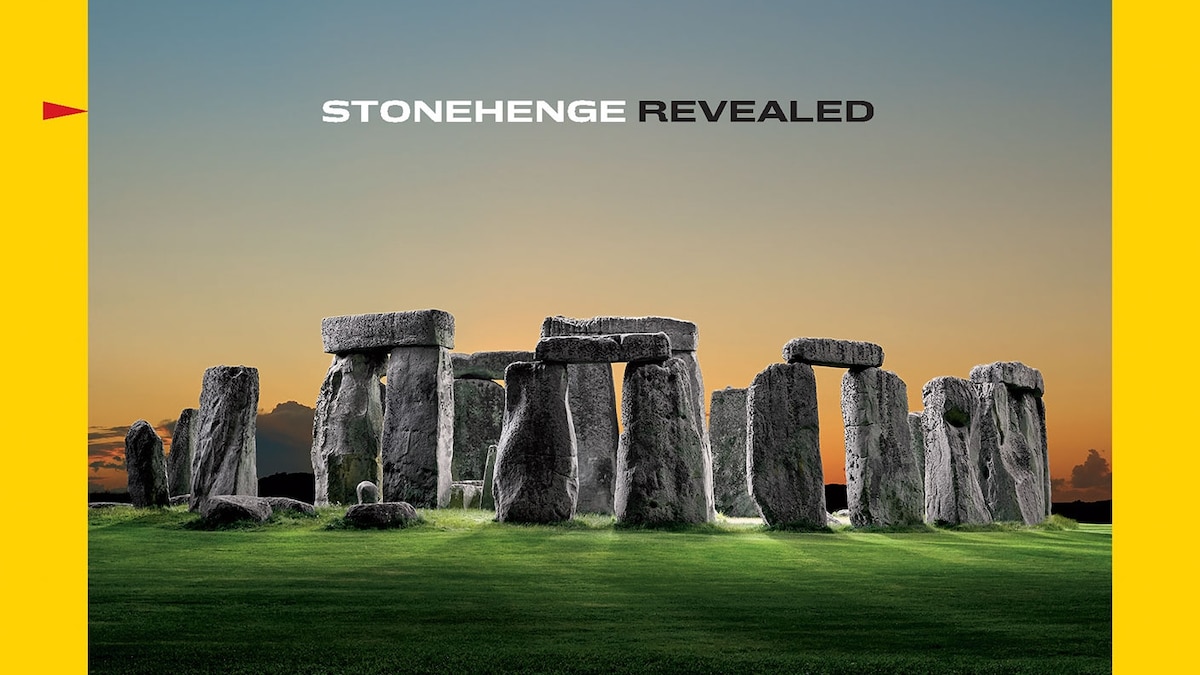
National Geographic commissioned Wu to photograph Stonehenge after he spoke at its 2020 Storytellers Summit, and the resulting image became the magazine's August cover. Unable to fly a drone directly above the stones, he lit them with a Bluetooth-operated LED attached to a 50-foot telescopic pole held by an assistant. He also used a small drone alongside the pole to light the stones precisely, a lighting technique he traces to the bold contrasts of light and dark in chiaroscuro painting. After the shoot, Wu learned that photographer Harold Edgerton had lit Stonehenge from above with a strobe mounted on a bomber for the British military after World War II, a historical echo of his own drone technique. Wu has described his aim as “showing the familiar in unfamiliar light.”His work has entered the collections of the Guggenheim Museum, The Metropolitan Museum of Art, and the Museum of Modern Art, a status corroborated independently by his SuperRare profile.,In 2023, nftnow.com included him in its NFT100 list.