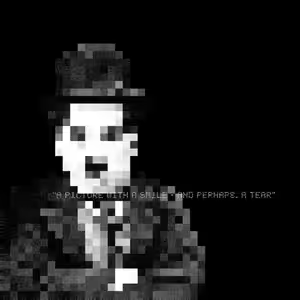
p.i.x.e.l.l.a.r.e. is the digital art practice of the graphic and product designer Dario, who transforms photographs into shifting pixel compositions using generative coding, animation and installation.Born in Winterthur, Switzerland, to Italian parents, he was raised largely in Italy and trained under the designer A.G. Fronzoni in Milan.,
He was studying Economics and Business at university when a chance meeting with Fronzoni changed his path. Fronzoni told him, “Those who refuse to design accept to be designed”, and he left his degree to study design instead.He later worked as a freelance designer across graphics, exhibition design and architecture, based at different times in Genoa, Naples, Lecce, Venice and Milan. He began researching Bitcoin and blockchain in 2017, and around 2020 started studying the emerging market for digital art on the blockchain. Drawn to the CryptoPunks' use of pixels as a visual language, and to the work of Paul Klee, he coined the Italian neologism pixellare, meaning to turn everything into pixels. He minted his first NFT on 8bidou on March 26, 2022, under that name.
Much of his work is fully on-chain on Tezos, which he values for storing a work's complete data directly on the blockchain rather than linking to files held on outside storage such as IPFS. In 2023 he began Hack the Bomb, Spread the Peace, inviting nineteen artists to contribute their own responses to an original piece he made about nuclear war. Stumbling Blocks_On-Chain takes its name from Gunter Demnig's Stolpersteine memorials and uses the blockchain to record the stories of people who resisted injustice, again inviting other artists to contribute. For the #ArtForHumanity3 project, he made BellaCiao to raise funds for Palestinian civilians through Save the Children, referencing the Global Sumud Flotilla's attempt to break the naval blockade on humanitarian aid to Palestine.
As part of the second objkt Labs Residency, he released P.i.x.e.l.l.a.n.d.i.a. through the objkt labs Gallery in July 2026, a collaborative generative work pairing photographs from twenty invited photographers with autonomous pixel animation. Its title references Edwin A. Abbott's 1884 book Flatland, and the piece extends his long-standing interest in abstraction as a way of stepping back from an image to reveal structures that direct representation cannot.In his series i.c.o.n.p.x., he renders culturally iconic film images as semi-abstract pixel figures, each work embedding a small frame from the original source.