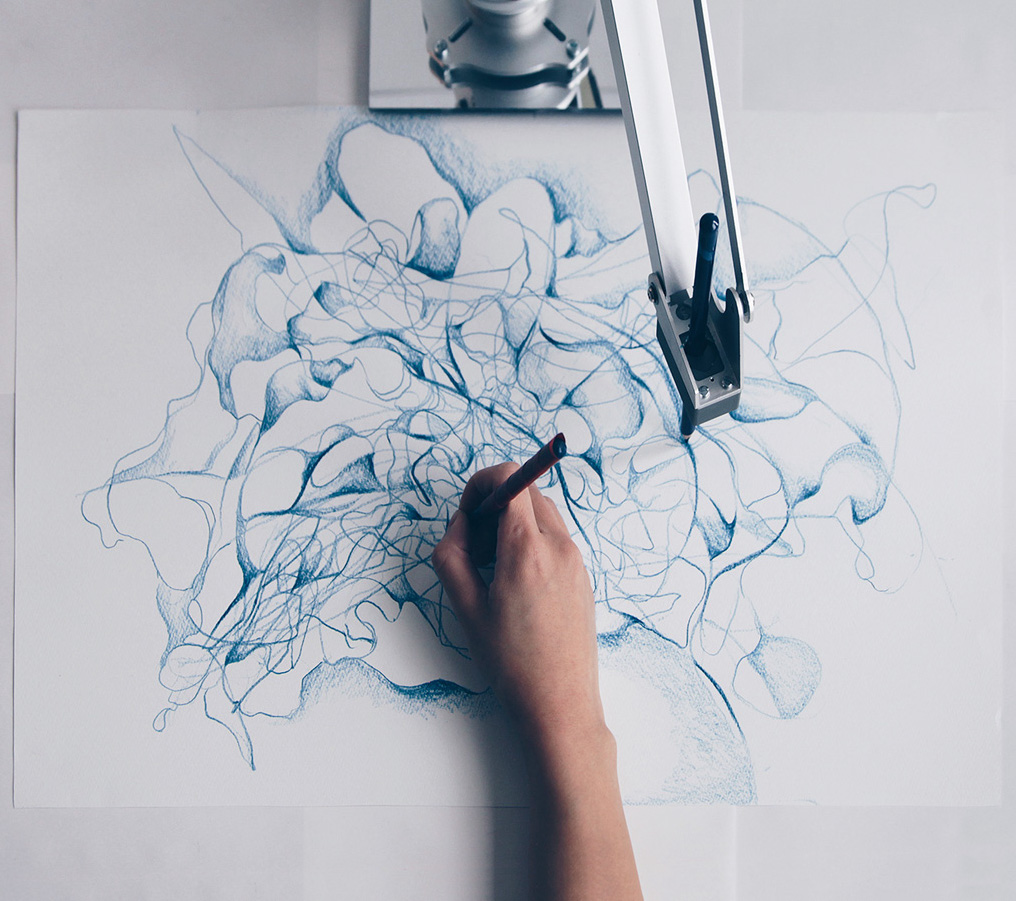
Pindar Van Arman is an American artist and roboticist who builds and codes robots that paint using artificial intelligence, robotic arms and 3D printing, most prominently through his long-running project CloudPainter. His robots work in a continuous feedback loop, analyzing each brushstroke before deciding the next, an approach the artist has developed over more than two decades of building painting robots.
He began building painting robots after competing in the DARPA Grand Challenge, and has spoken about the influence of Harold Cohen on his own approach. He knew Cohen personally and has said Cohen distrusted deep learning. His CloudPainter project has been grouped with Cohen's AARON and Sougwen Chung's D.O.U.G. as examples of artists collaborating with systems they built. His robots make aesthetic decisions using a mix of borrowed and custom algorithms, including k-means clustering for color, OpenCV's Hough Lines and Haar Cascades for edge and face detection, style-transfer neural networks, and generative adversarial networks. New York critic Jerry Saltz reviewed the robots' output and said they “have good taste”, and Van Arman took first place in the 2018 RobotArt International Competition after earlier placing second and third in 2016 and 2017.