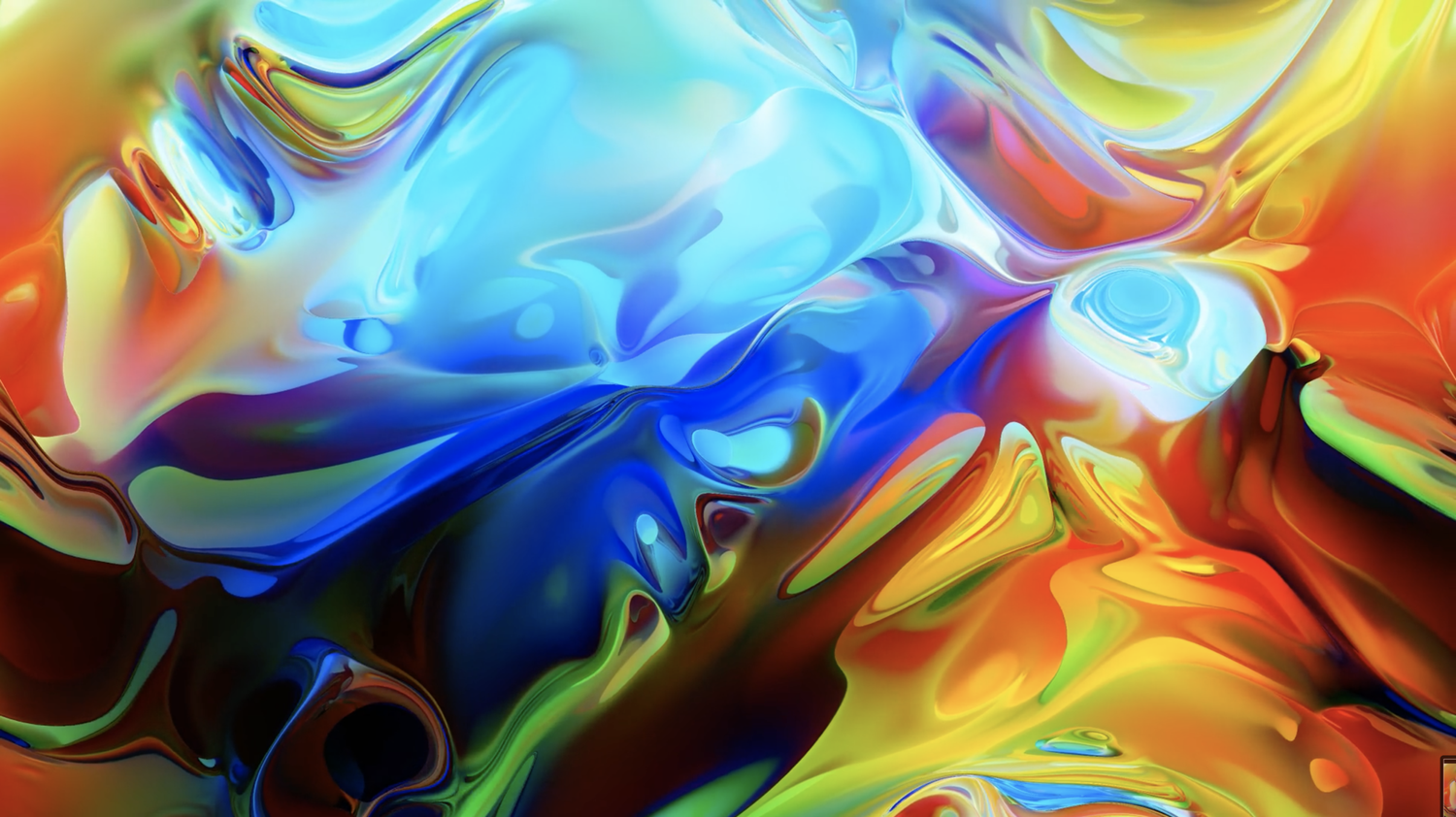
Jonathan McCabe is a generative artist based in Canberra, Australia, whose code-based works translate scientific theories of self-organization and pattern formation into vivid, evolving imagery.,His practice draws especially on Alan Turing's theory of morphogenesis and on cellular automata such as Conway's Game of Life.,
McCabe studied at the Australian Centre for the Arts and Technology, earning a Master of Electronic Arts in 2000.His interest in computing began with home microcomputers in the early 1980s, when he taught himself to write simple programs in BASIC and used a pen plotter to make drawings in the style of string art. He later became interested in cellular automata and noticed that they could behave like reaction-diffusion systems. This led him to Alan Turing's 1953 paper proposing that interacting chemicals could spontaneously form patterns of stripes and dots, as seen in the coats of animals such as zebras.
His series Multi-Scale Turing Patterns combines Turing patterns at different sizes to produce fractal-like structure. The technique has since circulated online independently of him, with images he recognizes as his own sometimes credited to other artists. In his Cellularity series, he extends Conway's Game of Life into a four-dimensional system in which each cell's state diffuses and reacts with its neighbors, producing forms that appear to grow and move like living organisms.In 2019 he collaborated with Oleg Pashkovsky and the studio Knot on Morphogenesis, a large-scale interactive installation at Stanford University's Bass Biology Building.His work has been exhibited at Canberra Gallery, Bridge Gallery, and Front Gallery, and featured by outlets including Wired, New Scientist, and the BBC.,