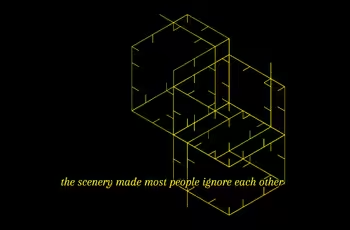
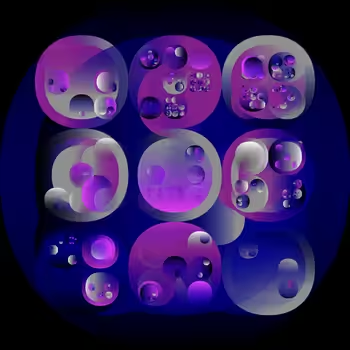
Harm van den Dorpel is a Dutch artist based in Berlin,who has spent two decades building websites, algorithms and generative systems that decide how images appear, mutate and circulate.The practice moves between net art, genetics-inspired software and blockchain.In 2015 van den Dorpel became the first artist to sell an NFT, Event Listeners, to a museum collection.,
Van den Dorpel's project Club Internet expanded the group-blog format of the 2000s surf-club scene into online exhibitions where each contribution filled the whole browser window and left no permanent trace. For several years the site Dissociations doubled as an online portfolio and a durational artwork, presenting three images or texts at a time and eliminating the least coherent of the three, gradually training the site to reflect van den Dorpel's own taste. With Delinear.info (2014) this became a social platform that replaced the linear feed with a drifting collage of images and text, where users' avatars hovered as circles marking their interests.In 2015 van den Dorpel co-founded Left Gallery with Paloma Rodríguez Carrington, a blockchain-based gallery for displaying and distributing downloadable digital art.Death Imitates Language (2016) bred a population of software organisms whose forms mutated through the artist's own subjective selection, with some of the resulting shapes fabricated as physical objects.In Resurrections (2018), shown at the Gamerz festival, van den Dorpel departed from that graphic, algorithmic register to animate found party photographs of unconscious revelers so that the bodies appear to levitate.
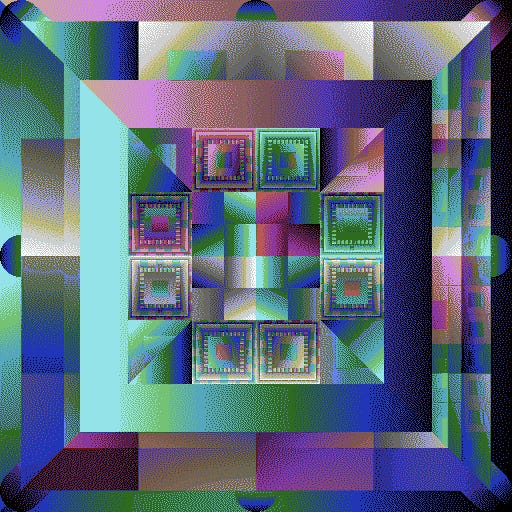
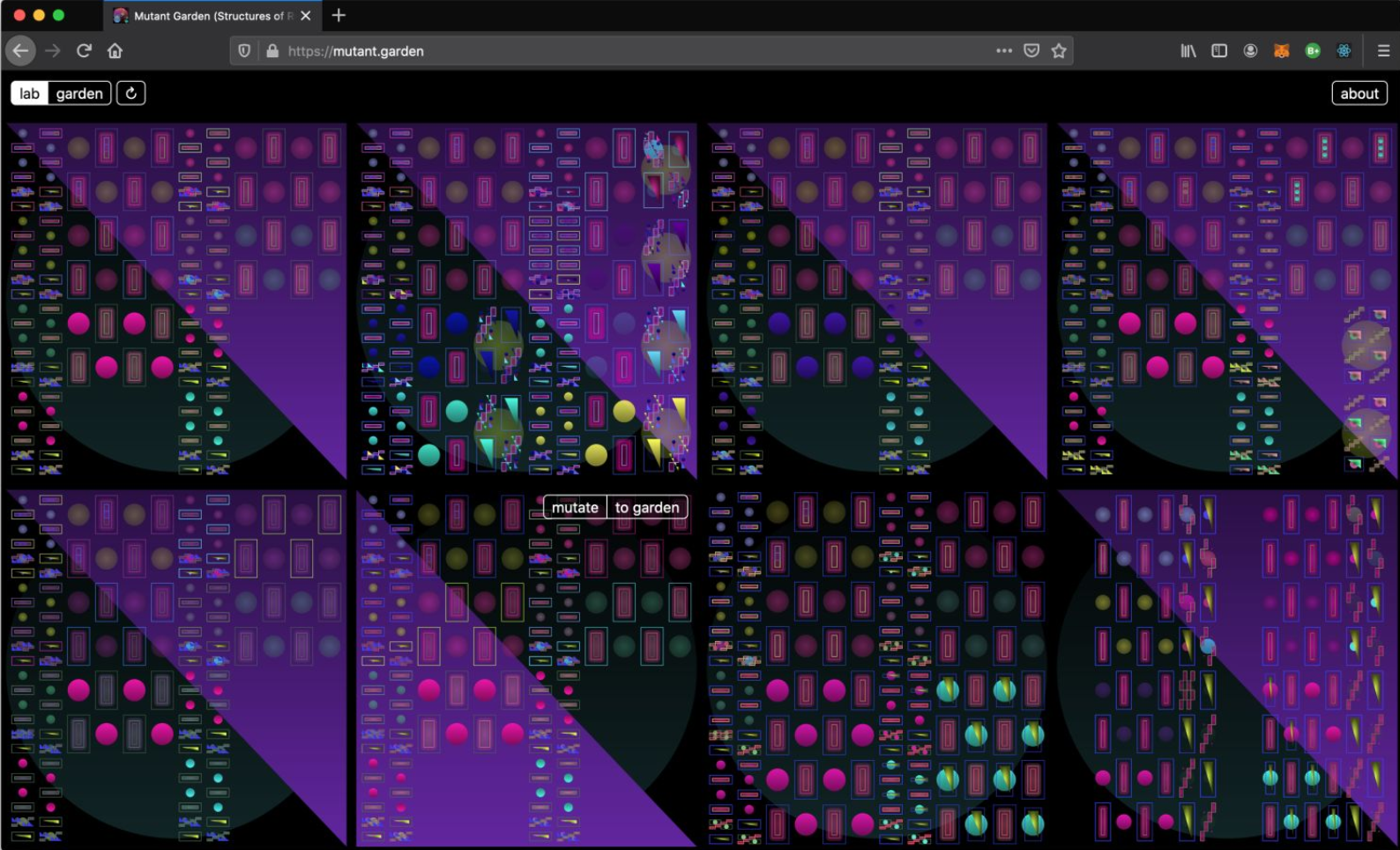
Mutant Garden, begun in 2018, mints NFTs whose forms are generated from network parameters such as block hashes and mining rhythms.Mutant Garden Seeder (2021) carried forward the selective-breeding logic of Death Imitates Language onto Ethereum, inviting collectors to mint chosen mutations, though the interface was often bypassed by collectors minting directly from the contract. Markov's Dream (2022) revisited Markov's Window, a 2004 experiment in algorithmic geometric abstraction, exposing each work's generative traits, including one variant that colors its forms using vocabulary drawn from the Diagnostic and Statistical Manual of Mental Disorders.In 2023 van den Dorpel produced Maschine, a 1,000-token generative collection about velocity and perception made in collaboration with Mercedes-Benz and Fingerprints DAO.,Quantizer (2025) lives as a single web page too large to store fully on-chain, recomposing its imagery through dithering algorithms once used to render color on limited 1980s and 1990s displays, so that it never repeats itself.