Driessens & Verstappen is the collaborative name of the Dutch artists Erwin Driessens and Maria Verstappen, who have worked together in Amsterdam since 1990 building self-generating systems that evolve or replicate according to their own rules rather than a fixed design.,“We like to create systems that themselves create other things”, the artists have said of this approach, which they call “meta creation”.
Both studied Visual Design at the Academie van Beeldende Kunsten in Maastricht in the 1980s, then Art Media Studies at the Rijksakademie van Beeldende Kunsten in Amsterdam, before beginning to work together as a duo in 1990.Their practice spans sculpture, installation and generative software, and centres on self-organising systems drawn from nature, ones that either replicate endlessly or evolve almost imperceptibly over long stretches of time.
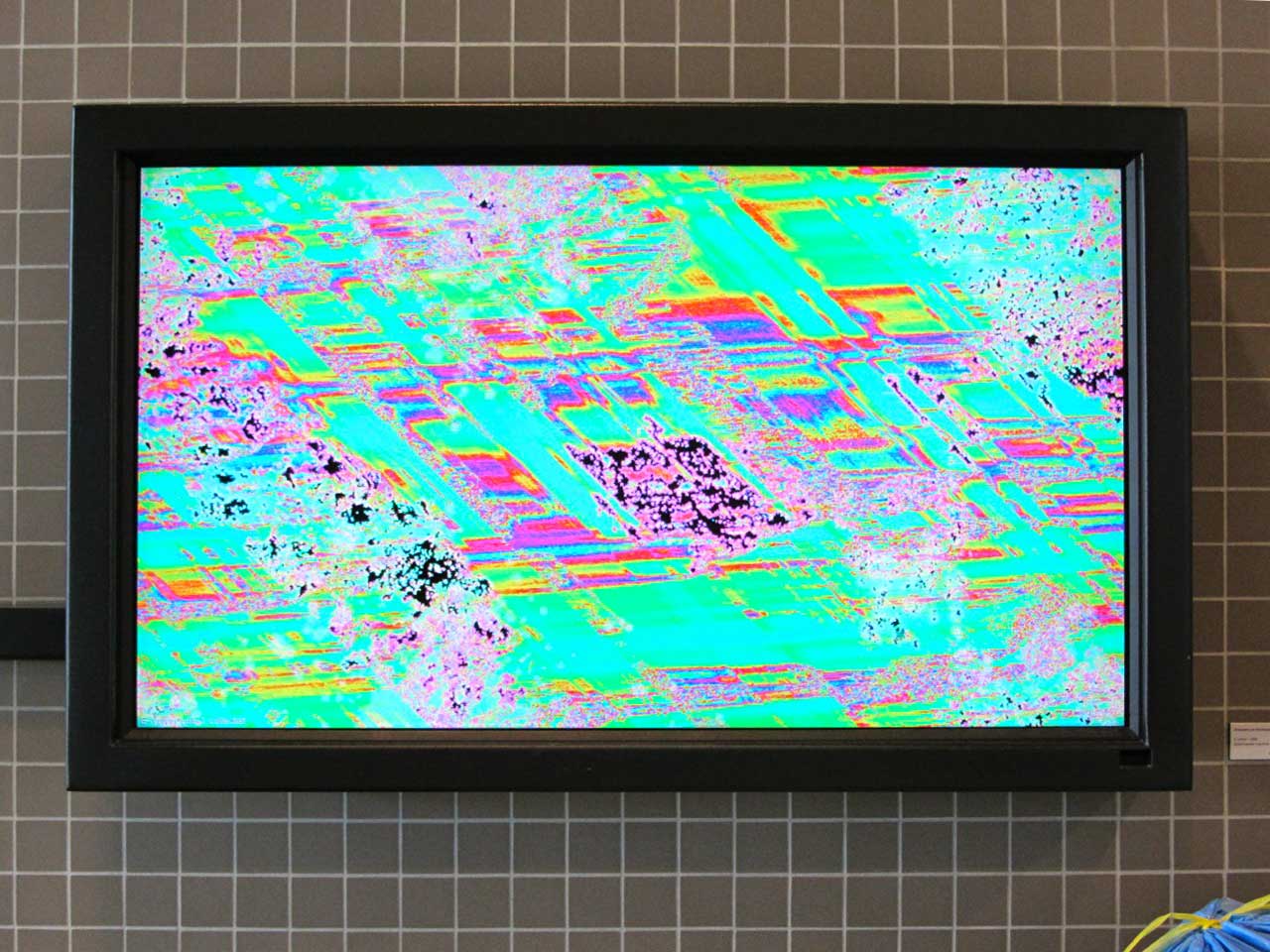
Breed (1995–2007) uses a computer program to grow physical objects from a single starting cell through incremental multiplication, selecting and mutating a governing code toward a fitness criterion.The work is included in the Dutch Digital Canon of digital art from 1960 to 2000.Accretor (2012) applies a related process of accretion, growing sculptures from small cubical grains that are 3D-printed with a level of detail beyond human capability. In E-volved Cultures (2005–2011) and Formulae E-volver (2015), the duo breed video animations through a feedback loop between artist and machine, applying artificial genetics to an evolving “primordial soup” of elementary code.
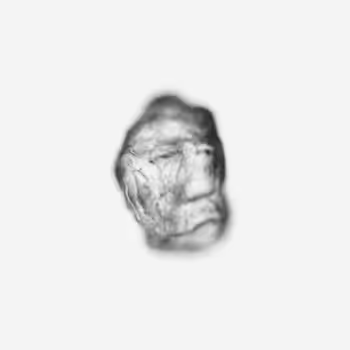
In Pareidolia, faces in grains of sand (2019), an automated robotic search engine hunts for human faces in grains of sand, extending the phenomenon of pareidolia into a machine-vision process.For Spotter (2018–2022), developed during a residency at Amsterdam's ARTIS zoo, the duo built a machine that observes, identifies and photographs animals using object detection and generative adversarial networks, then draws each animal from what it has seen. For Herbarium Vivum, first shown at Belmonte Arboretum in Wageningen in 2013, the duo grew crops inside a narrow two-dimensional frame so the living plants came to resemble pressed specimens in a herbarium.
Their work is held in the collections of the Stedelijk Museum in Amsterdam, the Centre Pompidou in Paris, and the Museum Boijmans Van Beuningen in Rotterdam, among others. In 2013 the duo received the Witteveen+Bos Prize for Art and Technology in recognition of their body of work.