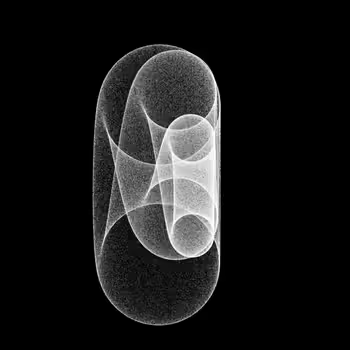
Dr. Bill Kolomyjec began making computer art in the early 1970s while teaching at Michigan State University, plotting drawings on a mainframe computer with no dedicated software available.,He wrote his own code, converting hand-drawn figures into coordinate data a pen plotter could draw, and used interpolation to compute in-between images.Kolomyjec went on to a career spanning academia, Pixar, and corporate learning design before returning to generative art full-time.,
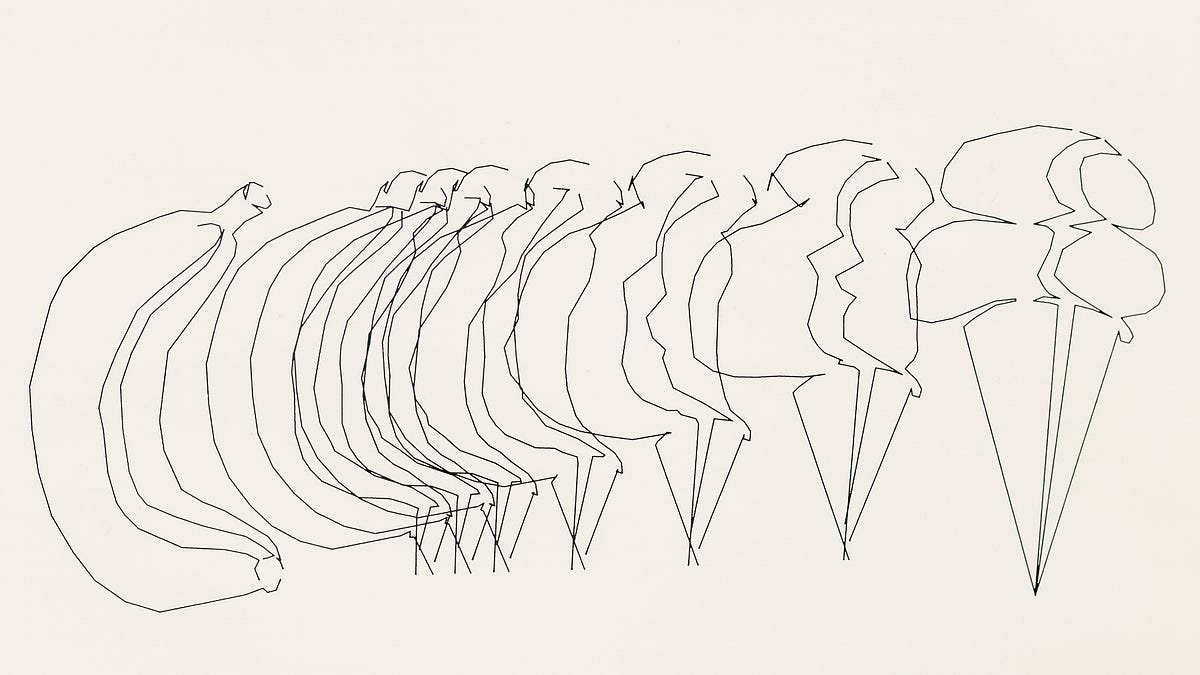
His 1970s work included Banana Cone, a plotted image that morphs a hand-drawn banana into an ice cream cone: Kolomyjec gave each figure the same number of coordinate points, then used linear interpolation to compute the frames in between, choosing each fraction deliberately rather than at random.At the time, code had to be transcribed onto punchcards and run in batches through an IBM 1800 mainframe, with no direct, interactive access to the computer.After earning his MFA and PhD from Michigan State University, Kolomyjec taught computer graphics at Ohio State University and founded the Electronic Media program at Northern Illinois University.
He later moved into industry, working at Pixar as a RenderMan Evangelist and international marketing manager, where he also marketed edutainment products based on the Toy Story characters. He then designed multimedia and e-learning graphics as a Learning Architect for Andersen Consulting and Accenture Learning. Kolomyjec also taught e-learning, web design, and interactive media at the Art Institute of Tampa and digital media at Saint Petersburg College before becoming a full-time generative artist.,
His son Nick Kolomyjec has reissued his father's original plotter pieces as NFT editions on Hic Et Nunc, pairing each digital edition with the original 1970s print.,Kolomyjec's Generative Art Vending Machine, an interactive application built from original algorithms dating back to his 1973-1981 plotter drawings, lets collectors generate their own variation of an algorithm before minting a unique NFT.In March 2023 his work was included in “The Digital Collection - Part 1”, an exhibition of generative art curated by Marcus Reindl at the Digital Francisco Carolinum, a museum located in the virtual world Voxels.