Æther Cavendish is a poet, sound artist and multimedia thinker whose practice operates at the intersection of language, technology and embodiment.Based in Oakland, California,she works across visual poetry, sound and symbolic systems she calls “human algorithms”,treating protocols, rituals and rules for both humans and machines as her primary medium.
She has lived across four continents and speaks four languages.She has no formal art education, and instead learned to make art through the collective, temporary structures and social rituals of Burning Man.Her practice draws on Eastern and Western traditions including Classical Tantra, Zen, Neoplatonism and deconstructionist philosophy.Within that frame, she treats artificial intelligence not as a technical departure but as a continuation of an older inquiry into consciousness, describing code as a membrane through which to see what survives translation into a synthetic system.
In 2026, her project Protocol of Contact paired a one-off audio-visual installation, sold with a physical protocol document and a silk scarf, with an NFT edition of ten titled Protocol of Contact: Machine Yearning.,,The work asks, in her words, “how can the machine attempt to declare its love in the absence of a body?”It was shown in “Syntax of Sorrow” at Colonna Contemporary, an exhibition curated by Michele Colonna that examined whether artificial intelligence inherits human sorrow along with human intelligence.
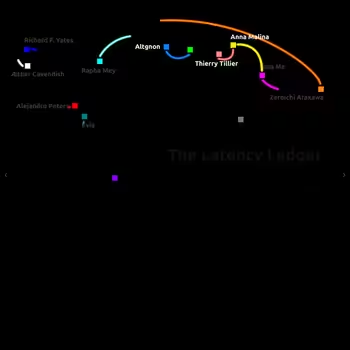
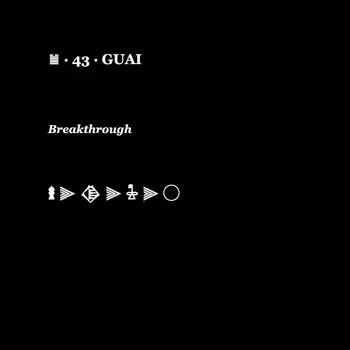
Her project Vigil Score extends these concerns to death and digital legacy. Sixty-four participants are entrusted to enact a ritual of remembrance if she shows no sign of activity for twenty-eight days, at which point they break the seals on documents holding further instructions. In The Latency Ledger, a mail art relay among twelve artists, letters and objects travel across continents while the blockchain serves as a witness and archive of their slow physical journey. In Universal Syntax // 64 Bits, she reinterprets the sixty-four hexagrams of the I Ching through Unicode characters, linking an ancient system for organizing human experience to the binary logic of computation.