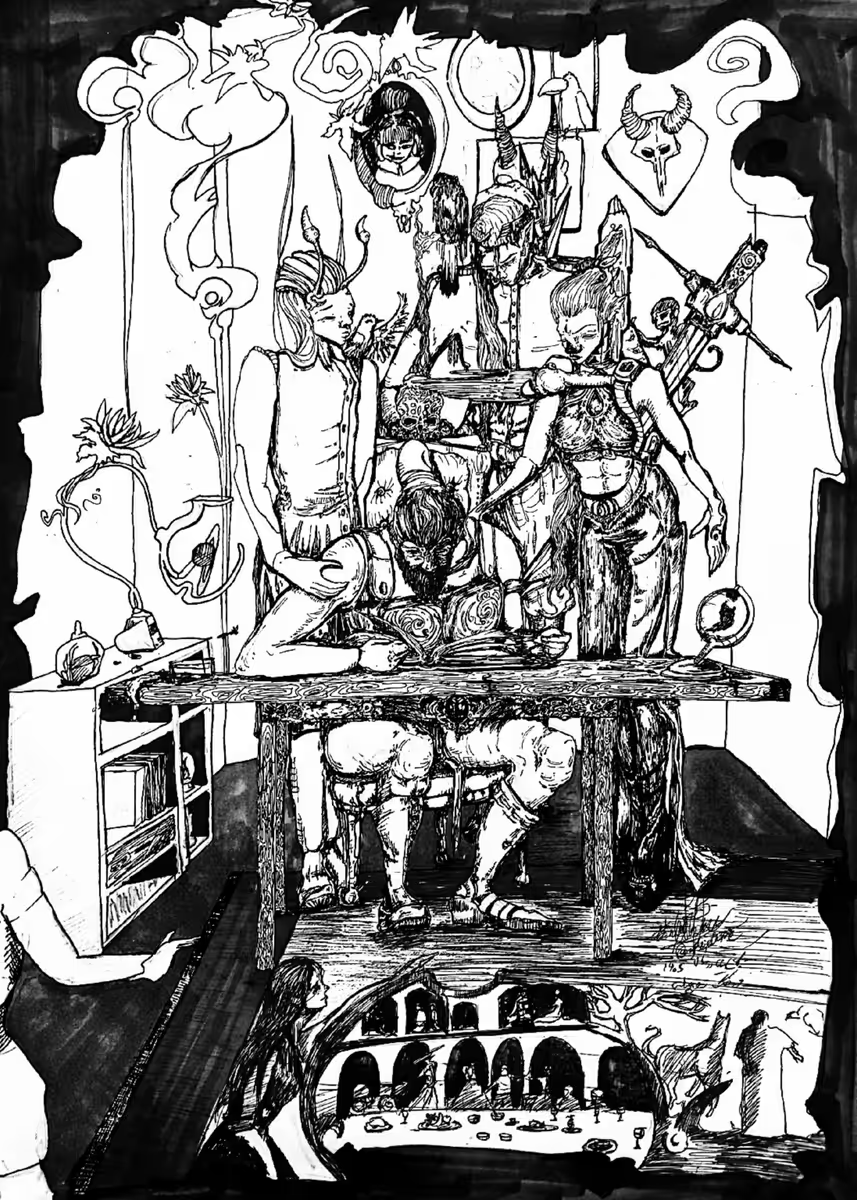
White and black rapid collection: Codex of Silent Architects
Codex of Silent Architects presents a compelling fusion of surrealism, biomorphic imagination, and symbolic narrative. Rather than relying on a conventional composition, the artwork unfolds as a psychological map in which every figure, object, and architectural fragment functions as part of an interconnected visual language.
The central seated figure establishes the conceptual anchor of the composition. Surrounded by hybrid beings and mythological presences, the act of reading transforms into a metaphor for decoding consciousness itself. Knowledge is portrayed not as information, but as a ritualistic process shared between memory, instinct, and imagination.
One of the work's strongest qualities is its visual density. The intricate pen work encourages prolonged observation, rewarding viewers with new symbolic relationships over time. Instead of directing the eye through a linear narrative, the composition invites exploration, allowing each viewer to construct a unique interpretation. This open-ended structure reflects characteristics associated with visionary art and psychological surrealism.
Stylistically, the drawing demonstrates influences from Surrealism, Symbolism, Biomorphic Art, and Automatic Drawing. However, it avoids direct imitation of these traditions by developing a personal mythology populated with recurring archetypes rather than recognizable cultural references. The hybrid figures, ritual objects, and architectural motifs suggest an invented cosmology that exists outside conventional historical or religious frameworks.
The use of blue ink reinforces the intimate nature of the work. A medium commonly associated with sketches and personal notebooks is elevated into a highly elaborate visual manuscript, creating a compelling tension between spontaneity and meticulous craftsmanship. The visible linework preserves the artist's thought process, allowing the drawing to function simultaneously as image and record of cognition.
Conceptually, the artwork explores themes of memory, identity, mythology, and the transmission of knowledge. The surrounding figures appear less as independent characters than as psychological manifestations—embodying instinct, ancestral memory, forgotten belief systems, and fragmented aspects of the self. The interior space becomes an archive of consciousness where temporal boundaries dissolve and symbolic thought replaces literal reality.
Ultimately, Codex of Silent Architects succeeds not by providing answers, but by constructing an immersive symbolic environment. It invites repeated viewing, where meaning emerges gradually through observation rather than explanation. The result is a work that bridges contemporary surrealist illustration with philosophical inquiry, positioning itself as both a visual narrative and an exploration of the architecture of the human mind.
Ink on Paper
Blue Ballpoint Pen
Mixed Media Drawing
Hand Drawn Illustration
Surrealism Biomorphic Illustration Visionary Art Symbolism Automatic Drawing Dark Fantasy Neo-Mythological Art Psychological Narrative Ink Illustration Contemporary Figurative Art