White and black rapid collection: Reflection Inside the Machine
📖 Story of the Artwork
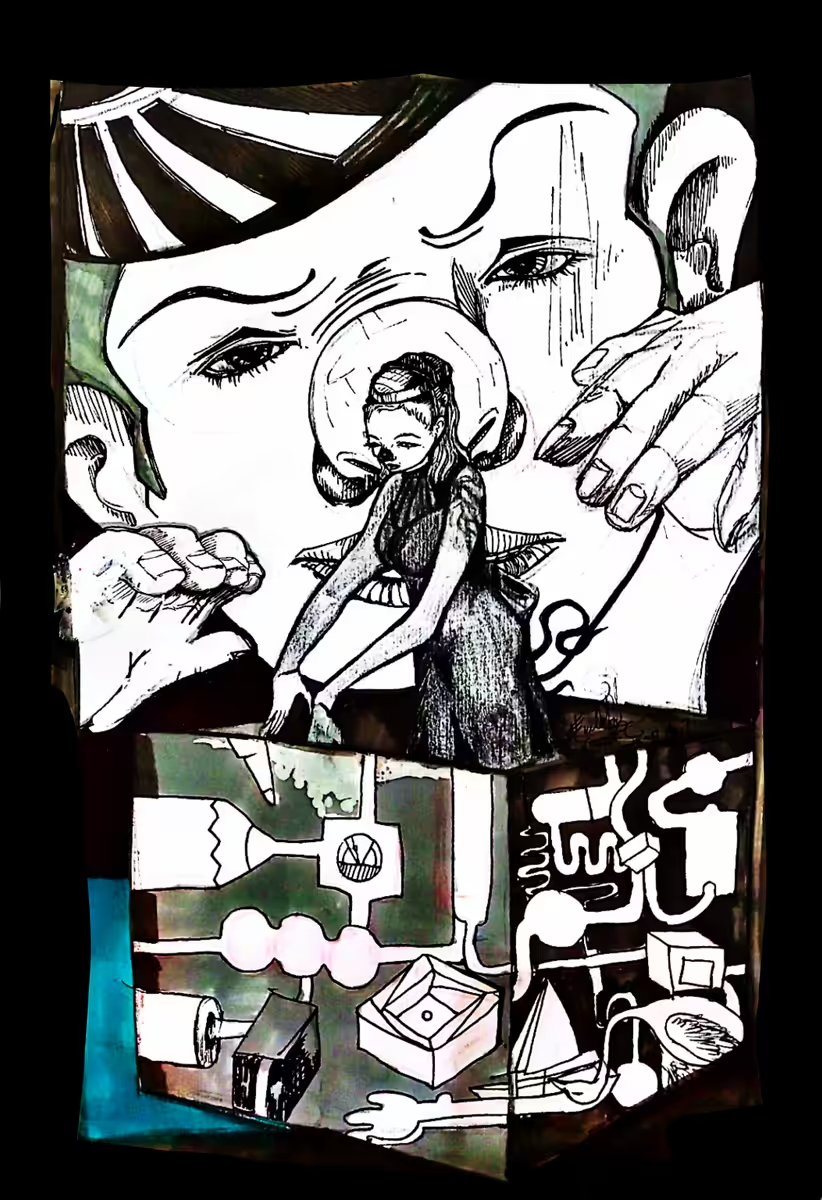
In a not-so-distant future, humanity has reached a point where self-understanding no longer requires a mirror or a psychoanalyst; instead, the human mind is placed inside a device to see what truly defines it. The girl in this piece represents the human within the system — one who searches inside a box that simultaneously embodies her mind, her machine, and her world. She breathes within a glass bubble — separated from the outer world, yet still under the gaze of larger faces above her: perhaps her creators, perhaps society, perhaps consciousness itself. The lower box is filled with circuits, pipes, houses, and geometric shapes — symbols of engineered thinking, of a mind reconstructed through mechanical logic.
🔬 Scientific and Iconological Interpretation (Iconology + Semiotics)
- Composition
The artwork is structured on two distinct planes:
Upper Plane: The realm of emotion and consciousness (faces and the bubble).
Lower Plane: The realm of logic and systems (the box with geometric and mechanical lines).
The girl’s arm connects these two worlds — a metaphorical bridge between the mental and the mechanical, between the inner self and the machine.
- Chromatic Analysis
The dominant hues are black and olive-brown, evoking a sense of industrial decay and mechanical wear. The cooler green and blue tones at the bottom introduce a feeling of synthetic life and mechanical oxygen. Together, these colors symbolize the tension between organic existence and engineered systems.
- Form and Symbolism
Large faces in the background: Represent higher consciousness, observation, or the ruling artificial intelligence.
The girl in the bubble: Symbolizes the modern human in the cyborg age — detached from nature but linked to systems.
The surrounding hands: A duality of control and protection; dominance and dependency.
The lower box: Represents the world of data, circuits, codes, and digital memory.
Angular, mathematical lines: Rationality and structure in contrast to the soft, emotional human form.
- Conceptual Critique
The piece is not a dystopian warning about machines overtaking humanity, but rather a meditation on mechanical introspection. It depicts an individual who has accepted being part of a system, yet remains curious — still searching within the machinery of her own existence. The work resides within the philosophy of Posthumanism, where the question is no longer “How human-like can a machine become?” but rather “How much of the human has already become machine?”
💬 Artistic Critique
Artistically, the fusion of hand-drawn ink lines with translucent watercolor patches produces a vivid contrast between control and chaos. The skewed perspective of the box below bends spatial logic, creating the impression of a warped or dreamlike memory. The disproportionate faces above enhance the sense of fragmented identity and psychological tension. The piece recalls the narrative anxiety of Francis Bacon and the symbolic architecture of Marcel Duchamp, merging existential reflection with mechanical symbolism.