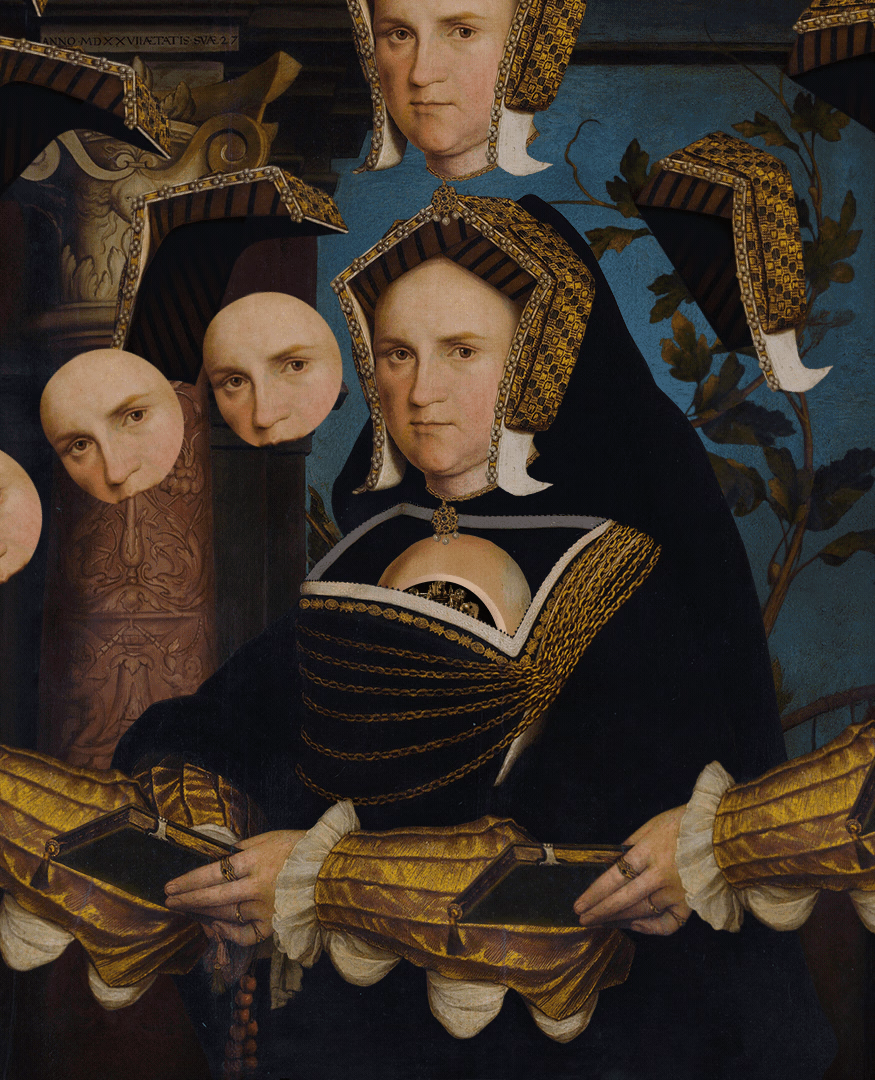
Vandalized: Lady Guildford (Mary Wotton, 1499–1558)
Copy after Hans Holbein the Younger
The lavish costume, ostentatious jewelry, precious devotional objects, and sumptuous setting of this portrait indicate the high status of Mary Wotton, Lady Guildford, at the court of Henry VIII. It is a copy of the well-known portrait of the same sitter in the Saint Louis Art Museum, which is the pendant of the portrait of Sir Henry Guildford in the Royal Collection at Windsor Castle, both by Hans Holbein the Younger. Mary Wotton was the daughter of Sir Robert Wotton of Boughton Malherbe, Kent, and Anne Belknap. In 1525 she became the second wife of Sir Henry Guildford, an important courtier who served the king in several capacities, including as chamberlain of the receipt of the Exchequer. Each of the portraits of the couple is dated 1527, the year in which Sir Henry, as the king’s master of the revels, was charged with making the arrangements for the king to receive an embassy from France at Greenwich, an event planned to celebrate the peace accord with Francis I. This may have been where Guildford first met Holbein (probably the artist referred to in records of the event as "Master Hans"), who was engaged to produce paintings for a banqueting hall and theater at Greenwich. Sir Henry also knew Sir Thomas More and Erasmus, other patrons of Holbein, and they may have introduced him to the esteemed painter. The pendants are among the first that Holbein made after his arrival in England.
Although the Museum’s panel was originally thought to be the pendant of the Windsor Castle portrait of Sir Henry Guildford, and by the hand of Holbein himself, it began to lose its place of prominence when the Saint Louis painting surfaced in 1930. Indeed, if The Met's version is compared with the Saint Louis original, considerable differences in technique and execution are observable. While the copy is fairly faithful, its overall quality does not match that of works accepted as completed by Holbein and his workshop. The execution is not as refined, the techniques do not seem to match with Holbein’s workshop practices, and portions of the painting do not correspond correctly to the original.
The question has been raised whether the Museum’s copy might have been made in Holbein’s workshop during the artist’s lifetime. Arguments against this possibility are supported by evidence derived from the technical examination of the painting, in particular from the study of the underdrawing. It has been well established that Holbein’s habitual working procedure for portraiture was to employ his preparatory drawing of the sitter as a cartoon, tracing its essential features onto the grounded panel with the aid of an interleafing, carbon-coated sheet. This method was used for the Saint Louis painting, which was based on a rendering of Lady Guildford in colored chalks on paper (Kunstmuseum Basel, Kupferstichkabinett). The Museum’s portrait shows no obvious evidence of a traced pattern for Lady Guildford’s facial features. Furthermore, placing a mylar photostat of the Basel drawing over the painting revealed that, even though the painted contours of the eyelids, nose, and mouth coincide to some degree with the drawing, the contour of the face does not, and the forehead has been elongated by shifting the hood farther upward. Holbein’s workshop pattern was therefore clearly not used for this painting. This examination of the underdrawing, coupled with the known details of Holbein’s execution and handling, indicate that the painting was not made in Holbein’s studio by a workshop assistant but rather was copied after Holbein’s painting at a later moment in time.
Clues concerning when the painting might have been made come from x-radiography and dendrochronology. The x-radiograph (see fig. 1 above) shows that the picture was painted on top of another. Turned 180 degrees, the x-radiograph reveals the fragment of a male figure, specifically the left leg from the thigh to the toes and a tiny portion of the right leg above the knee of a man in aristocratic dress, as well as an undetermined oval object in the lower right corner of the painting. The stance of the figure immediately recalls the pose seen in the official full-length portraits of Henry VIII, which derived from the famous Whitehall Palace mural that Holbein painted in 1537, or in those of Edward VI after his coronation. The painting beneath the image of Lady Guildford is not likely to be one of the portraits of Henry, since the left leg (visible in the x-radiograph) is more vertically positioned than the obliquely angled one of the Henry model; it is thus more similar to the Edward VI portraits. The dendrochronology of The Met's painting indicated that it could have been produced at the earliest in 1540 and more likely in 1546 or later—precisely the period in which the new standing portrait models were painted in multiple versions.