Eirenic Collections: ANABASIS
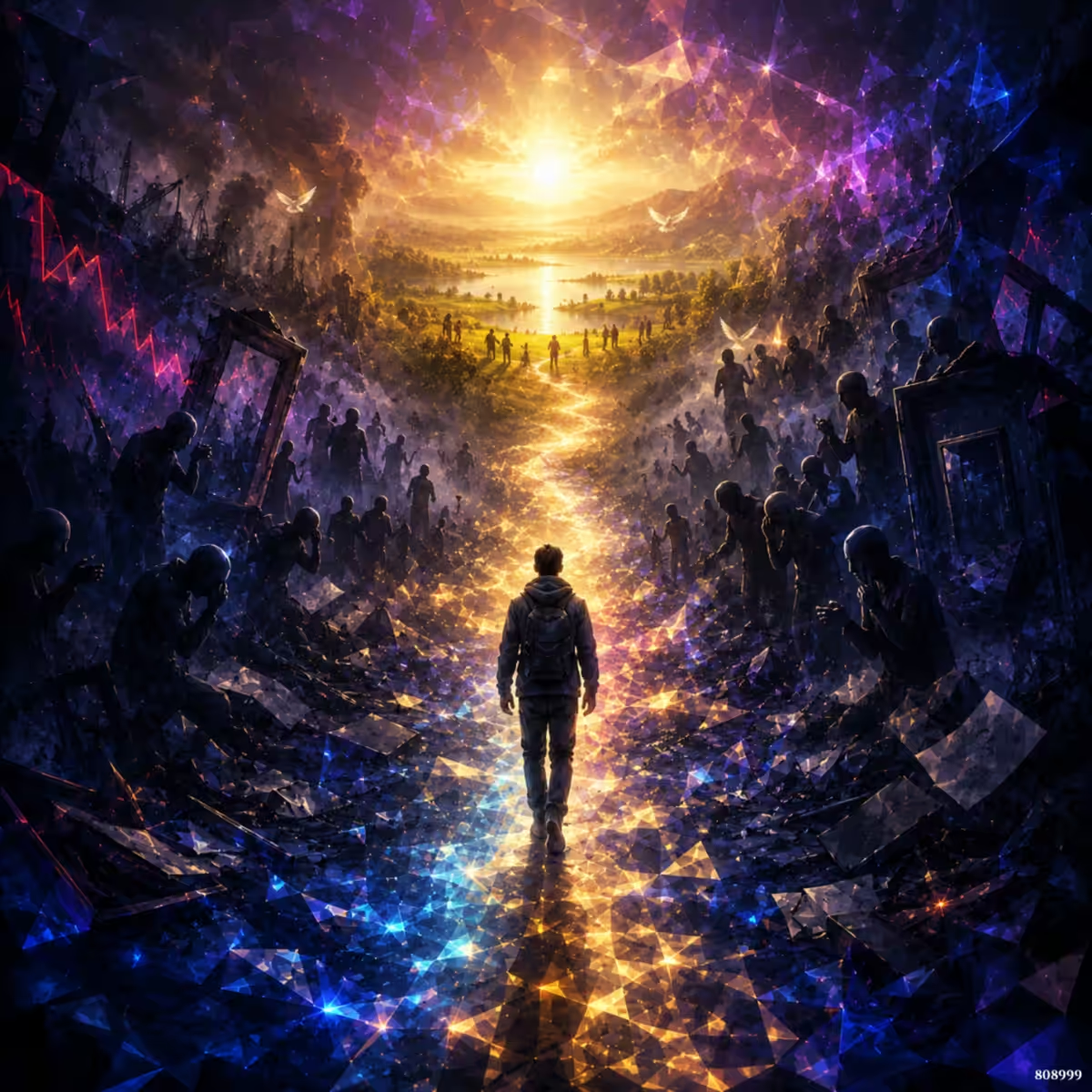
A luminous vision of ascent through shadow — a journey from affliction toward radiance, from the valley of fear toward the horizon of peace. The title carries the meaning of an upward passage, a rising movement, a sacred climb from lower ground into renewed light. In this artwork, the central figure walks through a fractured corridor of darkness, accusation, ruin, and uncertainty, yet every step draws him closer to a golden landscape beyond the valley.
Rooted in the spirit of Psalm 23:4, Anabasis interprets the valley not as a final place of defeat, but as a passage of transformation. Around the traveler, shadowed figures appear as symbols of ridicule, fear, social judgment, and unseen hostility. Broken structures, collapsing forms, and dark crystalline fragments suggest economic distress, emotional pressure, social abandonment, and a world unsettled by conflict. Yet the path before him burns with sapphire, gold, and rose-lit brilliance, declaring that the soul is not made to remain in the shadow.
The emotional power of the artwork lies in its movement. Unlike an image of still suffering, Anabasis shows progression. The figure is walking, not collapsing; passing through, not surrendering; ascending inwardly, even while the external world remains fractured. The valley narrows behind him, while the horizon opens into a radiant field of gathering souls, birds, water, and dawn. What once appeared as desolation becomes a threshold.
I conceived and orchestrated Anabasis through a layered, AI-assisted digital art methodology — bringing together my original vision, symbolic construction, prompt engineering, compositional calibration, aesthetic refinement, and final curatorial judgment. The creative process began with the idea of “No Evil, Only Passage”: a soul surrounded by shadow, ridicule, anxiety, and instability, yet moving forward under the quiet certainty that darkness is not the destination. This concept was refined into a cinematic visual language of luminous surrealism, crystalline geometry, atmospheric contrast, radiant pathways, and sacred emotional depth.
Every visual element was intentionally guided. The lone traveler represents the human spirit in motion through trial. The dark figures along the sides embody fear, mockery, doubt, and worldly condemnation. The broken valley reflects the realities of loss, poverty, conflict, and uncertainty. The glowing path signifies providence, courage, and direction. The golden horizon becomes the promise of restoration, while the birds suggest release, hope, and the return of peace after passage.
Anabasis speaks to anyone who has walked through seasons of rejection, economic difficulty, estrangement, depression, institutional mistreatment, or war-shadowed anxiety. Its message is universal: the valley may surround the body, but it need not imprison the soul. Peace is not always found by avoiding darkness; sometimes it is discovered by walking through it with courage, dignity, and light still ahead.
As part of the Eirenic vision, Anabasis continues the meditation on peace amid ruin, resilience amid collapse, and luminous hope amid shadow. It is not merely an artwork of escape; it is an artwork of ascent. It stands as a testament to the soul that keeps walking — pressed but not possessed, surrounded but not overcome, shadowed yet steadily rising toward dawn.
Technical Details: 4096 × 4096 px, 300 DPI, RGB, 8-bit sRGB PNG.
By 808999