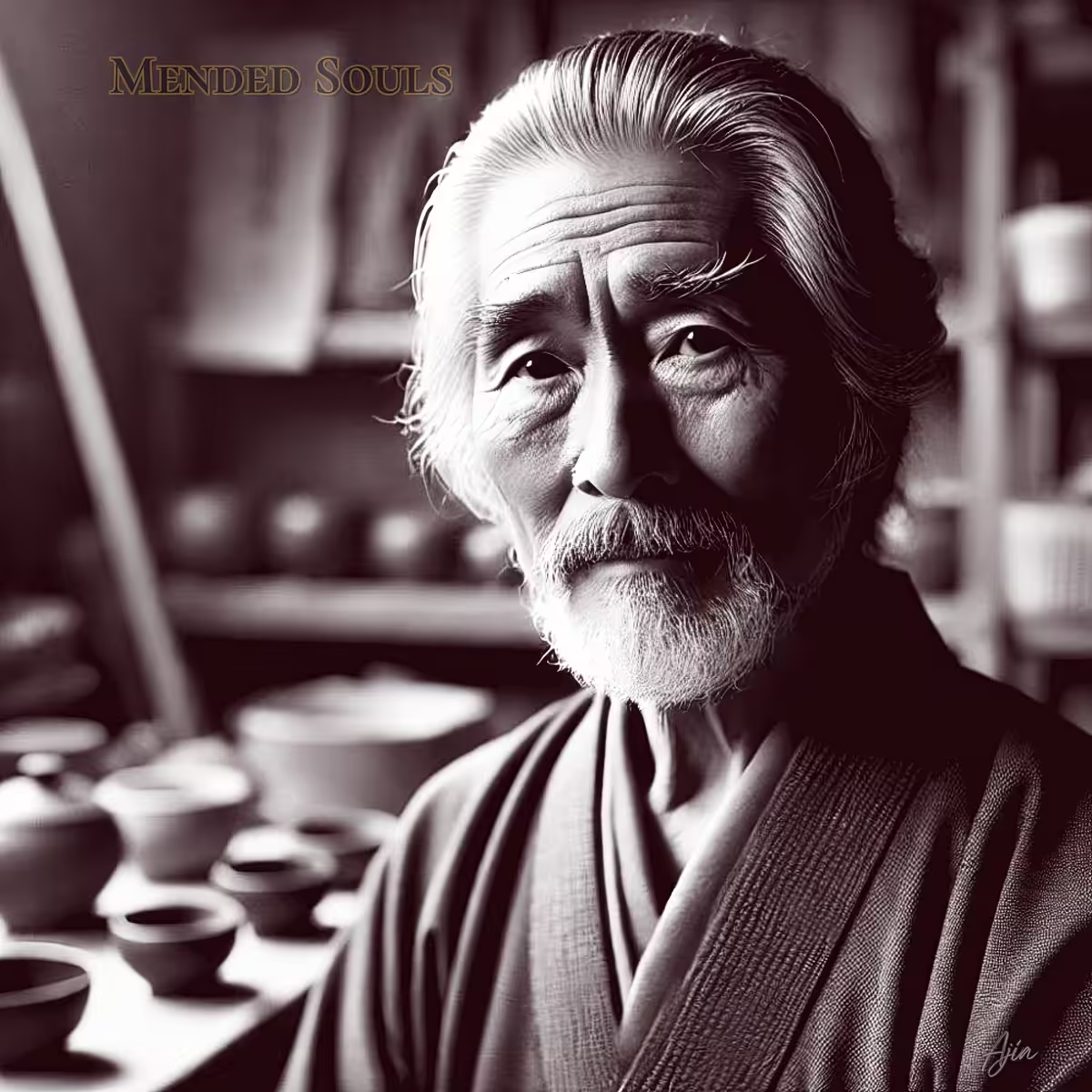
Mended Souls: Kenshin, the Kintsugi Master - Giveaway
In Kenshin’s hands, gold was not just a material but a bridge between what had been and what could still be. Born into a family of artists, Kenshin had mastered the ancient art of kintsugi, the Japanese technique of repairing broken ceramics with gold, transforming them into something even more valuable. To him, kintsugi was a philosophy. Every fracture told a story; his role was not to erase the past but to honor and elevate it.
Kenshin lived in a small house at the foot of a mountain, surrounded by cherry trees that bloomed every spring. The peacefulness of the landscape inspired his work. He often walked along mountain trails, finding meaning in the rustling leaves or the river’s steady flow. One day, fate led him to something extraordinary. Something faintly glimmered under the sunlight among the rocks and mud of a riverbank. Kneeling, Kenshin discovered what remained of a puppet: a broken wooden body, rusted metal joints, and faded colors. The once-bright red, blue, and gold were now dull, hidden under dirt and wear. To most, it would have been trash, but Kenshin saw something different. The puppet seemed to whisper of struggle and survival. Gently, he picked it up and brought it to his workshop.
Repairing Eiko was more than a technical process; Kenshin immediately recognized the puppet as something special, its scars telling a story of hardship and resilience. Kenshin studied each crack and imperfection by the soft glow of a lantern, reflecting on his invisible wounds—the regrets and losses that had shaped him. Kenshin knew what it meant to be broken, and in mending Eiko’s fractures, he also found himself healing. He began with the wood, carefully smoothing the splinters and reinforcing weak points.
Using urushi, a lacquer mixed with gold dust, he sealed the cracks, his steady hands tracing lines that gleamed like rivers of sunlight. The puppet’s rusted joints were restored to motion with patient effort. With each stroke of his brush, Eiko seemed to regain a spark of life, as though it recognized the care being poured into it.
The restoration took weeks. Kenshin worked deliberately, treating each step as a dialogue with the object. When he finished, Eiko was no longer a broken toy. Its golden scars gleamed in the light, each testament to its resilience. The puppet’s faded colors now harmonized with the gold, creating a beauty that could not have existed without the cracks it carried. Kenshin gazed at it, feeling pride and a sense of connection.
Eiko had become a manifestation of Kenshin’s philosophy: beauty does not lie in perfection, but in the meaning we give to our imperfections. Each scar deserved to be celebrated, a marker of survival and transformation. But Eiko was not the only one transformed. Kenshin, too, found solace in the act of repair, as if restoring the puppet had restored something within himself.
Kenshin prominently placed Eiko in his studio, where it shone as an artwork and a message. Visitors who saw it were captivated by its golden scars, and when asked, Kenshin shared its story—not just as the tale of a toy but as a universal message of resilience. What breaks us does not define us; it transforms us into something extraordinary. In Kenshin’s hands, kintsugi was not simply a craft but a celebration of life itself.
Theme and Message The celebration of resilience through the art of kintsugi, where every fracture and scar tells a story of transformation and beauty. What is broken does not lose its value; every crack represents an essential part of our story, transforming us into something deeper and more meaningful.
Emotions The emotions evoked by Kenshin’s story are deeply layered. There is a profound sense of hope as his art turns pain into healing, showing that every scar can be a mark of strength. At the same time, his philosophy encourages reflection, inviting viewers to look beyond appearances and uncover the value in challenging experiences.
Inspiration The piece draws inspiration from the ancient Japanese art of kintsugi, a craft that Kenshin has mastered as a technique and a way of life. Kenshin’s narrative, filled with loss and resilience, intertwines seamlessly with restoring Eiko, the puppet, a symbol of fragility and the strength inherent in every individual.
Artwork Description This duotone giveaway edition celebrates the essence of the Mended Souls collection, offering a monochromatic perspective of its profound themes.