Observation: Vanishing Point
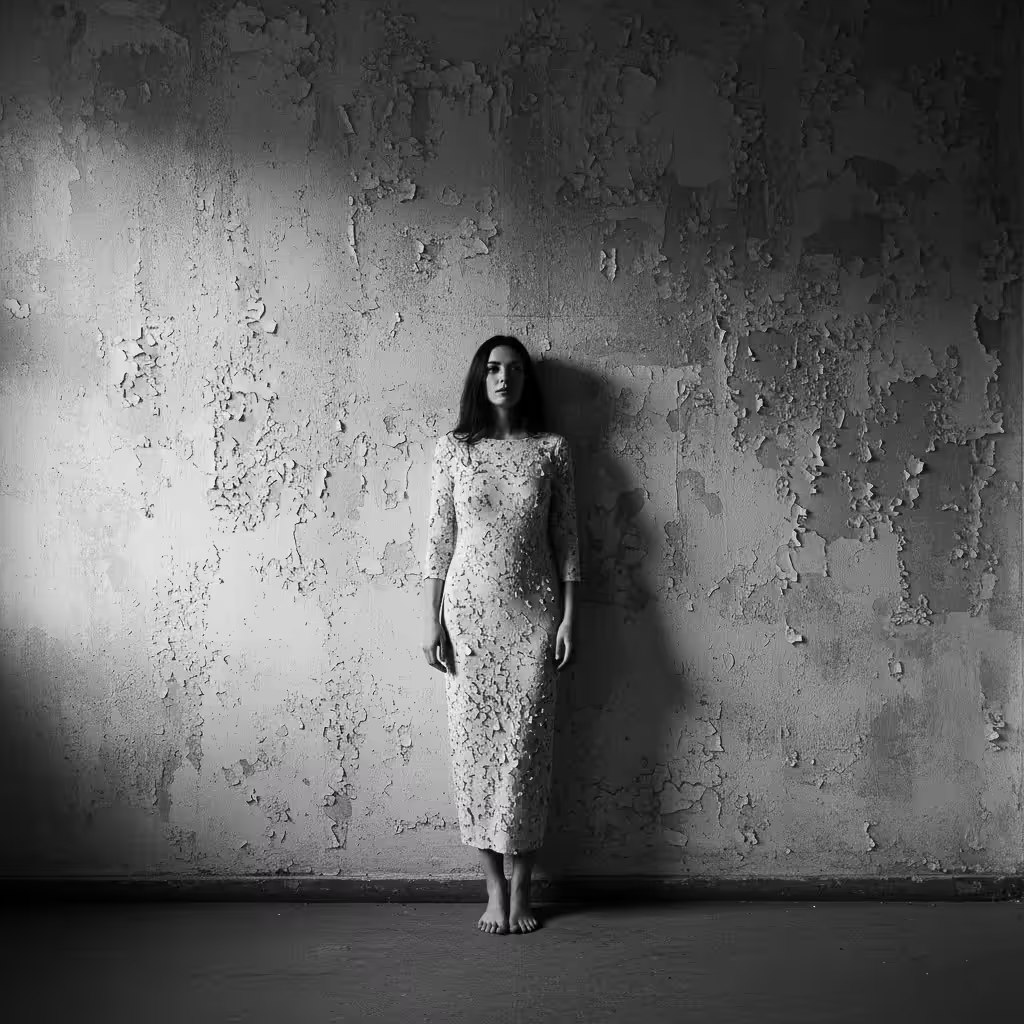
“Vanishing Point” inhabits the fragile territory where the body begins to surrender its boundaries. The figure stands upright, almost ceremonial in her stillness, yet she does not dominate the space. Instead, she recedes into it. The peeling wall behind her does not act as a backdrop but as an extension of her own surface—cracked, weathered, quietly deteriorating. Flesh and plaster enter into a silent agreement: neither entirely solid, neither entirely permanent.
The vanishing point in perspective is where lines converge and depth collapses into illusion. Here, that convergence is existential. The body becomes the meeting place of presence and erasure. She is fully there—bare feet grounded, posture composed—yet she seems already halfway dissolved, as if time has begun to reclaim her outline. The dress mimics the wall’s texture, suggesting that identity is porous, that we absorb the environments that contain us until separation becomes uncertain.
There is no dramatic gesture, no overt emotion. The power of the image lies in restraint. Stillness becomes an act of tension. To stand so motionless against decay is to confront impermanence without resistance. The peeling paint, once protective and ornamental, now reveals what lies beneath. In the same way, the human self sheds layers—roles, expectations, constructed narratives—until only something raw and unadorned remains.
“Vanishing Point” does not portray disappearance as tragedy. It proposes it as transformation. The loss of sharp definition is not annihilation but transition. To fade into the wall is to question the stability of the individual self: are we ever separate from the spaces that shape us? Or are we, from the beginning, already dissolving into them?
In this quiet convergence, the body does not collapse—it converges. And in that convergence, it becomes something both less visible and more essential.