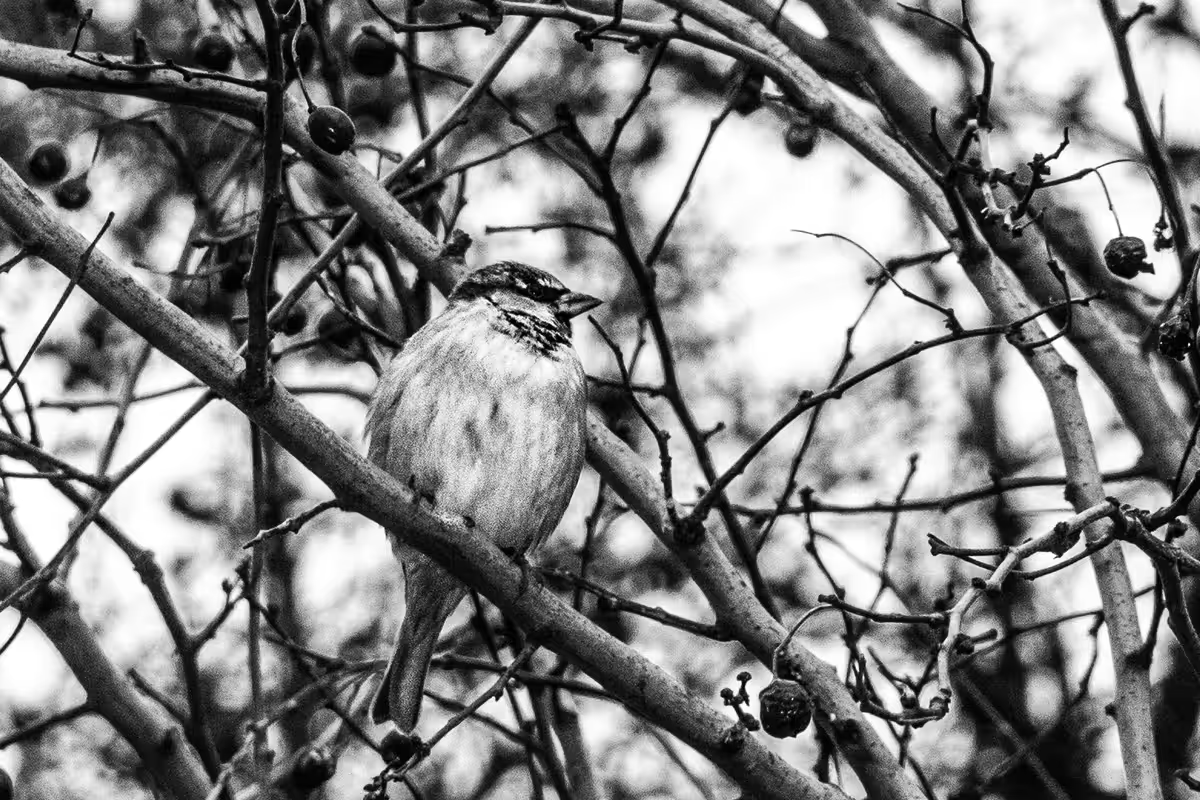
Observation: Perched
Perched captures a moment of deliberate stillness within a world of entanglement. The bird does not dominate the branches, nor is it overwhelmed by them; it occupies a fragile interval between motion and rest. Its presence feels provisional, as though it could vanish at any moment, leaving the structure unchanged. This tension gives the image its quiet gravity.
The surrounding branches form a dense network—paths without direction, lines without destination. They suggest the complexity of thought, memory, and obligation, while the bird appears as a single, conscious pause within that complexity. To be perched is not to escape the world, but to momentarily suspend one’s participation in it. It is an act of observation rather than intervention.
There is no drama in this posture, only awareness. The bird does not sing, does not flee; it simply remains. In this refusal of action, Perched proposes a subtle philosophy: that existence does not always demand movement or resolution. Sometimes meaning resides in holding one’s place, in enduring the present without explanation.
The image invites the viewer to consider stillness as a form of resistance—against urgency, against noise, against the insistence that life must always progress. Here, to pause is to assert being. The bird becomes a quiet witness to the world’s complexity, reminding us that presence alone can be enough.