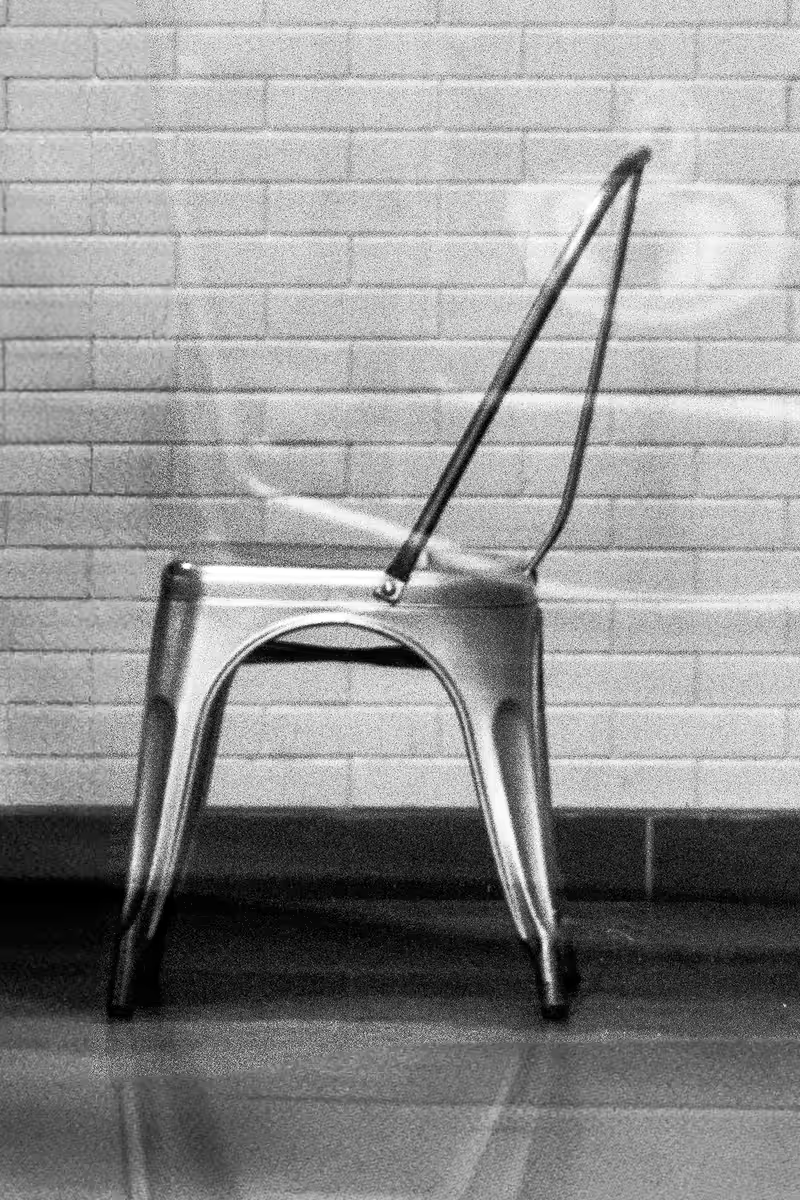
Observation: A Chair for No One
What appears here is an object designed for rest, yet staged in a way that quietly rejects it. Its form promises support, balance, usefulness—ideas deeply tied to the human body—while its posture undermines all of them. The familiar becomes suspicious. Something meant to receive weight seems to resist it, as if the very concept of being occupied were a burden rather than a purpose.
There is a subtle violence in this refusal. Not loud or dramatic, but structural. The object has not been destroyed; it remains intact, functional in theory. And yet, its orientation suggests that function is no longer a certainty. It stands as a reminder that usefulness is not inherent, but conditional—dependent on context, agreement, and trust. Once those collapse, even the most ordinary things become unreliable.
The emptiness here is not accidental. It feels deliberate, almost rehearsed. Absence is not simply the lack of a body, but the presence of a decision. The space where someone could sit becomes charged, tense, slightly hostile. It asks an uncomfortable question: is rest something granted, or something permitted only when systems allow it? When stability is withdrawn, the body learns hesitation.
There is also a quiet commentary on expectation. We are trained to believe that certain forms will always behave as promised. When they don’t, the failure feels personal. This image captures that moment of doubt—when trust in structure falters, and the body must renegotiate its relationship with the world. What once felt neutral now carries risk.
In this sense, the object becomes a metaphor for larger systems: social, emotional, even existential. Support structures exist, but they do not always serve. They can tilt, withdraw, or subtly exclude without ever announcing their refusal. Nothing is broken. Nothing is missing. And yet, something essential is no longer available.
What remains is a quiet standoff between presence and denial. The object waits, not inviting, not collapsing—simply existing in a state of unresolved tension. It does not scream emptiness; it practices it. And in doing so, it mirrors a familiar condition: being surrounded by structures meant to hold us, while feeling unmistakably unsupported.