Observation: System
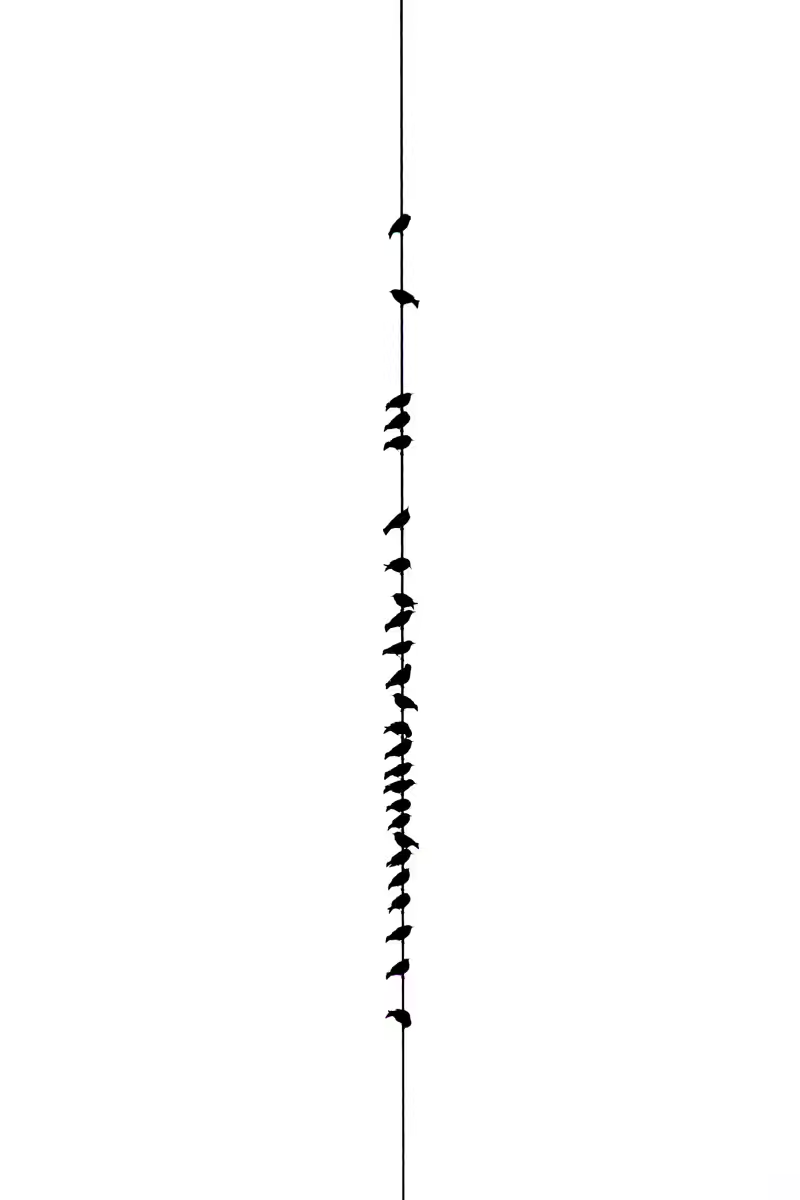
At first glance, the image appears simple: a vertical line, and along it, a series of birds resting in quiet succession. Yet within this simplicity lies a profound meditation on freedom and its contradictions.
Freedom is often imagined as movement, expansion, and the absence of limits. We associate it with flight, with open skies, with the refusal to remain still. And yet, here we see creatures capable of flight choosing to remain suspended, aligned, restrained by a single thin wire. This choice unsettles our conventional understanding of freedom. Are they less free because they pause, or more free because they choose to?
The wire functions as both support and boundary. It holds the birds above the ground, offering safety and perspective, but it also confines them to a narrow path. This duality mirrors the human condition. Social structures, systems, and norms act much like this wire: they restrict us, yet they also make coexistence possible. Absolute freedom, devoid of structure, may not be freedom at all, but chaos or isolation.
Each bird occupies a distinct position, separated by small but meaningful distances. They are together, yet not merged. This reflects a philosophical tension between individuality and collectivity. Freedom does not necessarily mean separation from others; sometimes it is negotiated within proximity. The image suggests that freedom can exist alongside order, that autonomy does not require solitude.
The vertical composition emphasizes hierarchy and progression. Some birds are higher, some lower, yet none dominate the line entirely. This raises questions about comparative freedom: is freedom measured by position, by elevation, by proximity to the sky? Or is it internal, defined by awareness rather than circumstance?
Perhaps the most striking aspect of the image is stillness. In a world obsessed with motion and productivity, stillness is often mistaken for passivity or submission. But philosophically, stillness can be an act of resistance. To pause is to refuse urgency. To remain is to assert presence. In this sense, the birds are not waiting helplessly; they are inhabiting the moment.
Ultimately, the image challenges the romantic idea that freedom is found only in escape. It proposes instead that freedom may reside in conscious restraint, in chosen limits, and in shared space. The birds can fly at any moment, yet they remain. That possibility—the power to leave, paired with the decision to stay—is where freedom quietly lives.
Freedom, then, is not the absence of the line, but the awareness of it.