Observation: Before Anyone Arrives
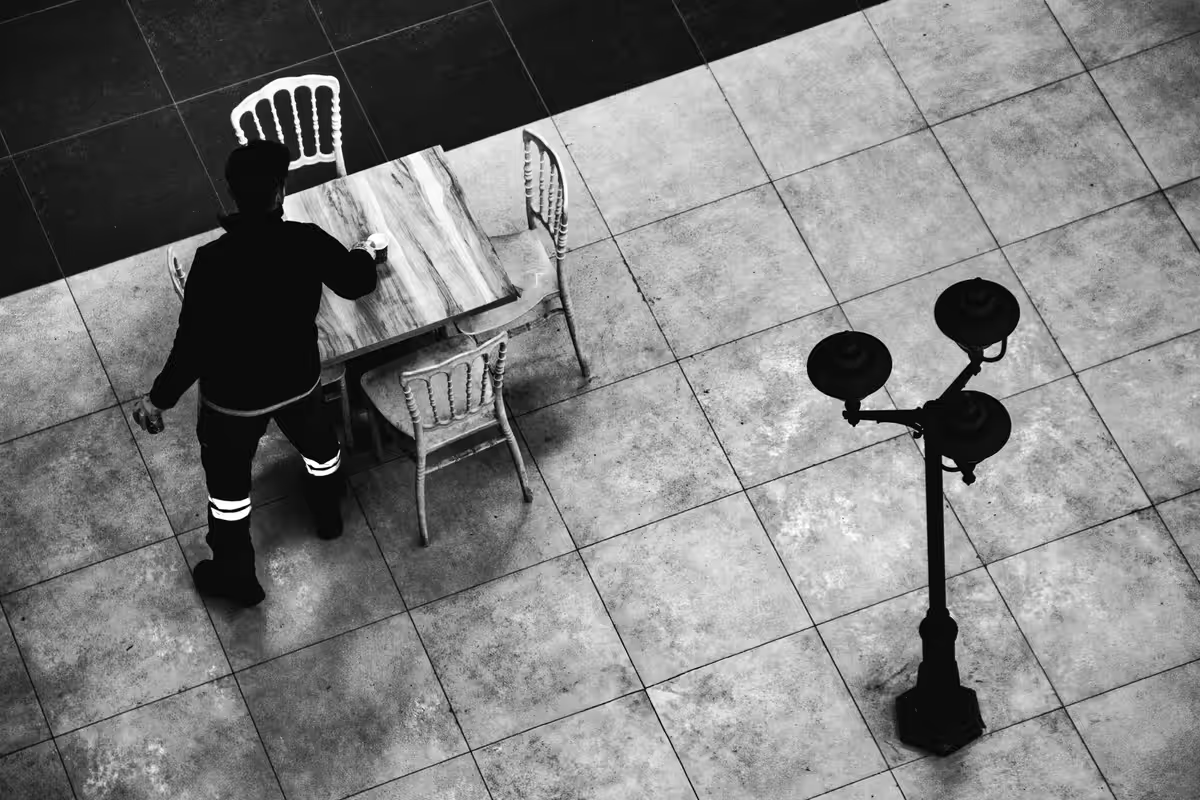
From above, the world becomes honest. Lines stop pretending to be paths, objects stop performing meaning, and a single figure is reduced to presence rather than story. What looks like isolation at first is not abandonment, but clarity.
This is a moment suspended between uses: before conversation, before occupation, before noise. A table is not yet a meeting, a chair is not yet memory, a cup is not yet unfinished. Everything exists in readiness, not loss. The space does not reject the figure—it makes room for them.
There is hope in this distance. Because solitude here is not a wound, but a structure. It suggests that meaning does not always arrive through others, but sometimes through alignment: the body finding its place within order, the ordinary becoming sufficient. Nothing is collapsing. Nothing is ending. The scene breathes.
Seen from above, the individual is small, but not insignificant. They are held by the grid, balanced by the objects around them, allowed to pause without explanation. This is not loneliness as absence, but as possibility—the quiet confidence that something may arrive, precisely because nothing has yet.