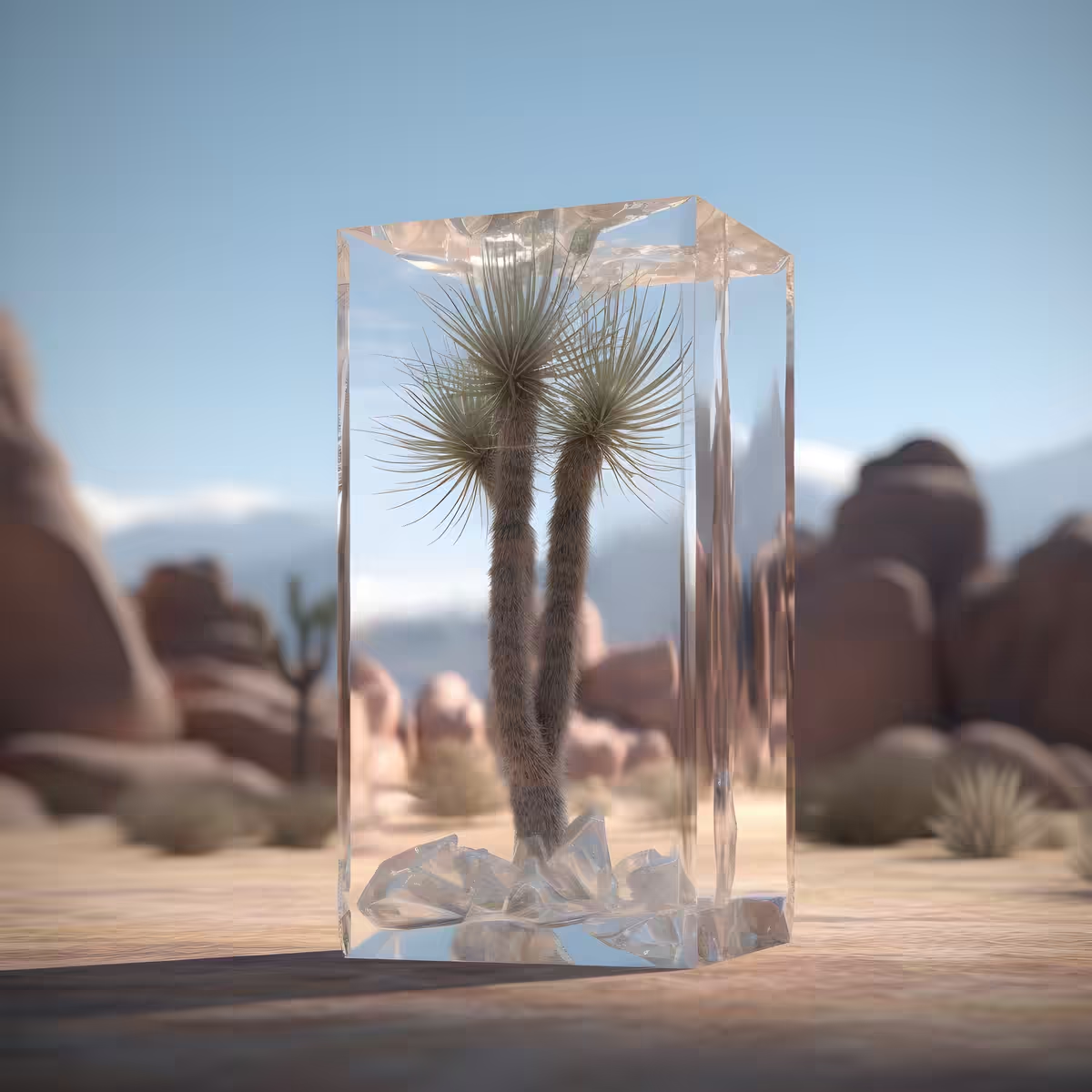
Everlasting Nature: Yucca Brevifolia
Yucca Brevifolia (also known as the Joshua tree, yucca palm, tree yucca, and palm tree yucca) is a plant species belonging to the genus Yucca. It is tree-like in habit, which is reflected in its common names.
This monocotyledonous tree is native to the arid Southwestern United States, specifically California, Arizona, Utah, and Nevada, and, according to Plants of the World Online, also to northwestern Mexico.
It is confined mostly to the Mojave Desert between 400 and 1,800 m (1,300 and 5,900 ft) elevation. It thrives in the open grasslands of Queen Valley and Lost Horse Valley in Joshua Tree National Park. Other regions with large populations of the tree can be found northeast of Kingman, Arizona in Mohave County; and along U.S. 93 between the towns of Wickenburg and Wikieup, a route which has been designated the Joshua Tree Parkway of Arizona.
Joshua trees are fast growers for a desert species; new seedlings may grow at an average rate of 7.6 cm (3.0 in) per year in their first 10 years, then only about 3.8 cm (1.5 in) per year. The trunk consists of thousands of small fibers and lacks annual growth rings, making determining the tree's age difficult.
This tree has a top-heavy branch system, and a broad root system, with roots in one case found 11 m (36 ft) from the nearest Joshua tree. If it survives the rigors of the desert, it can live for hundreds of years; some specimens survive a thousand years. The tallest trees reach about 15 m (49 ft). New plants can grow from seed, but in some populations, new stems grow from underground rhizomes that spread out around the parent tree.
The evergreen leaves are dark green, linear, bayonet-shaped, 15–35 cm long, and 7–15 mm broad at the base, tapering to a sharp point; they are borne in a dense spiral arrangement at the apex of the stems. The leaf margins are white and serrated.
Flowers typically appear from February to late April, in panicles 30–55 cm tall and 30–38 cm broad, the individual flowers erect, 4–7 cm tall, with six creamy white to green tepals. The tepals are lanceolate and are fused to the middle. The fused pistils are 3 cm tall and the stigma cavity is surrounded by lobes. The semi-fleshy fruit that is produced is green-brown, elliptical, and contains many flat seeds. Joshua trees usually do not branch until after they bloom (though branching may also occur if the growing tip is destroyed by the yucca-boring weevil), and they do not bloom every year. Like most desert plants, their blooming depends on rainfall at the proper time. They also need a winter freeze before they bloom.