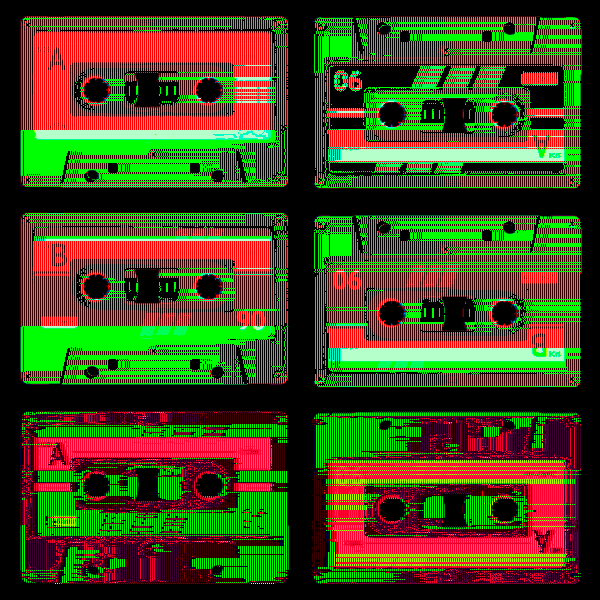
MEMORY-Malfunction: CASSETTE-Tempo
I'm sitting on the floor of my room, surrounded by cassette tapes, and I'm instantly transported to precious moments from my past. There was this dual-deck radio where I would spend hours recording music and audio from radio stations—adjusting the antenna, tuning stations, and pressing record—thus building a collection of snippets of voices, sounds, and music.
These cassette tapes have now become time capsules, preserving fragments of memories filled with the imperfections of lived moments: hisses, abrupt cuts, and unexpected silences that tried to capture something ephemeral, the passage of time. These imperfections enhance the authenticity of the recordings, making them more special and genuine than memory itself.
The beauty of imperfection lies in its ability to convey a palpable sense of humanity and vulnerability. These small faults and variations serve as reminders that life isn't perfect, and it is precisely in these gaps and irregularities that we find its true value. Every crackle and distortion connects me to a past full of real experiences, offering a charm that today's often immaculate and flawless digital recordings simply cannot capture.
Our memories are subject to imperfections and transformations, and the act of recalling is often an act of reconstruction, where details can be altered, forgotten, or imbued with new meanings. The imperfections in the tapes, therefore, are not merely testimonies of an analog era but also metaphors for the fallible and mutable nature of human memory.
-- random pixel manipulation in p5.js 600x600px 24 frames 690 KB