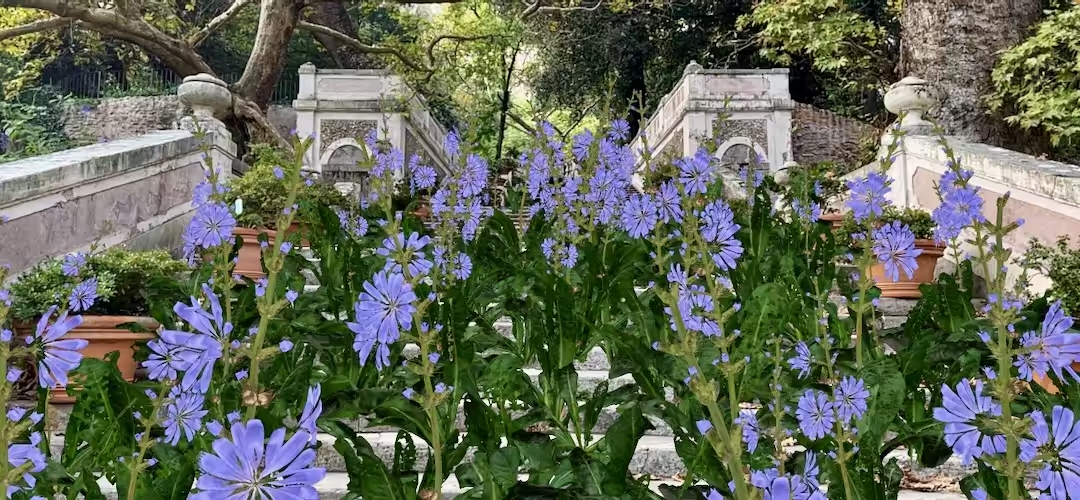
Blue Flower AR at the Botanical Gardens in Rome
This image was created in the Botanical Gardens in Rome, also known as Orto Botanico, which has a rich history spanning centuries, originating from the 13th century as a medicinal garden. It has evolved from a papal garden to an academic and scientific research institution, incorporating the private grounds of Palazzo Corsini. The garden's current location was established in 1883 and is run by Sapienza University of Rome. The physical 3D printed sculpture of Biotechnology from the Blue Flower was also exhibited at the garden during the time that this AR artwork was captured.
Images of virtually 'planted' gene edited wild chicory plants in relevant locations made by Anna Dumitriu using the Blue Flower AR app created in collaboration with Alex May. The physical gene edited plants represented here are not normally allowed to leave the laboratory in many countries but through augmented reality users can transgress rules and fill the world with them.
Anna Dumitriu and Alex May's artistic project explores the cultural history and morphology of the chicory plant and investigates how new plant breeding methods such as CRISPR gene editing can be used to create future healthcare and food benefits. Chicory inspired the idea of the Blue Flower in German Romanticism, and became a central symbol of the movement. It inspired Goethe’s concept of the ‘urpflanze’ or original plant in his “Metamorphosis of Plants”. The romantic movement was a reaction to the industrial revolution and held nature and emotion in the highest esteem. Now we are part of a biotechnological revolution, and again the blue flower becomes an important symbol. This time in a more complex position at the interface of nature and technology, central to societal explorations of what may be acceptable in synthetic biology, and how ‘nature’ and ‘natural’ may be defined in the future. Or as Goethe stated “the unnatural that too is natural”.