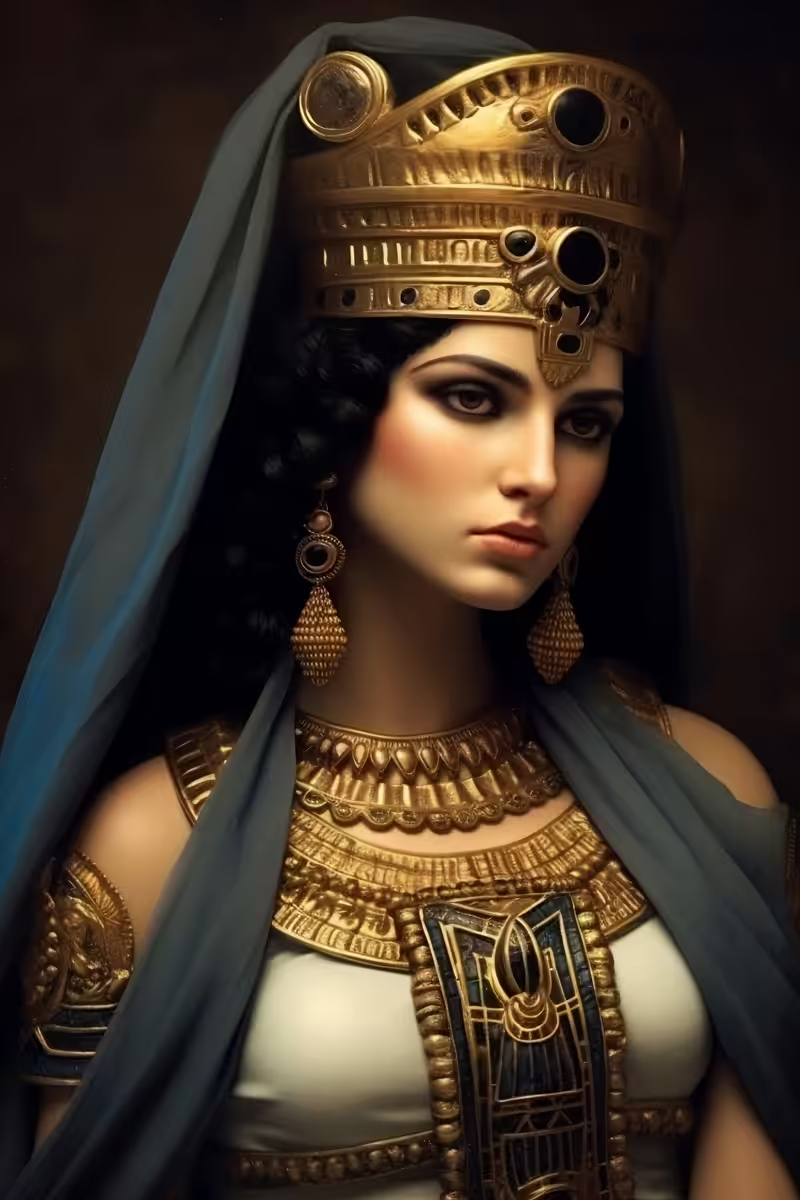
Empresses & Queens: Cleopatra VII of Egypt
Cleopatra VII of Egypt (69 BC - 30 BC): The last active ruler of the Ptolemaic Kingdom of Egypt, known for her political prowess and relationships with Roman leaders.
Cleopatra VII of Egypt, born in 69 BC, led a life filled with intrigue, power, and an indomitable spirit that has left an indelible mark on history. As the last active ruler of the Ptolemaic Kingdom, Cleopatra's life was shaped by political upheavals, strategic maneuvering, and legendary relationships with influential figures of her time.
Cleopatra was born into a world of dynastic complexities and shifting alliances. Raised in the royal court of Alexandria, she witnessed firsthand the inner workings of power and learned the art of diplomacy from a young age. This early exposure laid the foundation for her future reign and ignited a fire within her to protect and preserve Egypt's independence.
From the moment Cleopatra ascended to the throne, she faced immense challenges. The vast Roman Empire cast a looming shadow over Egypt, and she swiftly realized the importance of forging alliances to safeguard her kingdom. Her shrewd political maneuvers led her to establish relationships with influential Roman leaders, beginning with her association with Julius Caesar.
Cleopatra's connection with Julius Caesar was not only one of political alliance but also a passionate love affair. Their relationship propelled her onto the world stage, granting her a voice in Roman politics and ensuring Egypt's survival amid the turbulence of the era. However, Caesar's assassination and the ensuing power struggles forced Cleopatra to adapt and seek new alliances.
Her next influential liaison was with Mark Antony, a Roman general whose ambitions aligned with her own. Cleopatra's partnership with Antony created a formidable force, and together they challenged the rising power of Octavian (later Emperor Augustus). Their love affair and political alliance created waves across the Mediterranean and forever cemented Cleopatra's image as a seductive and influential queen.
Cleopatra's life was not solely defined by political machinations. She was a ruler deeply invested in the cultural and intellectual development of Egypt. Known for her patronage of the arts and support of renowned scholars, she fostered a renaissance of Egyptian culture. Under her rule, Alexandria thrived as a center of learning, attracting thinkers and creatives from far and wide.
However, Cleopatra's fate was sealed by the forces of history. Following the defeat of Antony and Cleopatra's forces at the Battle of Actium, and facing the imminent capture by Octavian, Cleopatra chose to take her own life rather than endure humiliation and subjugation. Her death marked the end of the Ptolemaic dynasty and the annexation of Egypt by Rome.
Cleopatra's life remains shrouded in both mystery and fascination. Her intelligence, charm, and determination to protect Egypt and its sovereignty have made her an enduring symbol of female empowerment. From her strategic alliances to her impact on culture and the arts, Cleopatra's legacy transcends time, reminding us of the complexities of power, love, and the indomitable spirit of a queen who defied societal expectations and left an indelible mark on history.