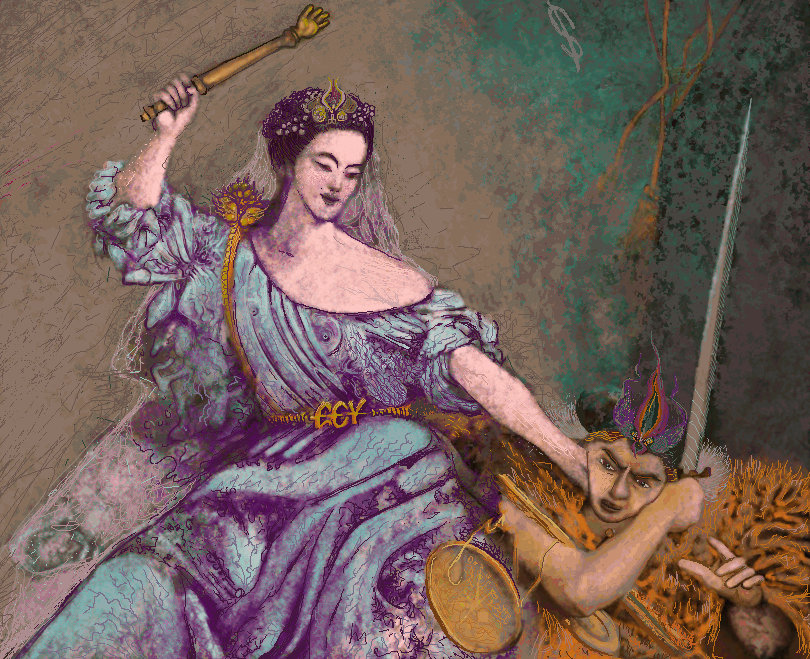
Corruption
Technical Data Sheet for the Original Artwork
Artist: Jean-Marc Nattier (famous portraitist to the court of Louis XV)
Year: 1737 Technique: Oil on canvas Style: Rococo
A Hidden Portrait?: Although officially an allegory, this work was long known as "Madame Adélaïde in the guise of Justice." It is believed that Nattier used the face of Louis XV's daughter, Princess Adélaïde, to personify the goddess, a common practice at the time to flatter the royal family. Royal Destiny: It was not painted for a museum, but as a direct commission from Louis XV to decorate the "Salon du Temple" or audience chambers at Versailles. Its purpose was to remind all who entered that the King was the source of supreme justice. Series of Virtues: This work was not alone. It was part of a set of seven paintings depicting the Cardinal Virtues (such as Prudence and Strength) commissioned for the same decorative space.
From Versailles to private hands: Unlike other permanent murals, this canvas left the palace. After passing through several prestigious collections (such as that of the Wildenstein family), it was auctioned at Sotheby’s Paris in 2015 for over €600,000.
The work presents a political and moral allegory. In the center, Justice (often identified with the goddess Themis) holds her classical attributes: the scales (balance) and the sword (the power to execute judgment).
The action: Justice is not static; she is in the act of "teaching" or punishing a figure representing Injustice, who appears defeated at her feet, symbolizing the triumph of royal order over chaos and vice.