⭐️ I am the Astra ⭐️: Guaraná
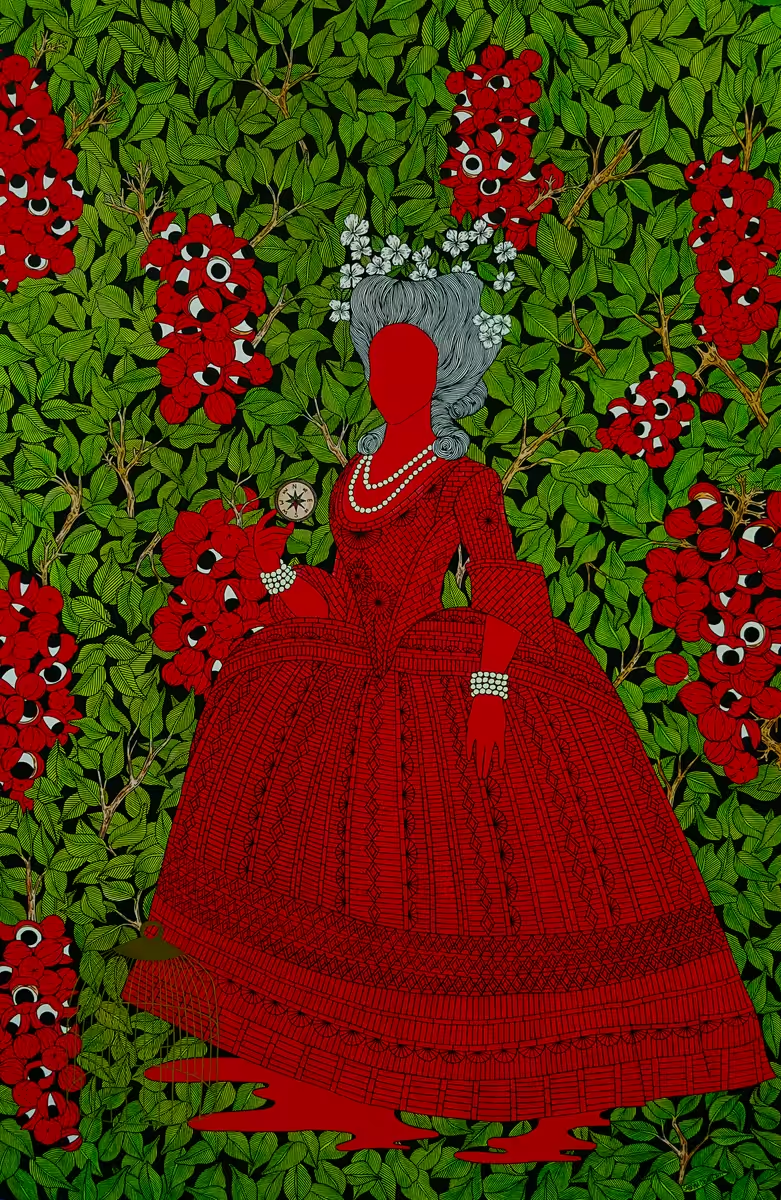
The work Guaraná is inspired by the painting Carlota Joaquina, Infanta de España, Reina de Portugal by the Spanish painter Mariano Salvador Maella in 1785. The guaraná is a fruit originally from the Amazon basin, and the Sateré-Mawé indigenous were the pioneers in its planting. Guaraná was made to scale to the original painting, so 177 x 116 cm.
The body of work entitled Vermelho é a cor da paixão started in 2017. Those works are heavily inspired by the problematics around identity and the colonisation of Brazil.
This collection aimed to demystify the traditional portraiture of the European Expansion across the globe. The artworks are allegoric, each detail is placed meticulously, have a complex meaning and a history to tell.
Everything is contaminated to problematize history. My works are dense, convoluting and often chaotic, and the intricacy of the visuals is an attempt to attract the viewers towards it.
Also, the name Brasil comes from a tree called Pau-Brasil, named thus because of its red colour, that resembled embers of fire. This tree has properties that made it the first truly valuable product in the period of assembly of the Portuguese colonial system. “Ibirapitanga” was the name used by the native indigenous, that means in the Tupi- Guarani language red wood.
Through the reframing of Eurocentric aesthetics, I want to present a new possibility for the traditional visual and discursive interpretation that had been imposed via the hegemony of Western culture translating in the romanticization of colonial portraiture throughout history.
In Guaraná, the pictorial elements are inverted via the use of bold colours and the mixed media technique itself. An empty birdcage replaces the canary that rests in Carlota’s fingers seen in the original painting, and it is as if this animal represented Brazil itself. The naive and delicate bird, perhaps also symbolise the “docile” and trustworthy aspect of how the native people of Brazil reacted towards the Portuguese invaders during that time.
In my version of the painting, the empty cage represents a symbolic and ideological space in which Contemporary Brazilian society seems to sustain their paradoxical sense of identity. Carlota Joaquina Teresa Cayetana de Bourbon (1775-1830) was born in Aranjuez, Spain. She was the Queen consort of Portugal, Brazil and Algarves and Empress consort of Brazil.
She was extremely ambitious and since the arrival of the Portuguese crown in Brazil in 1808, she began to conspire against her husband, D. Joao VI claiming that he was not able to govern and that she should be in power instead.
Her liberal attitude was very different from the values of other women at court. She was particularly criticized by Portuguese men who disapproved of the strength and resourcefulness with which Carlota Joaquina occupied, especially the public space and her keen taste for politics.
If we consider that most of the women of that time were deprived of social participation, Carlota's transgressive behaviour made room for many malicious rumours regarding her moral conduct to be raised by the court.
My interest in Carlota Joaquina started very early, as she was especially famous in Brazil and was a very important historical figure as well as being part of the popular culture of my country. Despite the negative aspects of Carlota's personality, I can not deny that many of her personal traits fascinate me. And at several moments in my artistic career, I used her image as inspiration for self-portraits.
Finally, the excess of the colour red is to demonstrate the violent nature of colonial processes, and the reason why Carlota appears faceless in the painting is to allude to the erasure of female narratives in history and the difficulties faced by women to have agency.