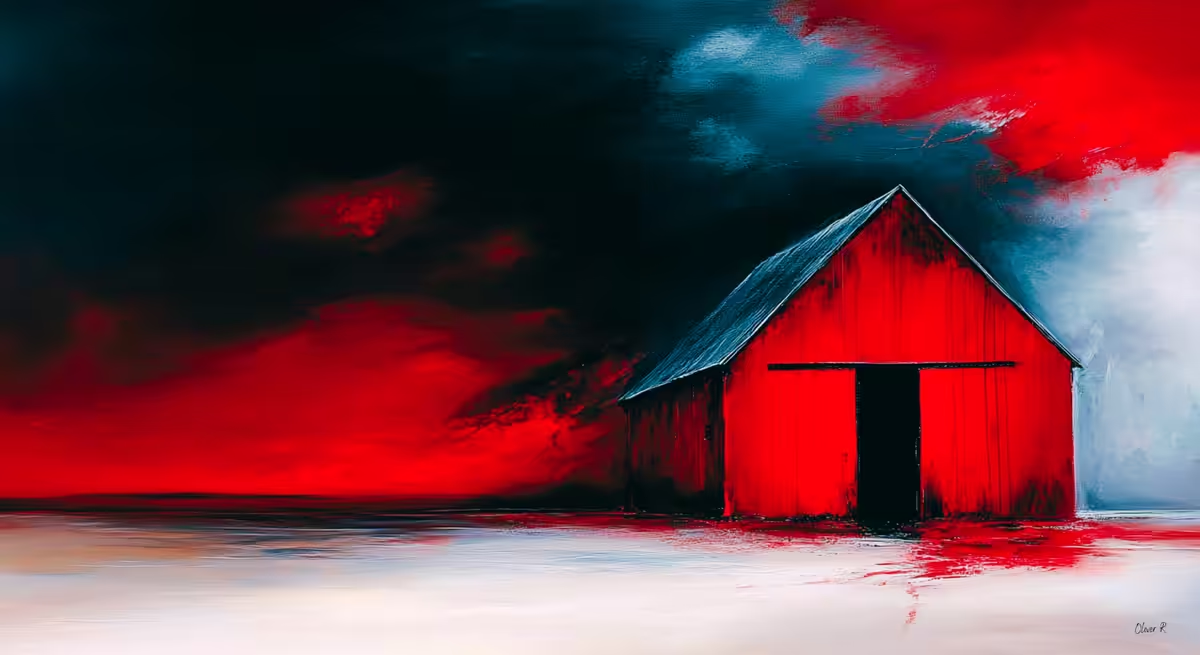
Collection Red Blue by Oliver R: "La Grange" signed by "Oliver R"
“La grange” by Oliver R: A Fiery Vision Between Rural Memory and Symbolic Violence
In La grange, the artist Oliver R presents a striking work in which a rural landscape shifts into an atmosphere of tension and mystery. Inspired by the song La Grange by the band ZZ Top, the painting goes far beyond musical illustration to become a pictorial meditation on ambiguity, memory, and latent violence.
At the center of the composition stands a red barn, shown from a three-quarter angle. Its architecture appears simple: a solid, isolated structure topped with a black two-sided roof. Yet this apparent simplicity conceals a deep sense of unease. On the façade, a dark opening immediately draws the eye. Is it a door? An absence? A void? The artist deliberately maintains uncertainty. No interior can be seen. This compact darkness acts like an impenetrable threshold, a silent space refusing any explanation.
In front of this opening, colors spread violently across the ground. Black and, above all, red invade the surface in an almost organic materiality. The black naturally evokes mud or soaked earth, while the red suggests blood. Oliver R never chooses definitively between the real and the symbolic; instead, he allows the viewer to construct a personal interpretation. This ambiguity is one of the painting’s greatest strengths. The material seems to have flowed out from the barn itself, like the trace of an ancient event, a memory impossible to erase.
The entire landscape contributes to this dramatic tension. The horizon and the sky dissolve into shades of red and black, as though the whole space had been contaminated by some inner fire. Red dominates the painting, not as a vivid or warm color, but as a heavy and suffocating presence. Black structures the composition and gives it gravity. Yet a few nuances of bluish gray appear on the right side of the canvas. These colder tones create a visual breath, a fragile light that prevents the work from sinking completely into darkness.
The treatment of the ground further reinforces this dramatic progression. In the foreground, white still largely survives, though already marked by scattered red streaks. But as the eye moves backward toward the barn and the horizon, red and black gradually take over. This advance of darker colors creates a sense of invasion, as if violence were slowly spreading across the entire landscape.
The musical inspiration plays a crucial role here. The song La Grange by ZZ Top refers to a brothel located near the Texan town of La Grange, a place that became almost mythical in American popular imagination. Oliver R does not literally depict this universe; instead, he captures its symbolic charge. The barn thus becomes a place of fantasy, secrecy, and transgression. Red recalls both passion and danger, while black evokes silence and prohibition.
Through its economy of forms and powerful chromatic intensity, La grange stands out as a deeply atmospheric work. Oliver R transforms an ordinary rural building into an almost tragic apparition. Somewhere between abstraction and figuration, between musical reference and psychological vision, the painting leaves a lasting impression: that of a place burdened with untold stories, where color itself becomes the true language of emotion.