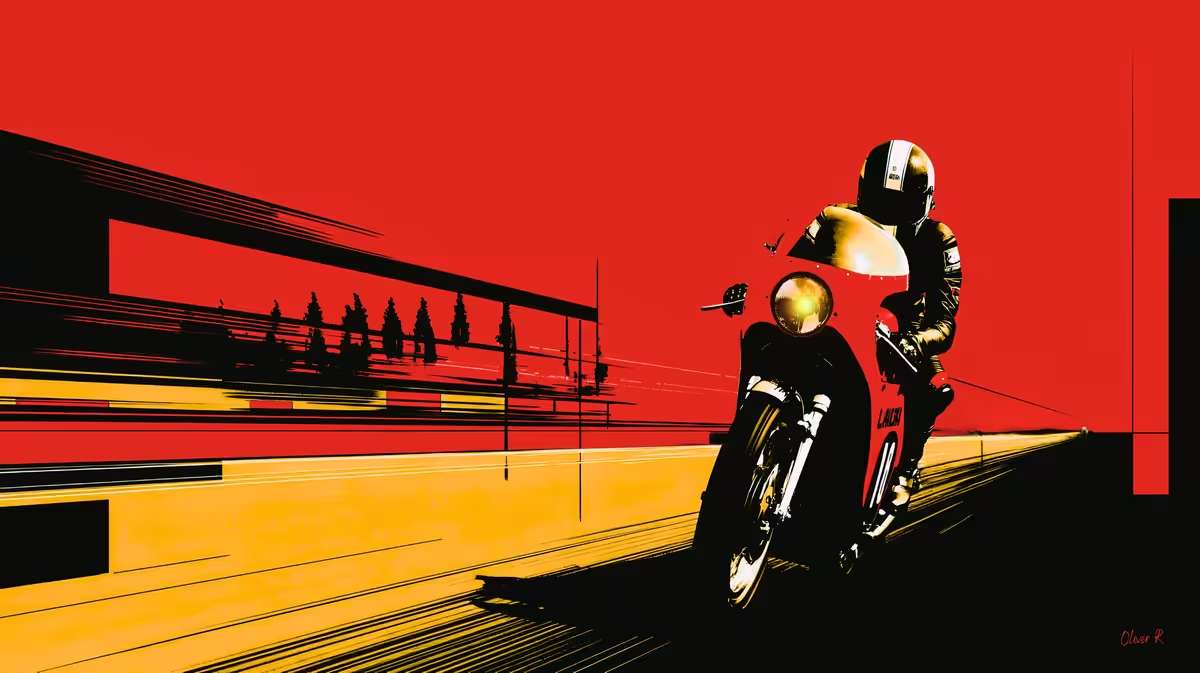
Collection Red Blue by Oliver R: "Bol d'Or 69" signed by "Oliver R"
Bol d’Or 69: Speed Incarnate by Oliver RIn the world of motorcycle art, few works manage to capture both the technical essence of a machine and the raw intensity of an endurance race. Oliver R’s painting “Bol d’Or 69” achieves this feat with striking visual power. Part of his Red-Blue collection, this canvas stands out with a palette dominated by vibrant red and deep black, breaking from the series’ usual balance to immerse the viewer in the nocturnal and incandescent atmosphere of a legendary race.A Motorcycle and Rider as OneAt the center of the composition, an Italian Laverda 750 races down a straight section of the Linas-Montlhéry circuit. This small manufacturer from Breganze, still young at the time, helped forge the myth of the 1969 Bol d’Or with its unique, robust, and daring machines. Oliver R perfectly captures this moment of pure tension: the motorcycle seems to burst out of the canvas, propelled by dynamic lines that evoke extreme speed. The rider, dressed in leather, has become one with his machine. His body, leaned forward, perfectly follows the contours of the bike in an almost organic fusion between man and mechanics.The lit headlight is one of the painting’s most powerful details. It reminds us that the Bol d’Or is a 24-hour race, contested partly in darkness. This bright beam pierces the night, symbolizing the pilots’ perseverance and determination in the face of fatigue and darkness.Night and Day: A Subtle Chromatic TransitionOliver R masterfully uses color to mark the boundary between day and night. The light violet that touches certain areas of the sky and background contrasts with the dominant black, creating a particularly evocative twilight or nocturnal atmosphere. This chromatic choice reinforces the feeling of immersion in a race that never stops, even when the sun disappears.The setting itself is deliberately abstract and blurred, as if seen through the windshield of a rider at full speed. The lines of the circuit dissolve, the grandstands and spectators become colored patches. Only the motorcycle and its rider remain sharp — almost sculptural. This technique brilliantly enhances the impression of speed and the isolation of the man-machine duo at the heart of the event.1969: The Year of RenewalHistorically, the 1969 Bol d’Or marked a decisive turning point. After a nine-year absence (the last edition was in 1960), the race was revived on September 13 at the Linas-Montlhéry autodrome, thanks to the initiative of Moto Revue magazine. This edition symbolized the renewal of French and European motorcycling in the face of the massive arrival of Japanese machines (notably the Honda CB 750), while highlighting bold European manufacturers like Laverda.The factory Laverda 750s, ridden by André-Luc Appietto and Jean-Pierre Naudon among others, were among the most competitive and left a lasting impression through their character and reliability. It is precisely this pivotal era — late 1960s to early 1970s — that Oliver R captures: the moment when the motorcycle evolved from a simple means of transport into a true modern racing machine capable of competing in 24-hour endurance events.A Passionate Artist Tackling a Demanding SubjectOliver R, a passionate motorcycle enthusiast, has been working for several years on a large-scale project combining art and the motorcycling world. However, this is not an easy subject to tackle. How do you convey speed, mechanics, noise, fatigue, and adrenaline on a static canvas? How do you avoid the trap of overly literal realism while remaining true to the spirit of a race?With “Bol d’Or 69”, the artist offers an elegant and powerful answer: a work that is both figurative and abstract, where technique (speed lines, rider-machine fusion) serves emotion and historical memory. The choice of a red-black palette — darker and more dramatic than his usual Red-Blue series — demonstrates artistic maturity and a willingness to adapt his visual language to the intensity of the subject.A Work That Still Vibrates Today“Bol d’Or 69” is not just a tribute to a legendary race. It is a celebration of that era when motorcycling became a field of innovation, passion, and adventure once again. Through movement, the headlight’s glow, and the intimate fusion between man and machine, Oliver R transmits all the raw energy of that September night in 1969 at Montlhéry.A canvas that, like the race it immortalizes, leaves a lasting impression and continues to “rev” long after you look away.