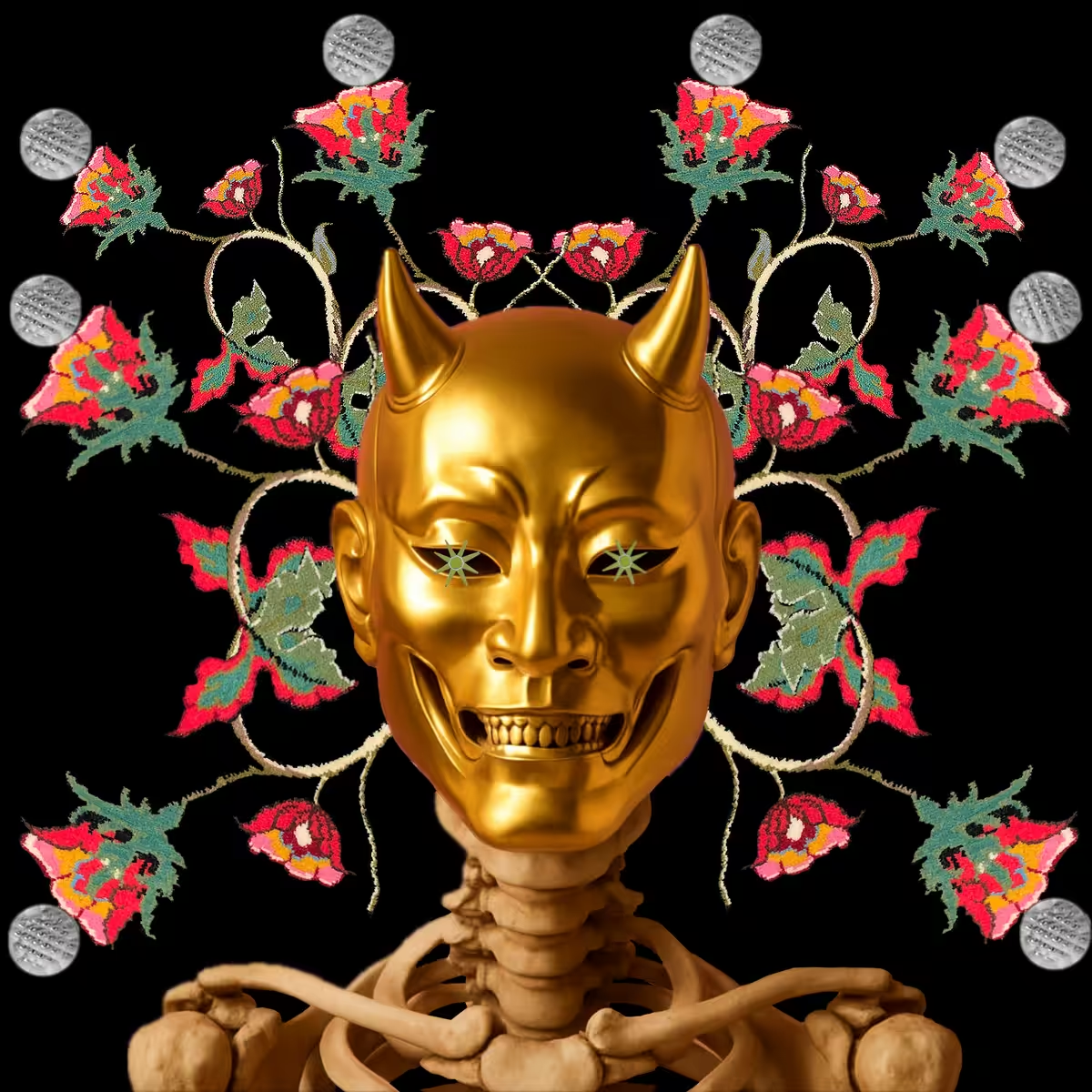
Geometric Echoes 1: Sun-Eyed Hannya in Blossoms of the Persian Carpet
In this work, the skeleton stands as the symbol of the deepest inner layer of every human being bare, unadorned, and truthful. Above it rests a golden mask inspired by the renowned Hannya mask from Japanese Noh theater,a face with horns and a frozen smile, holding both fear and beauty within. In tradition, Hannya embodies a woman transformed by jealousy and rage into a vengeful spirit, yet her expression always lingers between humanity and demonhood. Here, the golden surface of the mask reshapes that meaning: not merely anger or darkness, but transformation and eternity a mirror that turns the rawest human emotions into timeless splendor. The background is a collage of Persian carpet motifs taken from a family collection; flowers that unfold like a mythical garden, surrounding the figure with a halo of culture and life. In the eyes of the mask, two radiant suns shine crafted in 2021 from hand cut mirrors now burning like inner flames, shifting the mask’s cold gaze into light and awakening. The word hannya (般若) is a Japanese phonetic transcription of the Sanskrit word prajñā (प्रज्ञा), meaning 'wisdom'. There are several hypotheses as to why the mask used in Noh, which represents a vengeful spirit expressing female jealousy and resentment, was named hannya. According to the first hypothesis, the mask was named hannya because it is said to have been perfected by Hannya-bō (般若坊), a Japanese monk of the Bunmei era (1469–1487).