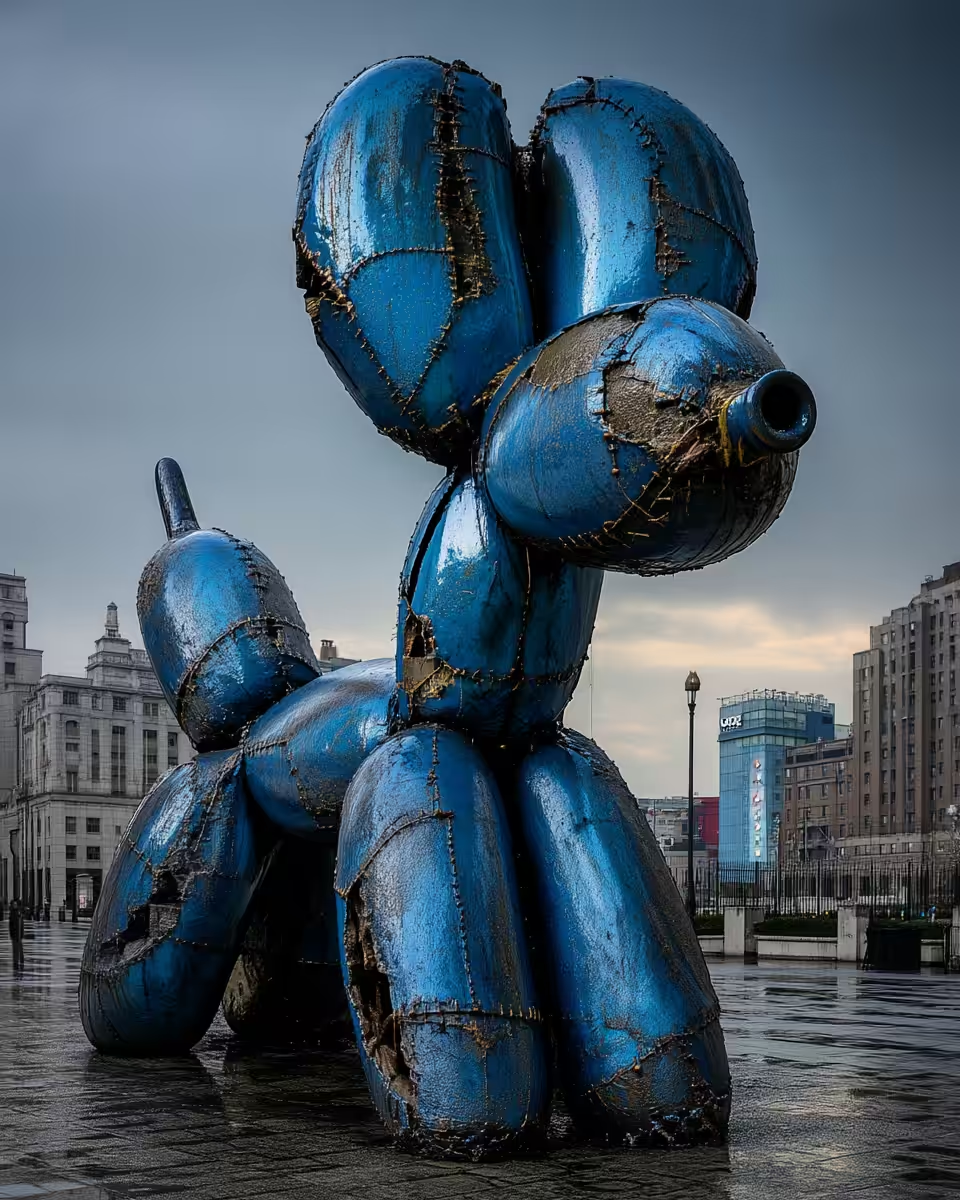
AI - Post Photography: Frictions - broken dog
Artificial intelligence has moved right into art. The future arrived a while ago, as el Indio would say, but it caught us fairly off guard. Many artists have been experimenting with AI for years, but the quantum leap it took in the last year and a half shows everywhere. Image production is growing exponentially. It floods social media, television, platforms, advertising, journalism and even our family photos. Writing, image, sound, music and the audiovisual were absorbed by the same logic of permanent generation. The algorithm knows it, feeds it and multiplies it. It slipped into every crevice of human creation, and we don’t know what to do with it without losing ourselves along the way. Many creators embraced these tools and others regard them with distrust. Complexity was never a comfortable place. “The polished, the neat, the smooth and the flawless are the signature of our time,” writes Byung-Chul Han in Saving Beauty. Artificial intelligence seems to be the perfect embodiment of that idea. Much of the imagery we consume today is bright, flawless, technically perfect. It makes no noise. It doesn’t unsettle. It offers no resistance. It replicates our supposed best version. It glides across the screen as easily as it disappears. And that is where my questions begin. I’m drawn to noise, to discomfort, to the wound as a way of making visible what a society tries to hide. I’m interested in everything that doesn’t fit Instagram’s imaginary of happiness. What falls outside the algorithm. What reveals a crack through which the narratives start to leak inconsistency. I think of frictions as detectors. As red traffic lights. As places where reality stops matching the image a society builds of itself. The question is how we carry out that exercise within the virtual. How do we detect frictions when the algorithm is designed to hide them? Byung-Chul Han finds in Jeff Koons’s sculptures the paradigm of an aesthetic of the surface: polished, flawless, without resistance. The perfect mirror where the viewer finds only their own reflection. Maybe that is where we should start looking. To break the mirrored. To stop staring, dumbfounded, at an image that promises perfection but returns only a surface. To pierce that synthetic skin and look at what lies beneath. This cycle proposes exactly that. To shine light on the cracks. On the broken. On the noise. On the uncomfortable. On what still resists. To fall down the rabbit hole, like Alice, to discover a world less perfect, but far more complex. Artificial intelligence is here to stay; the question is: will we still be able to produce friction? To defend what no algorithm can optimize: contradiction, vulnerability, time, experience and the capacity to make ourselves uncomfortable.
AI generative