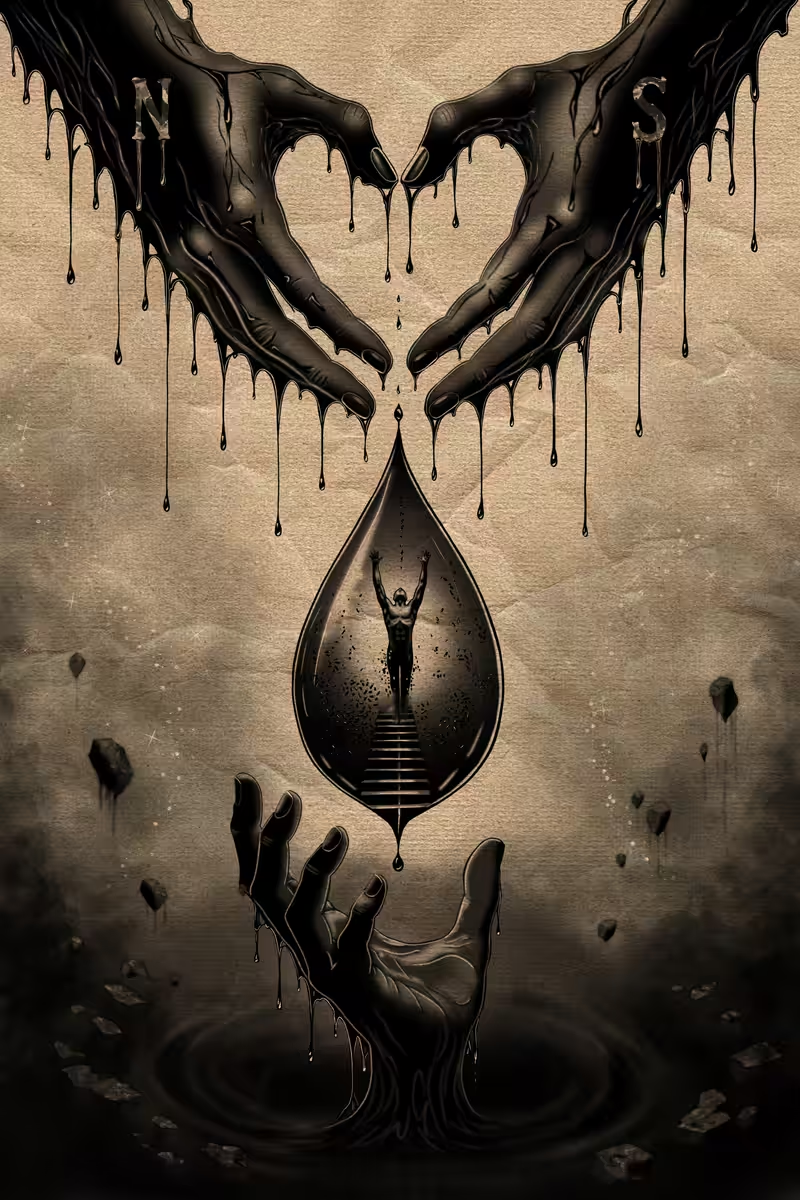
Sketch: «MAGNETIC ABYSS»
What if the things that hold us back are not the things we fear — but the things we already know? Human nature has a tendency to choose the familiar. We return to the paths we have already walked, repeat what has worked before, and trust what has been proven safe. The known becomes a kind of magnet — not because it is necessarily better, but because we understand it. The drop becomes a metaphor for this human instinct. Inside it, a figure moves along a familiar trajectory, suspended between two states — between what is known and what remains unseen. The magnet pulls him toward the path he recognizes, the one where every step feels predictable. Beyond it lies the abyss. But perhaps the abyss is not as frightening as we imagine. It has no defined shape because we have never entered it. We call it dangerous simply because we cannot predict what comes next. Yet the unknown itself is neither good nor bad. It is simply unknown. And perhaps this is the paradox of being human: We are not always afraid of the abyss. Sometimes, we are simply too accustomed to the path that leads away from it. The familiar pulls us back. The unknown waits. And somewhere between them, we make the choice — whether to follow the gravity of what we already know, or to discover what lies beyond it.