Genjitsu Gensō (現実幻想) - OBJKT: Noesis
What becomes of a soul that has seen too much?
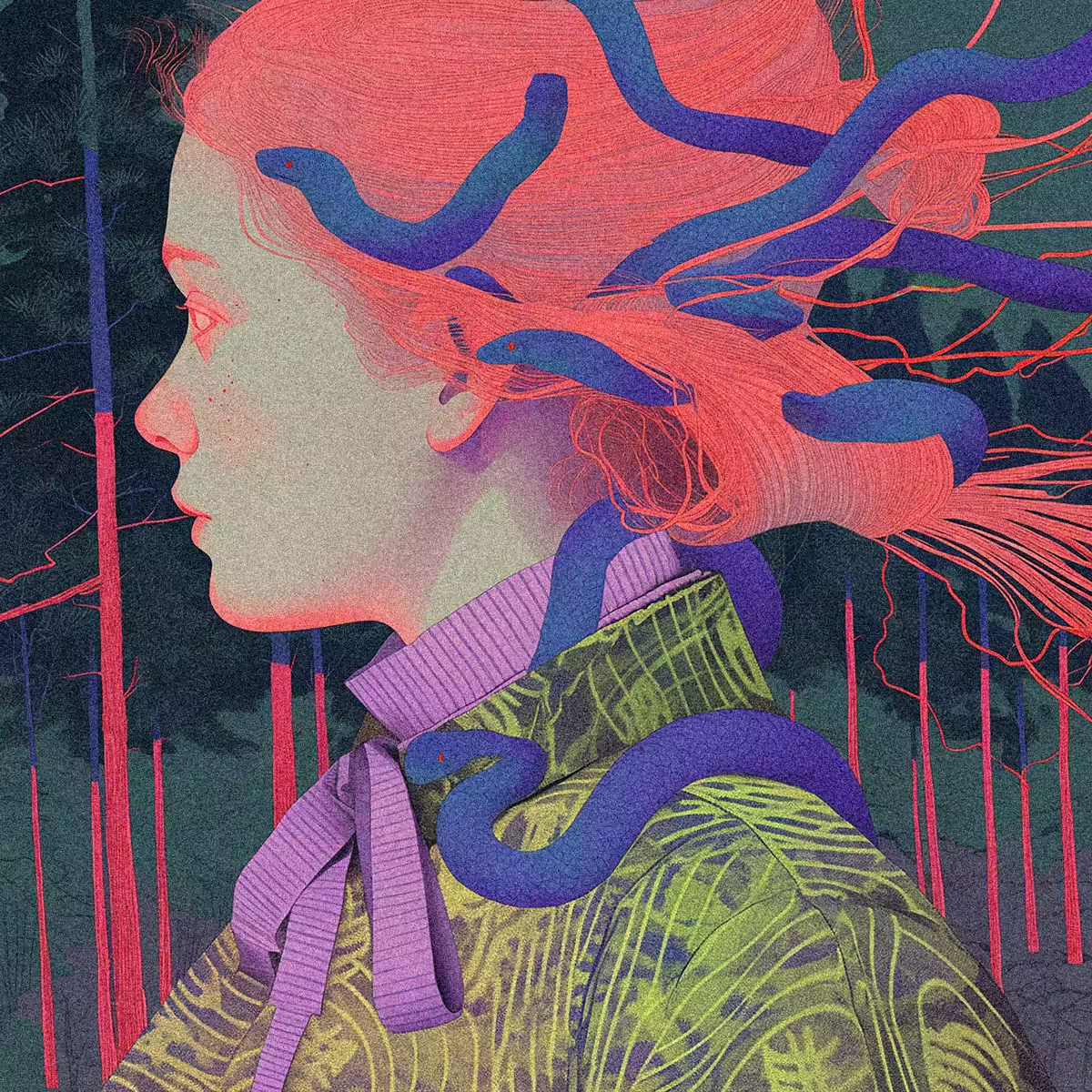
She stands in silence, not because the world has given her peace, but because it has taken away the comfort of innocence. Around her, serpents rise like living thoughts, each one carrying a truth too heavy to be spoken aloud. They do not threaten her. They belong to her, as if every secret she has learned, every hidden pattern she has uncovered, and every unseen reality she has been forced to witness has taken form and chosen to remain.
There is something haunting in her stillness. She does not resist what surrounds her, because resistance ended the moment knowledge became a part of her nature. While others move through life protected by illusion, she exists beyond that shelter, burdened with an awareness that cannot be undone. The forest around her feels less like a place and more like an extension of this inner state, dark, watchful, and alive with the presence of things most people never notice.
The serpents become symbols of knowing too much: truths about people, about power, about the fragile structures that hold reality together. Their glowing eyes suggest a vigilance that never rests, as though knowledge itself has a life of its own. In her calm expression there is no victory, only acceptance. She has crossed into a space where clarity is no longer liberating, but isolating.
At its heart, the piece asks a deeply unsettling question: is knowledge always a gift, or does there come a point when seeing too clearly becomes its own kind of curse? She embodies that threshold, the moment when awareness transforms from enlightenment into burden. What surrounds her is not merely darkness or danger, but the weight of truths that cannot be unknown.