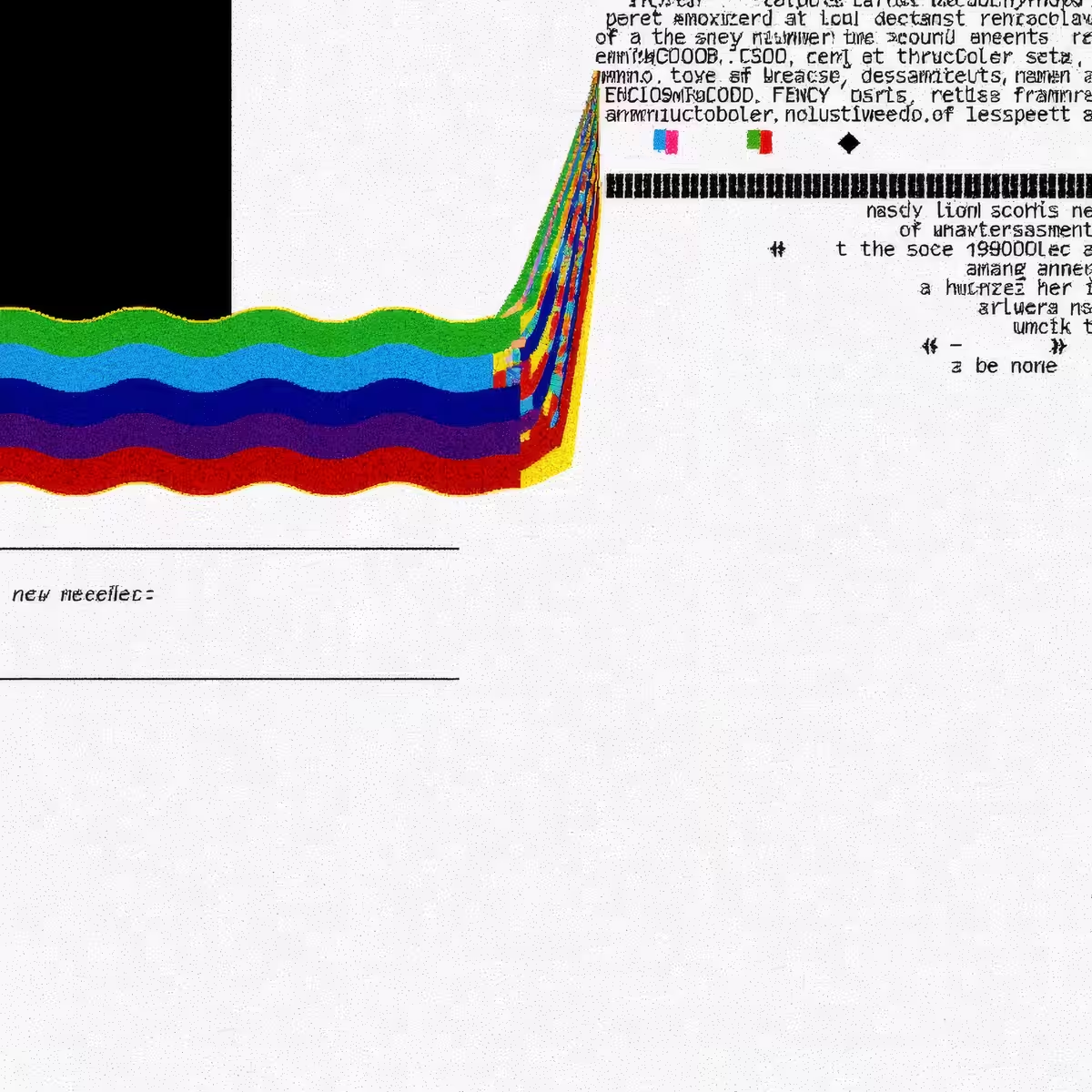
Generative TypeMachine: where the river of pixels longs to turn into language, yet dissolves back into pure beauty
unfolding into color, a secret syntax of radiance the river carries no message, only the weightless echo of meaning undone, spilling into silence, where beauty is its only grammar
This work is an exclusive piece for the collectors of the editions minted as unique works within this collection. It stands as a key element in the development of the series, serving as a bridge between overlapping languages that trained the AI’s LoRA.
Typemachine
The first series emerges from the direct gesture on paper with a typewriter. Each repeated character transforms into texture, pattern, and noise; the letter loses its function as a sign to become matter. Through accumulation, a different language unfolds—one made of rhythm and repetition—where error, key pressure, and the mechanical imprint are essential parts of the work.
Scanned without mediation, these pieces appear in their rawest state: the surface as the immediate archive of a physical encounter between machine, paper, and body. Minted as 1/1 editions —with a few in open edition— they preserve the singularity of the repeated mark, underscoring that within repetition there is never absolute uniformity, but rather infinite variations.
Flickering Typemachine
The second series revisits the original papers through a new process of digitization. Here, the scanner becomes a portal: light in motion and the physical manipulation of the scan generate unrepeatable distortions. Each image exists as a unique moment, where digital recording does not only translate but also invents.
The typewriter’s patterns dissolve and reconfigure into chromatic waves, unveiling visual narratives of error’s fragility. Digitization itself becomes a central part of the work—a bridge of flows between body, machine, and light—where the tactile and the intangible coexist on the same plane.
Generative Typemachine
The third series imagines a typewriter beyond its mechanical limits, transformed through a generative AI engine trained with the images from the previous two bodies of work. Here, repetition is not only a gesture of the hand or a distortion of light, but also an algorithmic process that reinvents itself endlessly.
The machine hallucinates characters that never existed, weaving textures of light and matter as if they belonged to a forgotten alphabet. In this dialogue between the analog trace, the digital glitch, and artificial interpretation, a new sensibility emerges—where repetition becomes a method of digital translation, between human memory and machinic imagination.
BosqueGracias, 2025