Collective Binary Loops: collective binary loops cbl12
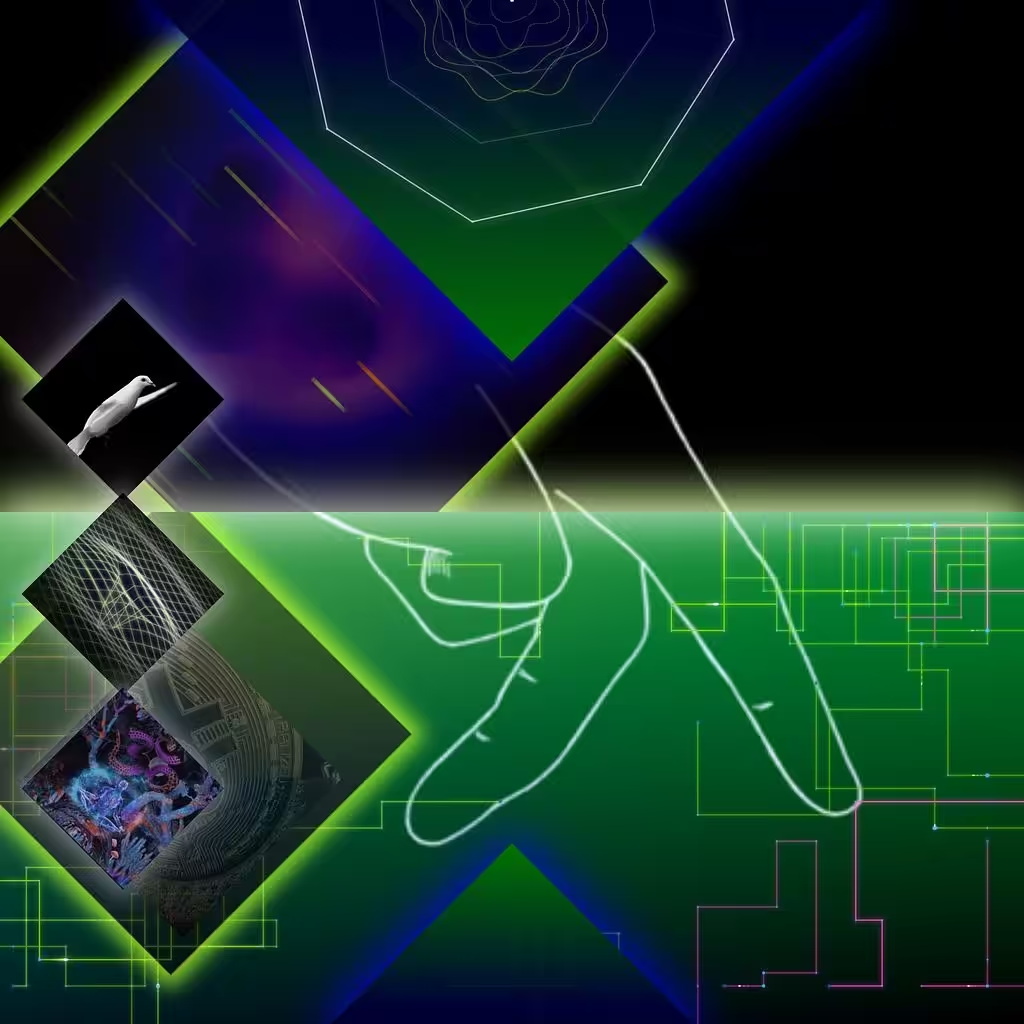
A collective of fingers is constantly steering and navigating the world, across billions of devices, in real time. In Collective Binary Loops, this distributed, almost invisible network becomes visible. The hand, and more precisely, the fingers, move us through digital space and, at the same time, actively shape and steer that space and, with it, our networked, computerized world. What legs are to the physical world, fingers have become to the information space: they navigate, select, and advance us, tap by tap, swipe by swipe.
In this collection by Florian Kuhlmann, that fundamental shift becomes the core of the work. Each piece is built as a structured visual system, divided along a central axis. On one side: the language of machines, grids, signals, repeating patterns, coded order. On the other: a more fluid, symbolic layer, organic shapes, abstract signs, cultural fragments. The composition is symmetrical, but the tension between these two worlds remains active.
At the center sits the hand. It does not belong to either side. It connects them. The fingers operate as an interface, linking structured systems with open meaning. They move across boundaries, activating relationships between elements that would otherwise stay apart. This is how we experience digital environments today: not as fixed systems, but as spaces we continuously navigate and reshape through input.
This becomes especially clear in the use of symbols. Bitcoin and the dove of peace appear within the same visual field. At first, they seem incompatible, digital finance versus humanistic ideals. But here, they share a common ground: both are built on ideas of freedom, autonomy, and self-determination.
Collective Binary Loops reflects a reality where opposites coexist and meaning emerges through interaction. It is not about choosing one side. It is about navigating between them. In this sense, the work aligns with a metamodern sensibility: a conscious movement in-between, an oscillation that holds tension without resolving it, embracing both sides at once while continuously shifting between them.
At the same time, the collection reconnects to the artist's early practice. Over 25 years ago, large-scale digital collages were created from thousands of images found online and manually assembled by hand with the world-defining tool, Photoshop. Today, this process has evolved. The artist still works with his hands, typing, structuring, and defining rules, but the final image is generated by code.
The principle remains the same: combining fragments, holding tension, creating systems that produce meaning. The axis of symmetry is no longer just a visual tool, it is part of a generative logic that links manual input and machine execution.
Collective Binary Loops captures how we move today: not just through physical space but through layered digital systems, guided by our hands, step by step, finger by finger.