THE ONE collection: Petal-Born Balance
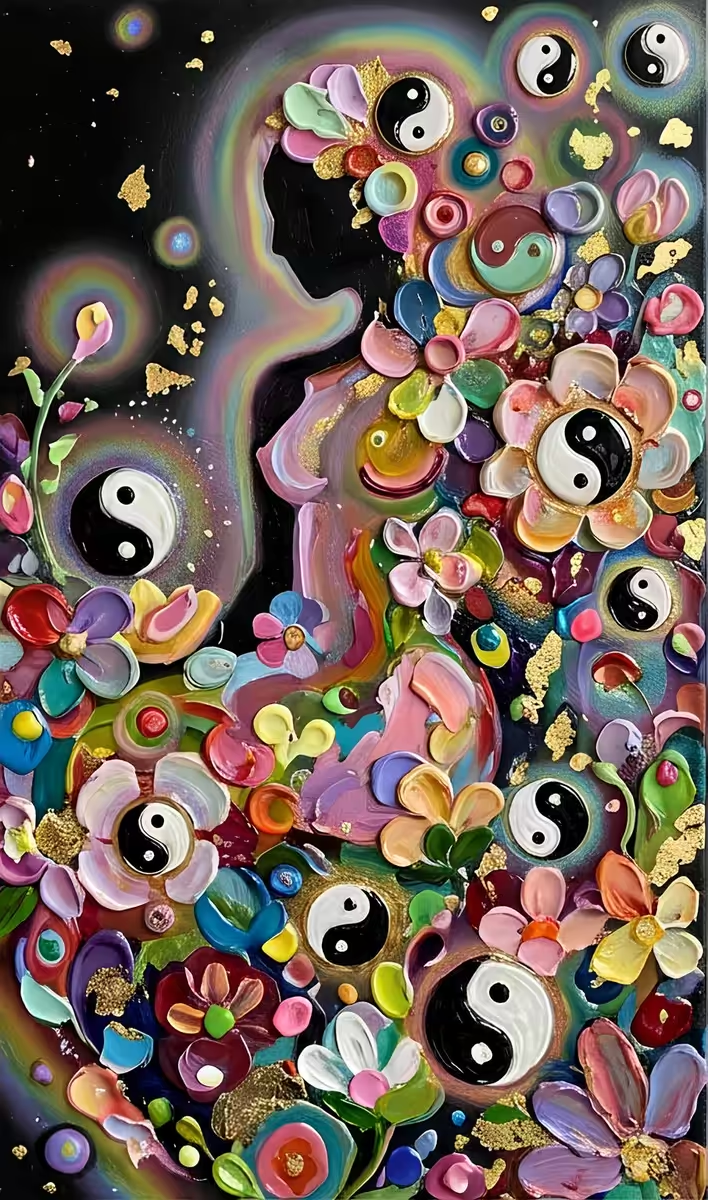
A silhouetted figure dissolves into thick, candy-like petals and gold dust, where yin–yang symbols bloom like seeds of harmony inside a chaotic, joyful universe.
This artwork treats the human form as a meeting point between opposites: softness and intensity, darkness and celebration, stillness and overflow. The central silhouette is quiet—almost empty—yet everything around it is loud with color, texture, and motion, implying a self that is defined less by outline and more by what it carries. The flowers feel sculptural, like wet paint or melted resin, suggesting emotion in its rawest, most physical form—desire, grief, love, confusion—piled into a living bouquet. The repeated yin–yang icons are not decorative; they are anchors. They imply that harmony is not the absence of chaos, but the ability to hold contradiction without collapsing. Gold flecks read like sacred fragments—moments of insight scattered through noise. The meaning behind the art is a philosophy of identity: we are not a single mood or story. We are a garden of opposites, and balance is not a destination—it is a practice, renewed every time the self blooms again.