The Limping Racehorse: Domesticates in Exile
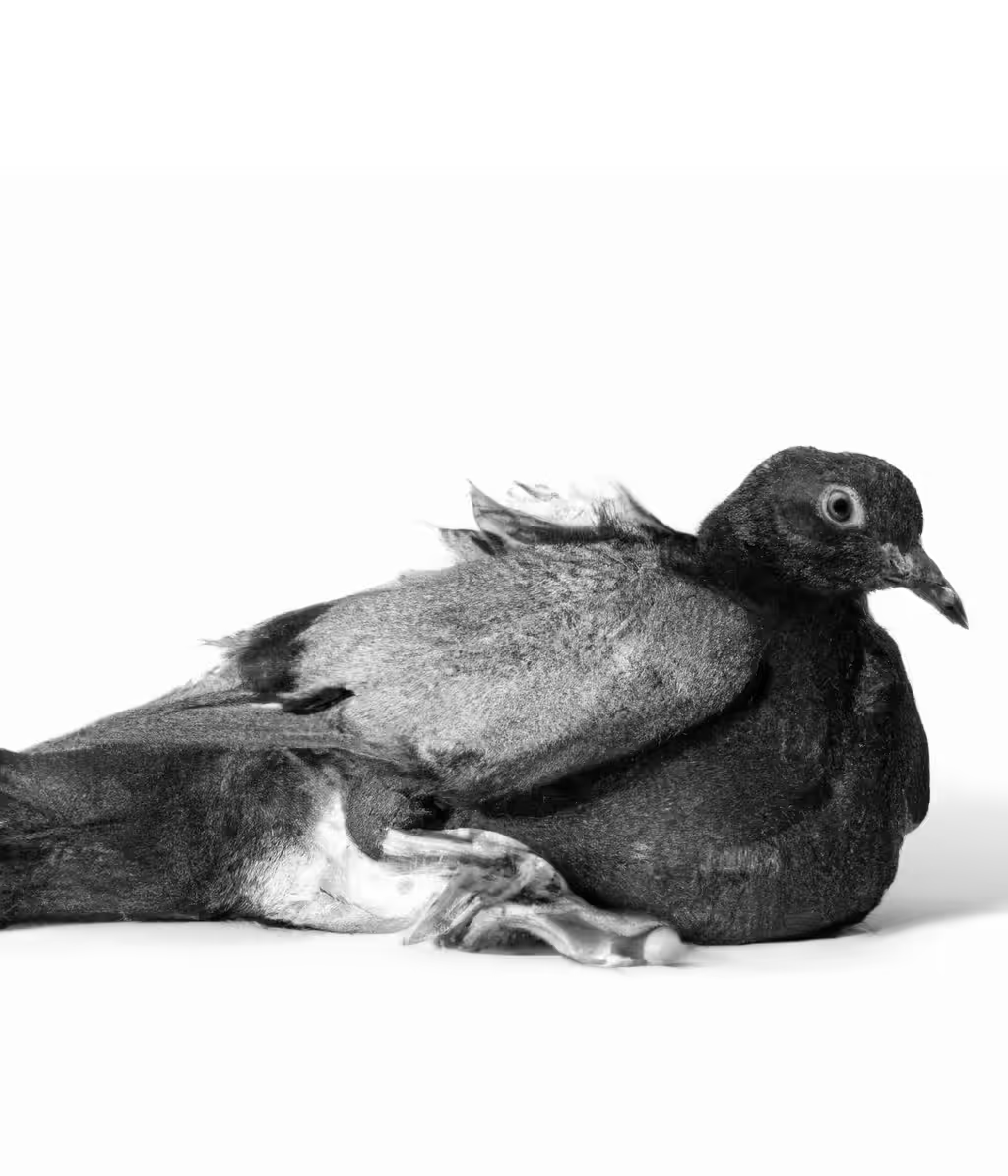
2022-08-01 22.57.57 Once bred to carry our words across kingdoms, now avoided like a rumour too persistent. Once welcomed at our windows, the pigeon lies in quiet collapse: wings worn thin, body folded, gaze held firm. Not broken, not whole, but paused. This is not collapse, but hesitation. The feathers tell of distance, of streets navigated and skies forfeited. Once a bearer of purity and peace, it is now seen as a nuisance. But what stories linger in the hollow of a wing held close? There is nothing tragic here, only quiet. A silence dense with memory. The bird does not ask to be pitied. It waits, as if remembering a time when to fly was to serve, to be cherished, to belong. The body does not perform. It simply remains. This gesture reminds us that rejection can be a form of grace. That to be discarded is not to disappear. This image, part of the Limping Racehorse series, rests at the threshold of myth and neglect. The white backdrop offers no cityscape, no perch, only stillness. And in that stillness, a slow reclamation. Not of flight, but of meaning.
“The Limping Racehorse” (2022) is a poetic image series based on poetry and diary fragments. Using DALL·E 2, Julia Albrecht explores memory, imagination, and the line between what was, what could have been, and what never existed.
In the summer of 2022, Julia Albrecht began a daily image-making process using the then-new DALL·E 2 model. What started as poetic fragments and diaristic reflections evolved into a visual series shaped by artificial imagination. Trained in photography but deeply rooted in language, Albrecht has long approached writing as a parallel artistic practice. With text-to-image tools, she found a way to return to language through images, letting words become visual material, and letting machine interpretation unlock forms that logistical or budgetary limits might otherwise have kept unrealised. “The Limping Racehorse” draws on aesthetic and conceptual impulses from the stark formalism of Richard Avedon’s portraiture and the therapeutic, self-reflexive strategies of Jo Spence’s photographic practice. At the same time, it extends Albrecht’s visual language, precise yet emotionally charged, navigating the threshold between control and ambiguity. The integration of AI served not as a replacement but as an accelerator to her existing process, enabling a faster and more fluid exploration of visual composition and poetic intent beyond the constraints of traditional photography. The limping racehorse becomes a metaphor for a transitional state: the moment after an intense chapter ends, and the next has yet to begin. Initially built for momentum, the body slows. Not to stop, but to reorient. It moves not with the drive to win, but with the need to understand. The series channels this in-between time: a period shaped by exhaustion, recalibration, and quiet refusal to rush forward until solid ground is found.
Julia Albrecht, Domesticates in Exile, AI-generated image, 2022