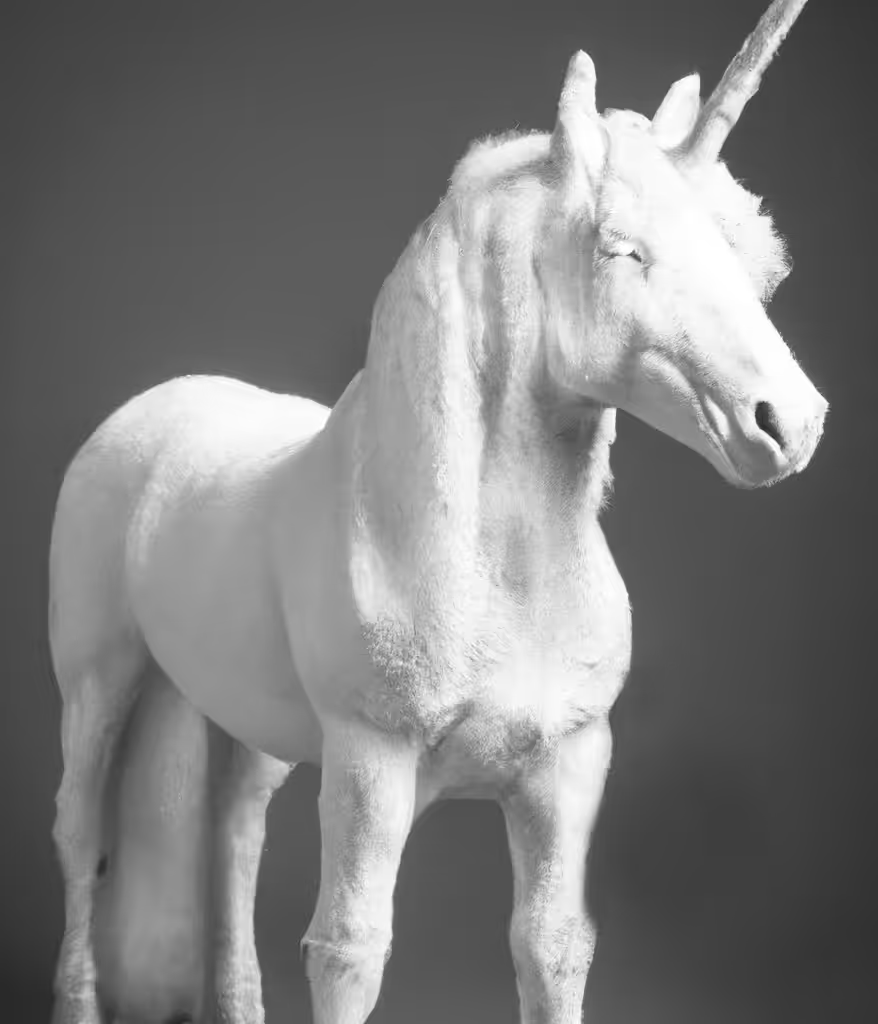
The Limping Racehorse: The Myth Made Flesh
2022-08-03 11.25.38 Not tamed, but released. The unicorn appears not as fantasy, but as a possibility, an arrival from a time just out of reach. Where once the racehorse fell, worn down by the rhythm of the grandstand, a new being rises from the bruise, no longer needing to gallop to be worthy. The body, relieved of the burden of finish lines, no longer performs. It stands. What was once a race becomes a stance. What was once an injury becomes a trace. The unicorn is the utopia of the limping racehorse, not healed, but transformed. Not returned to old strength, but opened to a different dignity. The horn: not a weapon, not a crown, but a signal for the improbable made real. This is not an escape. It is an offering. A space of possibility that says: there is an after. Beyond spectacle. Beyond the endless run. This image, part of the Limping Racehorse series, does not present a heroine. It opens a window. What might emerge if we stop running?
“The Limping Racehorse” (2022) is a poetic image series based on poetry and diary fragments. Using DALL·E 2, Julia Albrecht explores memory, imagination, and the line between what was, what could have been, and what never existed.
In the summer of 2022, Julia Albrecht began a daily image-making process using the then-new DALL·E 2 model. What started as poetic fragments and diaristic reflections evolved into a visual series shaped by artificial imagination. Trained in photography but deeply rooted in language, Albrecht has long approached writing as a parallel artistic practice. With text-to-image tools, she found a way to return to language through images, letting words become visual material, and letting machine interpretation unlock forms that logistical or budgetary limits might otherwise have kept unrealised. “The Limping Racehorse” draws on aesthetic and conceptual impulses from the stark formalism of Richard Avedon’s portraiture and the therapeutic, self-reflexive strategies of Jo Spence’s photographic practice. At the same time, it extends Albrecht’s visual language, precise yet emotionally charged, navigating the threshold between control and ambiguity. The integration of AI served not as a replacement but as an accelerator to her existing process, enabling a faster and more fluid exploration of visual composition and poetic intent beyond the constraints of traditional photography. The limping racehorse becomes a metaphor for a transitional state: the moment after an intense chapter ends, and the next has yet to begin. Initially built for momentum, the body slows. Not to stop, but to reorient. It moves not with the drive to win, but with the need to understand. The series channels this in-between time: a period shaped by exhaustion, recalibration, and quiet refusal to rush forward until solid ground is found.
JJulia Albrecht, The Myth Made Flesh, AI-generated image, 2022