The Limping Racehorse: Jawline Fracture
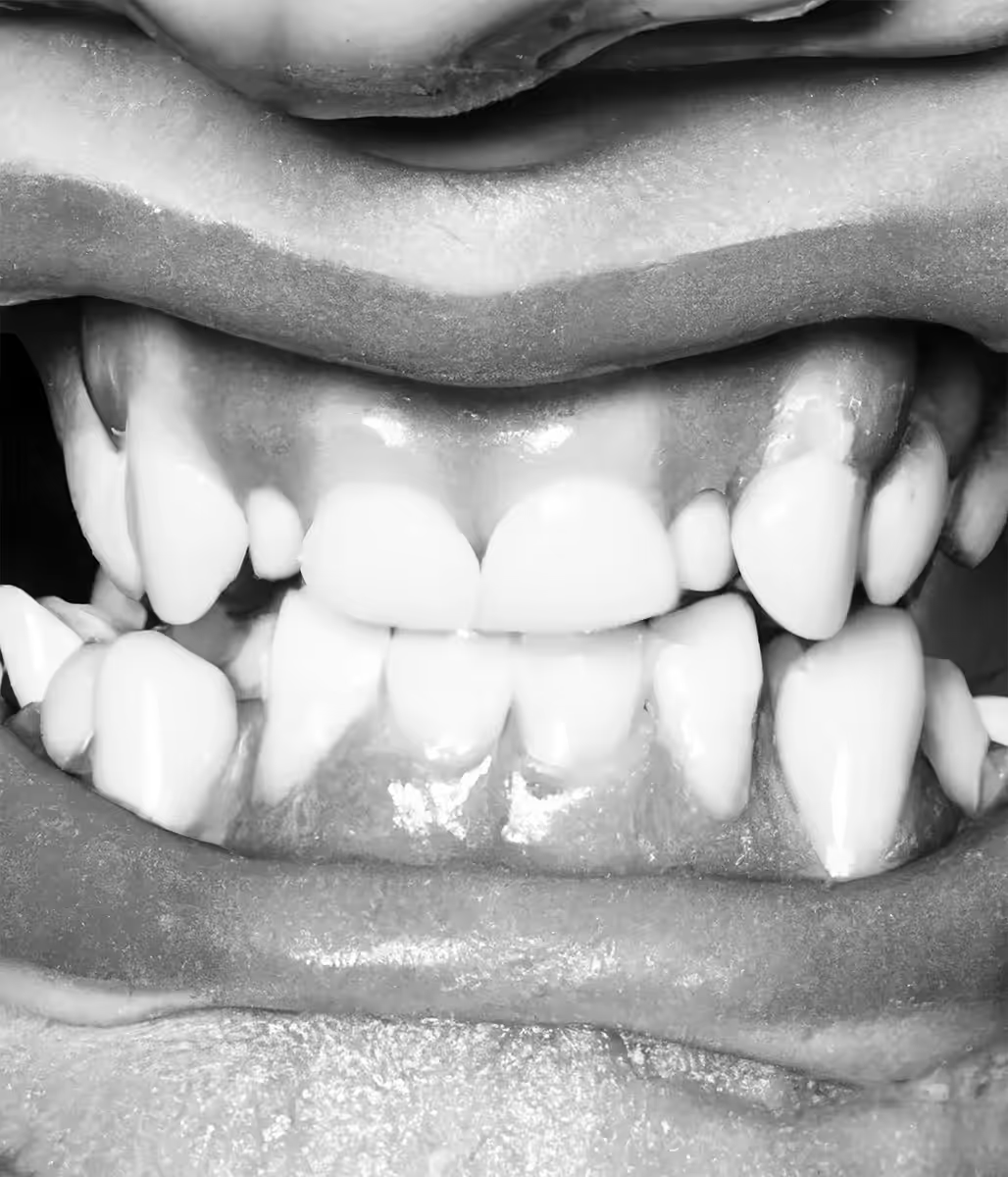
2022-10-13 11.37.05 Stretched across enamel and muscle, the smile holds. Not out of joy, but instruction. The teeth press forward like actors trained to shine, even as the stage collapses beneath them. Lips peeled, gums gleaming, the gesture insists: all is well. And yet, nothing rests behind it. This is not an expression. It is architecture. A scaffolding of performance. Bone, tendon, flesh aligned in the choreography of civility. But strain reveals itself in the corners. In the torque. In the uncanny neatness of something too controlled to be real. What happens when joy is not felt, only displayed? When the mouth is taught to betray the mind? This smile is not a bridge; it is a border between the self that speaks and the one that remains silent beneath. This image, part of the Limping Racehorse series, captures the cost of visibility. Not the absence of feeling, but its confinement. The forced grin becomes a symbol of compliance and tension: a practised violence softened into ritual. No applause. No release. Only the grip of expectation, clenched just beneath the skin.
“The Limping Racehorse” (2022) is a poetic image series based on poetry and diary fragments. Using DALL·E 2, Julia Albrecht explores memory, imagination, and the line between what was, what could have been, and what never existed.
In the summer of 2022, Julia Albrecht began a daily image-making process using the then-new DALL·E 2 model. What started as poetic fragments and diaristic reflections evolved into a visual series shaped by artificial imagination. Trained in photography but deeply rooted in language, Albrecht has long approached writing as a parallel artistic practice. With text-to-image tools, she found a way to return to language through images, letting words become visual material, and letting machine interpretation unlock forms that logistical or budgetary limits might otherwise have kept unrealised. “The Limping Racehorse” draws on aesthetic and conceptual impulses from the stark formalism of Richard Avedon’s portraiture and the therapeutic, self-reflexive strategies of Jo Spence’s photographic practice. At the same time, it extends Albrecht’s visual language, precise yet emotionally charged, navigating the threshold between control and ambiguity. The integration of AI served not as a replacement but as an accelerator to her existing process, enabling a faster and more fluid exploration of visual composition and poetic intent beyond the constraints of traditional photography. The limping racehorse becomes a metaphor for a transitional state: the moment after an intense chapter ends, and the next has yet to begin. Initially built for momentum, the body slows. Not to stop, but to reorient. It moves not with the drive to win, but with the need to understand. The series channels this in-between time: a period shaped by exhaustion, recalibration, and quiet refusal to rush forward until solid ground is found.
Julia Albrecht, Jawline Fracture, AI-generated image, 2022