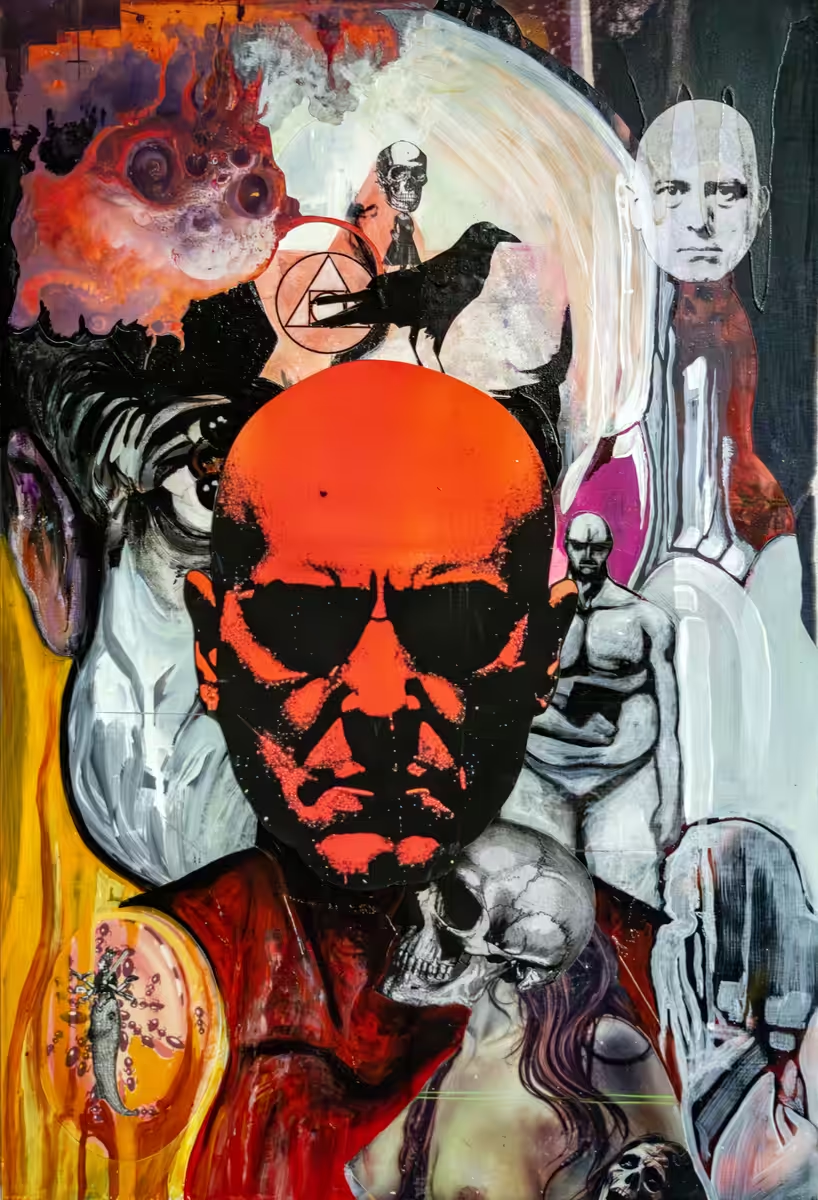
TH13TEEN: Judge Holden
Judge Holden mixed media on wood panel 16” x 24” x 2” 2024
This painting was created as part of the TH13TEEN exhibition but was not included, making it a reject of sorts. Judge Holden, in Cormac McCarthy’s Blood Meridian, is not just a towering, mysterious figure; he is a man of action whose deeds illustrate the novel’s bleak view of humanity. His actions throughout the book alternate between extreme violence and displays of terrifying intellect. Early in the novel, when he is introduced to the reader at a sermon in a tent revival, he falsely accuses the preacher of heinous crimes, causing the mob to attack the man. Afterward, the judge admits he never knew the preacher, and when asked why he made those claims, he simply replies: "Because I wanted to."
Holden’s capacity for violence is boundless and seems motivated by his personal philosophy, which is rooted in domination. He views war as a fundamental aspect of existence, famously proclaiming:
"War is the ultimate game because war is at last a forcing of the unity of existence. War is god."
He is a central figure in the Glanton gang, a group of Indian scalphunters, and while many of the gang members are brutal, Holden’s cruelty is different—more calculating, deliberate, and unfathomable. He plays a key role in many massacres, including attacks on Indigenous villages, in which women and children are slaughtered without hesitation. His indifference to human life extends beyond violence to a complete disregard for nature and beauty itself, symbolized in his act of meticulously sketching artifacts and natural objects only to destroy them afterward. This act reveals his obsession with control, as he claims that nothing exists unless it is acknowledged by him:
"Whatever in creation exists without my knowledge exists without my consent."
Holden's relationship with the novel's protagonist, the Kid, is tense and complex. Throughout the book, the judge fixates on the Kid, seemingly recognizing in him a resistance to the lawless, violent existence Holden so fully embodies. He repeatedly tries to break the Kid's spirit, urging him to embrace the same moral void, but the Kid resists fully surrendering to the judge’s worldview. In one chilling exchange, Holden tells the Kid:
"You alone were mutinous. You alone reserved in your soul some corner of clemency for the heathen."
Toward the end of the novel, after many of the gang members have perished, Holden remains, seemingly untouched by the brutality and chaos around him. His final encounter with the Kid (now referred to as the man) occurs in a jakes (outhouse), where the judge confronts him one last time. The precise details of what happens next are left deliberately ambiguous, but the scene ends with Holden emerging naked and triumphant, dancing with other men in a tavern, proclaiming his eternal power:
"He never sleeps, the judge. He is dancing, dancing. He says that he will never die."
Judge Holden’s actions, from his orchestrations of violence to his philosophical ramblings, contribute to his mythic, almost otherworldly presence. His character defies easy explanation, embodying both the raw, brutal forces of nature and the cold, calculated mind of a man who places himself above all forms of life and morality. His chilling assertions about control, war, and the meaning of existence make him one of literature’s most terrifying embodiments of evil.