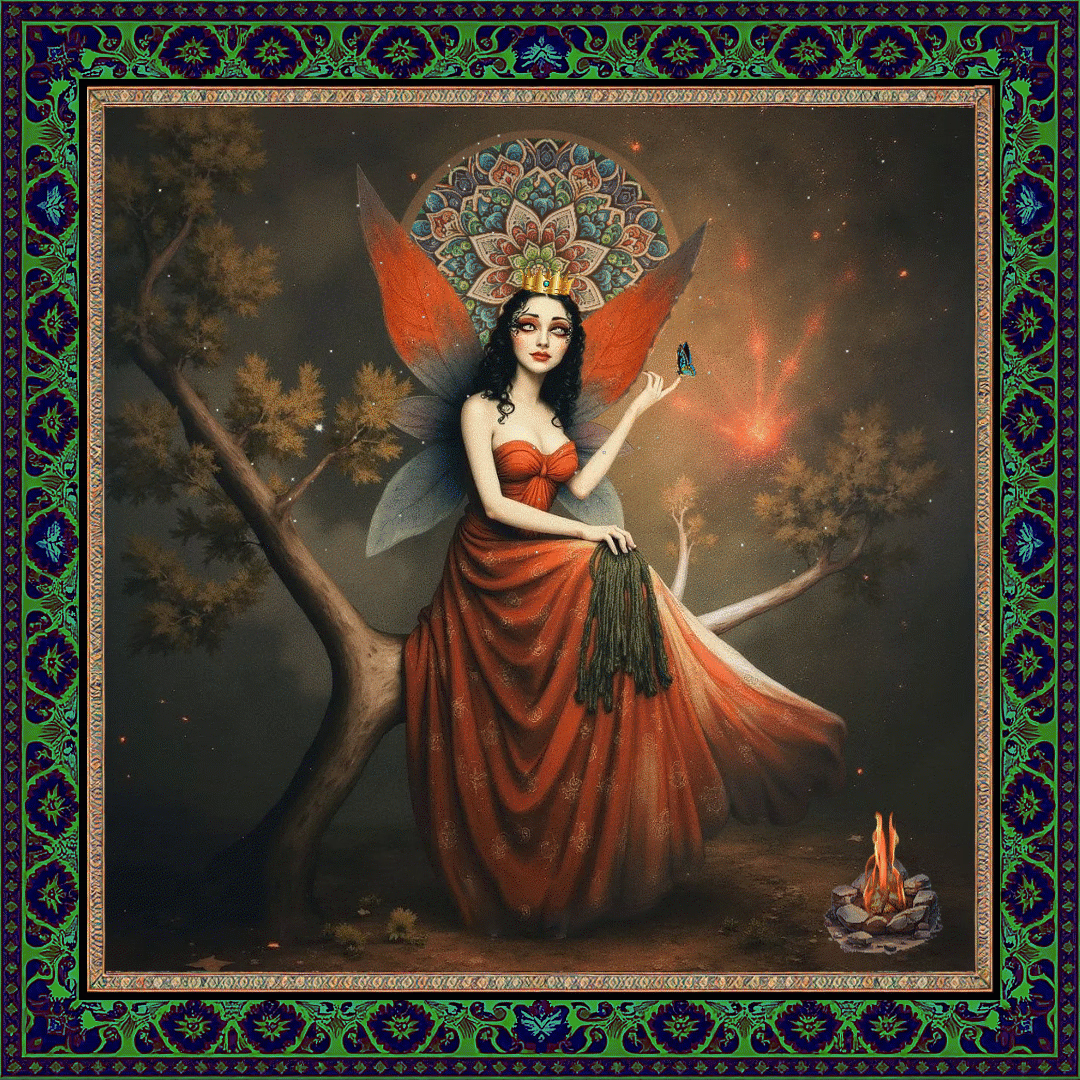
Carpet Model Art: Goddess of Life & Death , NZ 02
In the silence of night, a lone goddess sits—not to reign, but to witness the passing of moments. Her colorless, cold, and soulless eyes are a mirror of a truth hidden behind the veil of life; a truth that whispers: all that exists shall fade.
Her crimson dress is a burning flame of love that consumes but does not remain, and her delicate glass wings, more fragile than human desires, reflect red light and murmur tales of liberation from illusion. A butterfly rests upon her finger—beautiful, tender, and fleeting. Each flutter of its wings evokes the butterfly effect: the idea that even the smallest motion echoes through existence. Yet existence itself is but a shadow on the wall of imagination—impermanent.
Her braided hair lies upon her silent knee, a symbol of release from fabricated chains, a freedom born within. A lone tree stands in the distance of the desert, its roots in thirsty soil—a testament that even in desolation, hope may rise, though briefly.
Behind her, a spinning wheel turns—not of thread, but of time. Like a relentless clock, it marks the passage of life; a rotation that never halts, adorned with patterns of flowers and plants—symbols of nature’s bond with fleeting life.
Beside her, fire burns—not to warm, but to remind of a warmth that once was and shall be no more. Fireflies, like tiny stars, dance silently in light, as if life itself is made of these brief sparks of brightness.
The green frame encircling the scene is a ring of birth and death, of growth and decay. And the goddess, with a gaze drawn from the depths of nothingness, invites us on a journey inward—a journey to where life finds meaning not in permanence, but in its passing.
To live, in her eyes, is neither triumph nor sorrow—but a chance to see, to touch, to cherish what will inevitably slip through our fingers