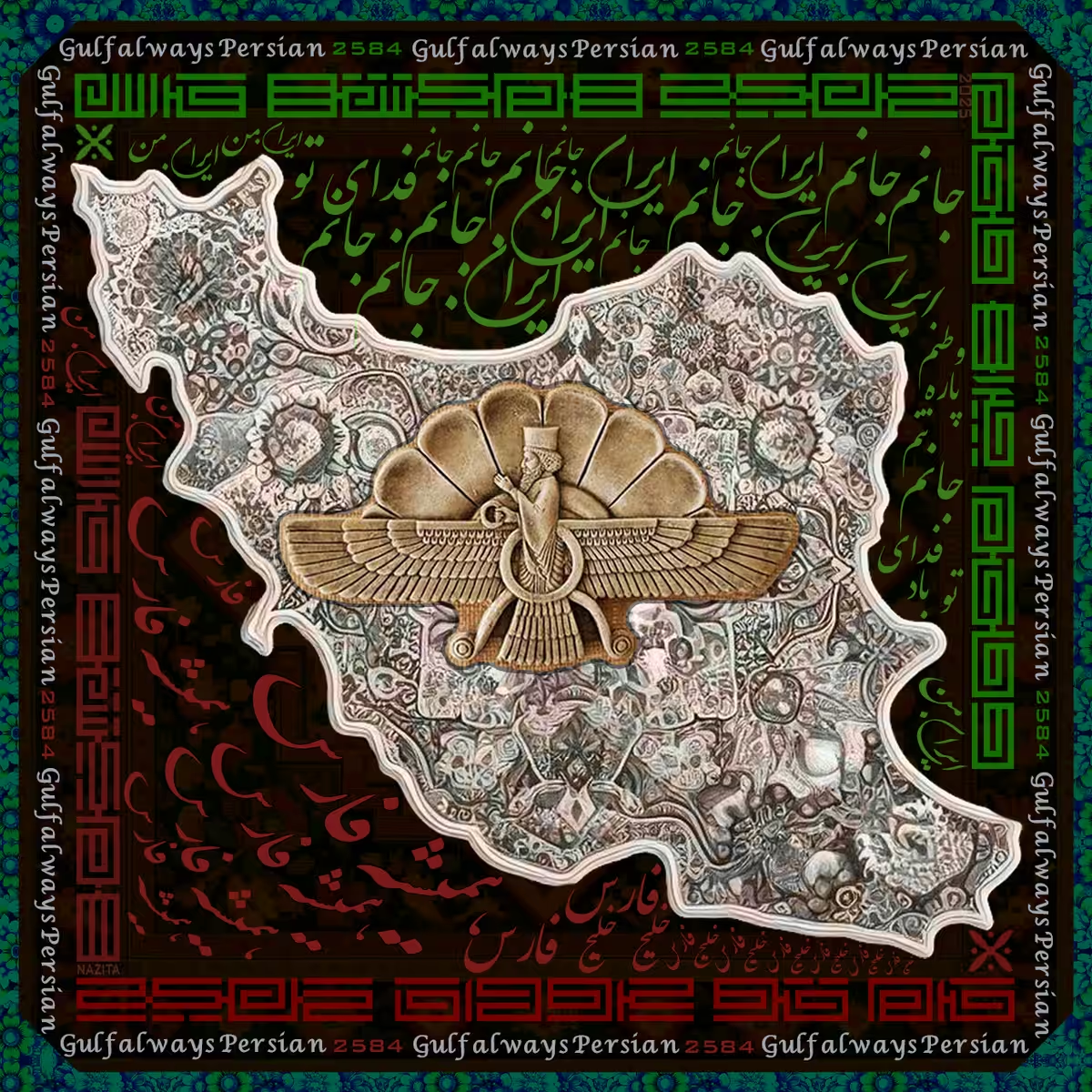
Carpet Model Art: My Iran , Gulf always Persian , NZ 01
The Persian Gulf and its synonyms in other languages represent the most authentic and ancient name, consistently used since centuries before Christ in all languages and global literature, intertwined with Pars, Fars, Iran, and Ajam—names for Iran—and their equivalents in other languages. During the years 550 to 330 BCE, coinciding with the Achaemenid Empire's rule over the Middle East, particularly the entire Persian Gulf region and parts of the Arabian Peninsula, the name "Sea of Pars" is widely found in written texts. From the same period, the Suez Canal inscriptions of Darius the Great, dating to the 5th century BCE, state: I ordered this canal (the Canal of the Pharaohs) to be dug from a river called the Nile (Pirava), which flows in Egypt (Mudrāyā), to the sea that begins from Pars (Pārsa). Thus, when this canal was dug as I commanded, ships sailed from Egypt through this canal to Iran, as I had intended.
Several atlases containing ancient names and maps of the Persian Gulf have been published, demonstrating that the name "Persian Gulf" has been used in all ancient maps. The book Documents on the Persian Gulf's Name, an Ancient and Eternal Heritage provides detailed information about these atlases. Among the oldest examples are the world map by Anaximander (610–546 BCE), a Greek geographer, reconstructed in Kleinere Schriften by Joachim Lelewel (1836); the world map by Hecataeus (550–476 BCE), one of the most prominent Greek geographers; and the world map by Ptolemy (90–168 CE), the renowned astronomer and geographer from Alexandria, who was the first to create an atlas containing 36 maps of various parts of the world