Bedtime stories: Childhood witnessing a fire
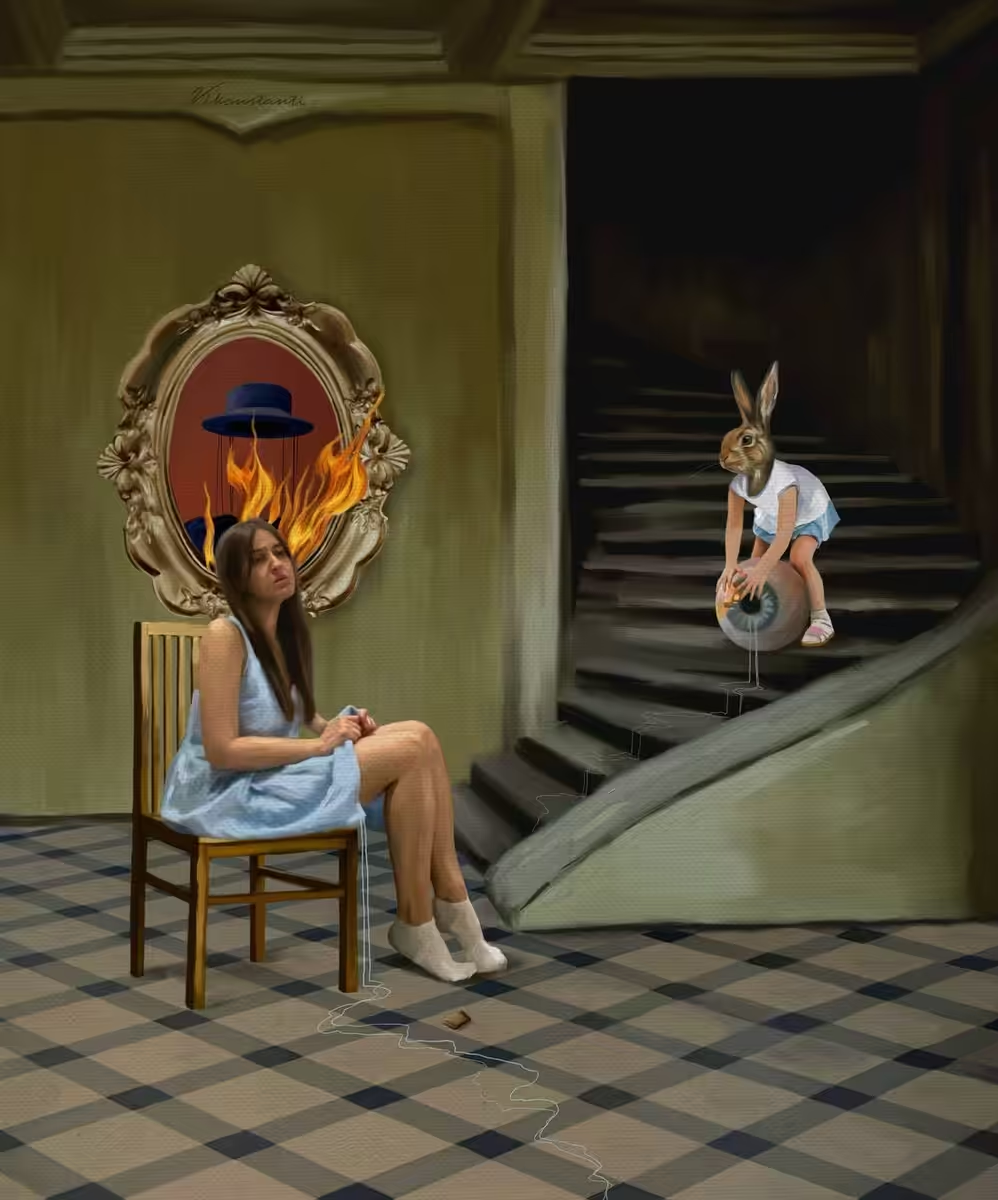
A woman sits on a chair, turned away from the wall. The fire has already been lit—it did not flare up suddenly, but rather was lit as a result of a conscious decision. She set the painting on fire herself. The lighter lies on the floor—small, ordinary, now useless. Her gesture is complete.
She does not look. Her gaze wanders to the side, as if she could turn off her vision by force of will. Her hands clench the hem of her dress — not to hold the fabric, but to hold herself. There is no calm in this movement, only fear that has found no outlet and is stuck in her body. She does not want to see what was recently part of her space, part of her identity, part of her past, burning.
On the stairs is a girl with a rabbit's head. This is not a random character or a fantasy. It is her — as a child. The version that does not yet know how to turn away, has not yet learned not to look. The girl reaches out with her hands toward the huge eye, trying to cover it, to hide it from what is happening, as if concern could be stronger than reality. But her hands are too small. They are unable to block the view.
The eye remains open. It sees everything: the fire, the tense posture, the discarded lighter, the fear of the adult woman. It becomes a witness to a scene that the adult version is trying to avoid.
This is a story about the impossibility of protecting the inner child from the consequences of adult decisions. About the fact that childhood always sees — even when they try to cover it with their palms. About the fact that once a fire starts, it remains real, regardless of who decides to look away.