Bedtime stories: A place where air pretends to be water
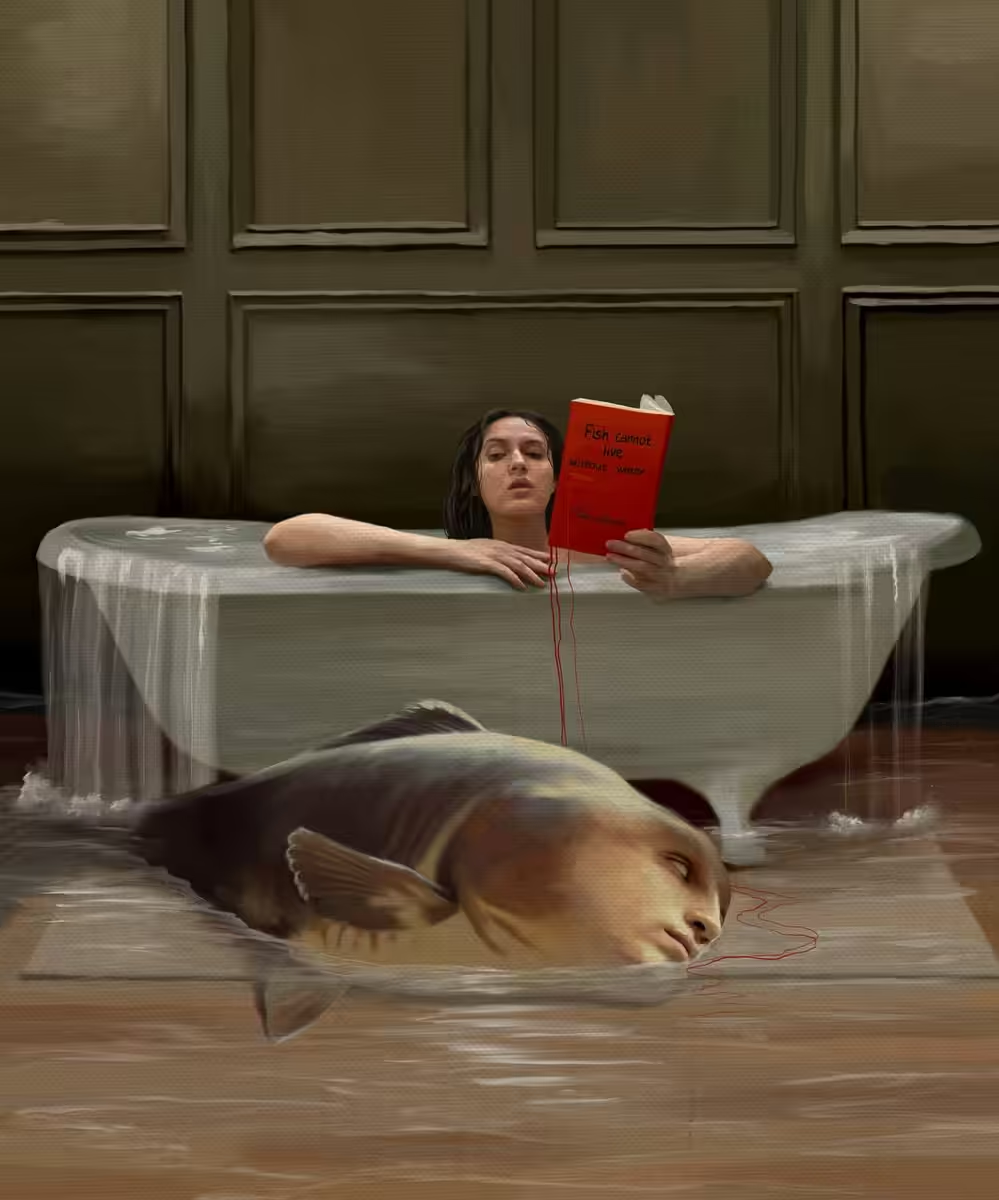
A girl lies in the bathtub with a book in her hands, but she hasn't been reading for a long time. Her gaze is directed downward—to where the water has overflowed the bathtub and spread across the room, filling the space that once belonged only to her.
In this water is a creature with a man's face and a fish's body. He is not a monster or a fairy-tale character. He is vulnerable. Helpless. And at the same time strangely accustomed to his helplessness — as if it were his natural form of existence. He can only live in water, but every time he finds himself where there is none.
The book in her hands — Fish Cannot Live Without Water — no longer sounds like a metaphor, but like an instruction she has memorized. This is not the first time the room has been flooded. It is not the first time that someone else's inability to breathe has become her task.
There is no sudden epiphany here. She understands everything in advance. The water flows from her side. She allows it to flow. Because she knows that if she doesn't, he will suffocate. And every time, the choice is made in the same direction.
The space slowly disappears under the water. The boundaries are blurred. There is less and less air. But it is not the fish that will drown.
This scene is not about heroism. It is about rescue as an addiction. About love in which one survives only if the other gradually stops breathing.