Bedtime stories: The hotel corridor of patience
The long corridor of the hotel looks impeccable—even lighting, identical doors, carpeted floors, muffled silence. It is a place for temporary accommodation, a place where no one really lives. You can stay here, but you can't feel at home. And that's what makes it a symbol of a life that seems to be happening, but doesn't feel like your own.
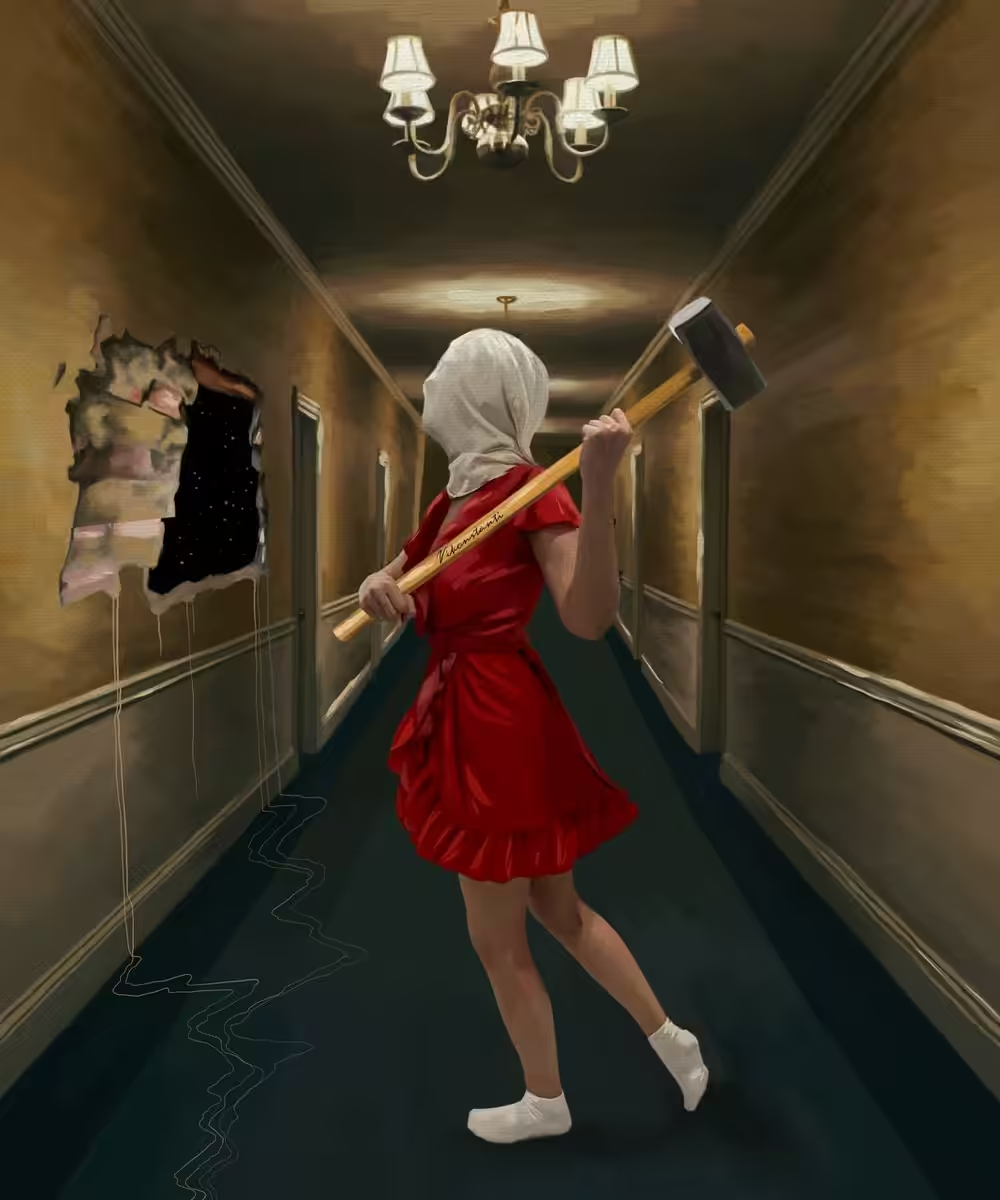
A breach appears in this sterile, impersonal world. An uneven hole in the wall does not open onto the next room or the street — behind it lies outer space, infinite and frighteningly honest. There are no schedules, rules of life, or neatly made beds here. There is only uncertainty.
The girl in the red dress does not leave — she takes action. The heavy hammer is not a sign of destruction, but an instrument of liberation. It was she who broke through the wall. Not in hysteria, not in chaos, but in a moment of inner clarity. When the realization comes: staying in a foreign space is scarier than risking a step into the unknown.
Her face is hidden by fabric — as if she no longer needs to be recognizable, comfortable, socially readable. In a hotel, everything is temporary, all roles are superficial. And by hiding her face, she seems to be removing her last obligation to obey.
The main idea of the work is contrast. Outwardly, there is no disaster: the corridor is still smooth, the lamps are shining, the doors are in their places. But inside, a rupture has occurred. The wall was destroyed not out of rage, but out of honesty with oneself. This is not an escape — it is the first independent choice of direction.