Bedtime stories: Vulnerability room
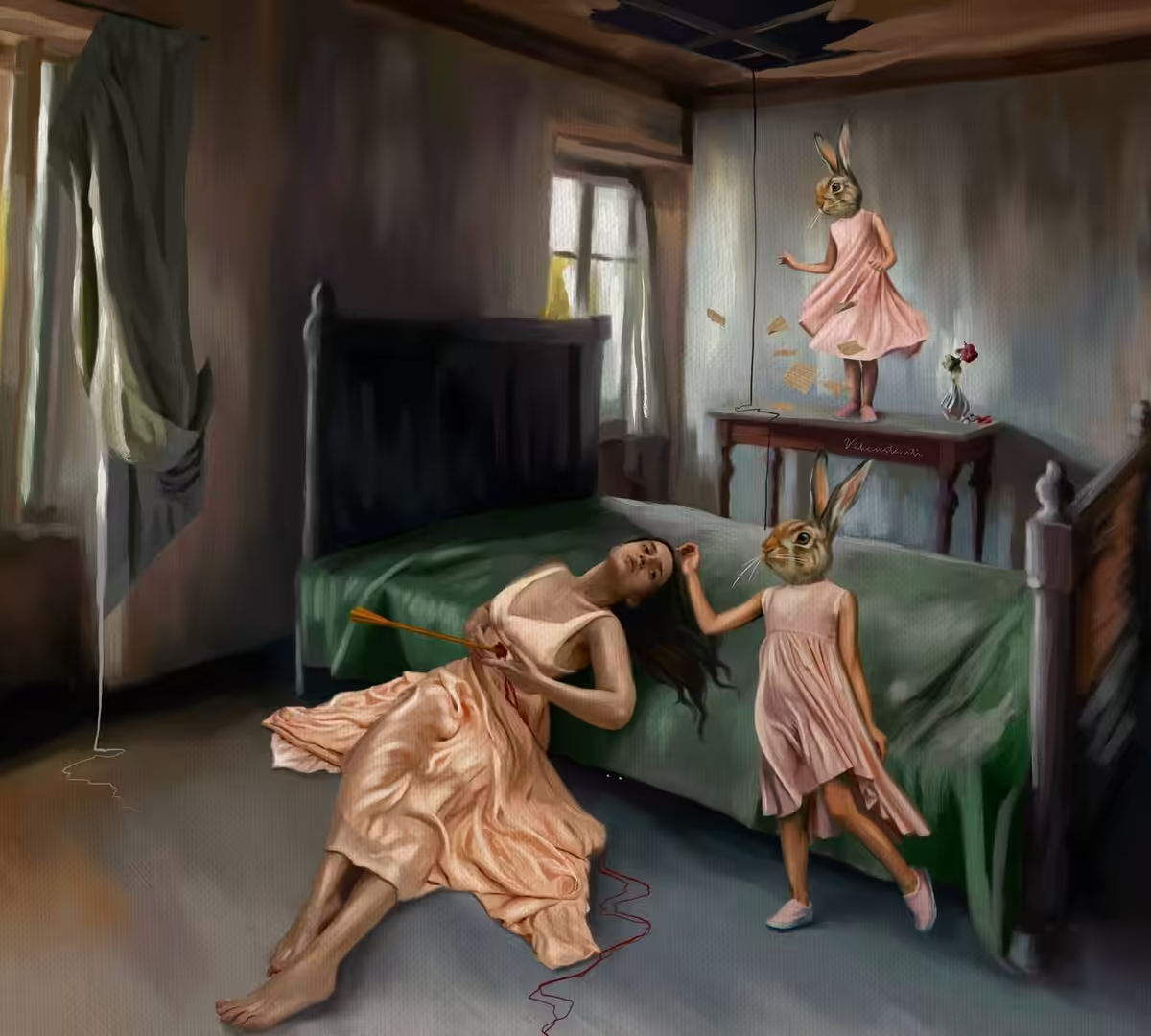
At the center of the composition is a girl struck by an arrow. Her body lies on the floor not at the moment of falling, but after the blow, when the event has already happened and the pain has ceased to be a flash, turning into a state. The arrow does not resemble a weapon—rather, it looks like a sign of invasion, a sharp blow to something vulnerable and personal, after which it is impossible to remain the same.
Around her are childlike zoomorphic creatures. They do not attack or rescue; their presence is calm and almost neutral. They are not witnesses to the tragedy or characters in a nightmare, but figures existing on another level — like parts of the inner world that continue to live their lives despite what has happened. Their childlike bodies emphasize naivety and vulnerability, while their animal heads emphasize the instinctive, uncontrollable nature of these states.
A wilted rose lies on the table, devoid of decorativeness and symbolic pathos. This is not an image of romance, but a trace of a feeling that has already passed, something that has not stood the test of time or influence. Two eyes glow under the bed — the only element of the scene associated with tension and hidden observation. They do not act, do not come out, but their presence makes the space unsafe, reminding us that even in apparent silence, something unconscious and alert remains.
The work does not tell a story of salvation or destruction. It captures the moment after—a state in which a person is already wounded but still exists, and inner forces, fears, and remnants of feelings remain close by, neither disappearing nor making decisions for him. There is no morality or explanation here, only a precise, almost silent observation of what the inner world looks like after the blow.