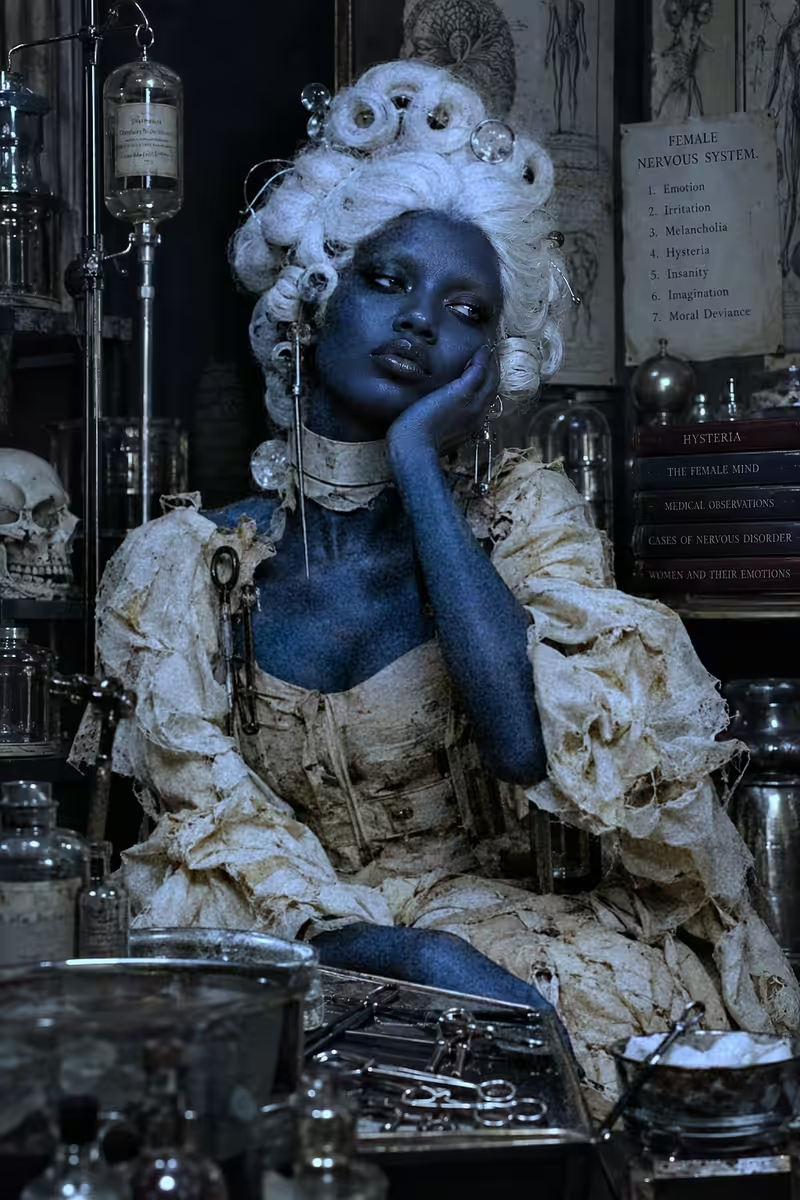
There was a time when a woman could be considered ill simply for feeling too much, speaking too freely, refusing to behave, or expressing a pain nobody cared to understand.
They had names for her. They had instruments, treatments, theories and entire rooms dedicated to finding what was wrong with her. Her emotions became symptoms, her resistance became evidence, and her individuality became something to be corrected.
Sometimes, the problem was never her.
This work draws from the history of female hysteria, a diagnosis that for generations was used to medicalise women’s emotions, experiences and behaviours. It reflects on the uneasy relationship between womanhood, medicine, power and society’s need to explain or control what it does not understand.
But beyond its historical reference, the work asks a much older question: how often do we mistake difference for disorder? How many people have been made to feel broken simply because they could not fit into someone else’s idea of normal?
I think about the women who were examined, labelled, confined and treated, whose experiences were interpreted by everyone except themselves. Women who were told what they felt, what they needed and who they were, often without anyone stopping to ask.
Perhaps they didn’t need another diagnosis. Perhaps they needed someone to listen.
And perhaps, even now, we haven’t entirely outgrown the habit of looking at what we don’t understand and deciding that something must be wrong with it.