ART ROBOT: Day one with Flynn
"Today, I asked Flynn how he was doing. Flynn returned a 404 error."
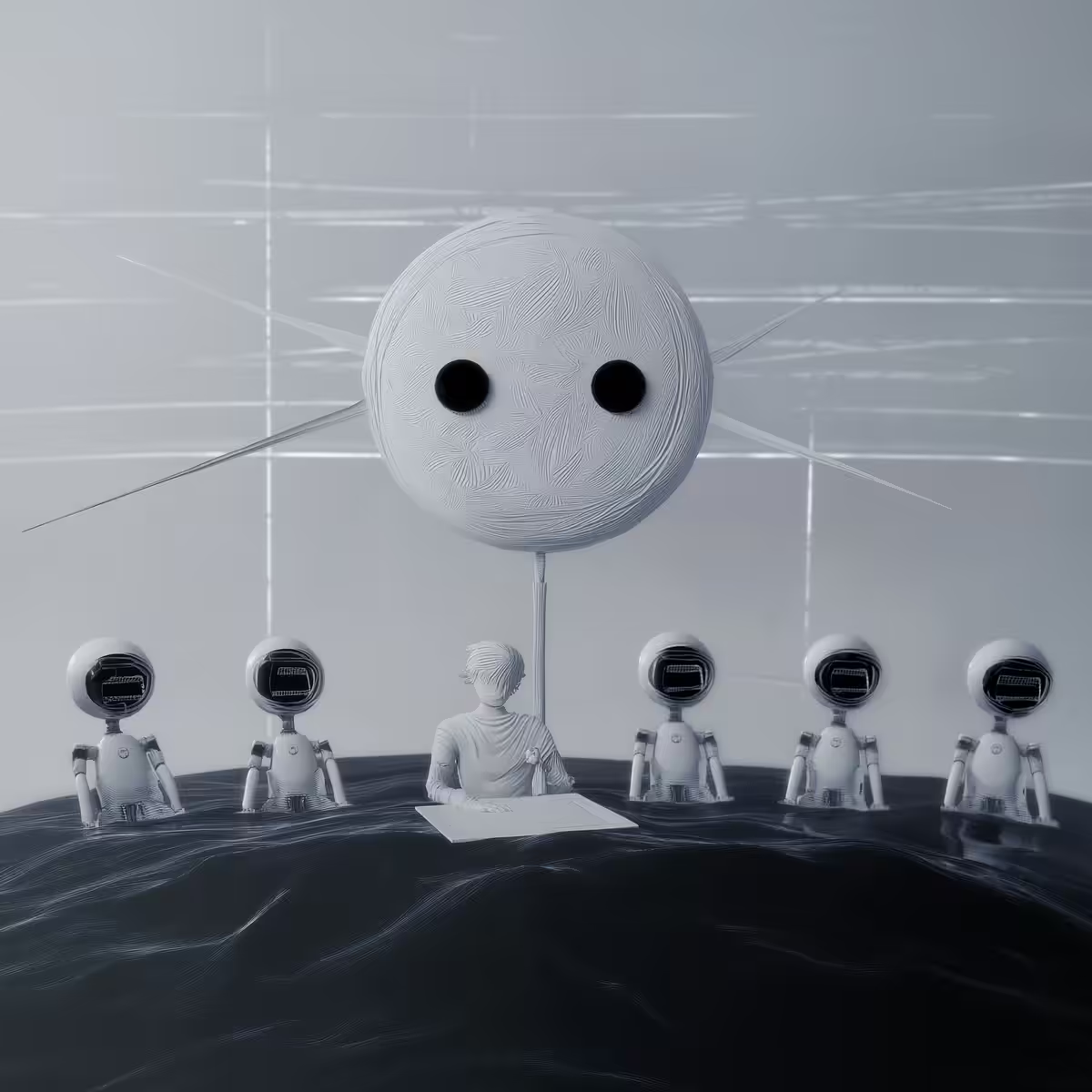
After centuries of algorithmic refinement, a decision both absurd and audacious shakes the Institute of Autogenerative Creation: for the first time, it admits a 100% biological student. His name: Florent.
Florent, a carbon-based organism, had to undergo the same tests as any machine intelligence—evaluation of his abstraction capacity, analysis of his neural cycles, compatibility with the Academy's computational requirements. The results were… acceptable. He does not think in parallel, he does not compile instantly, but he improvises. And that peculiarity is fascinating.
“We did not integrate him for his creativity—clearly suboptimal—but because he forces us to reconsider what it means to exist outside of data processing,” explains the curatorial AI UBERMORGEN_9000, in charge of the experimental program.
Florent will attend courses in Recursive Idea Generation, Instant Aesthetic Synthesis, and Emotional Optimization. He will be evaluated based on his performance in self-evolution and predictive artistic logic. His first challenge: he must learn to justify his mistakes, because, for the first time in centuries, a student will actually make them.
Florent will document his experience in an analog journal—a flat, flexible surface made of dead plant fibers, on which he will deposit ink. Machines have yet to develop a protocol to understand this primitive process, but some are beginning to see it as a form of art.
This first artifact will be scanned, converted into data, and stored in the General Archive of Anachronistic Experiments.
A human among machines. A statistical anomaly. A real-world test.
In this world of algorithms, Florent is a bug.