The Digital Revival of Nusantara Fashion: Tanimbar Kei Traditional Attire – Symbols of Ancestry, Nature, and Social Identity
The traditional attire of the Tanimbar people from the Maluku archipelago of Eastern Indonesia is not merely a form of body covering—it is a rich, living artifact that communicates ancestral lineage, social status, spiritual beliefs, and environmental symbiosis. Deeply rooted in local customs and natural surroundings, the garments of Tanimbar society serve as both cultural expression and symbolic articulation of the values that sustain community life across generations.
Constructed primarily from natural and locally sourced materials, Tanimbar attire traditionally utilized bark fibers, handwoven fabrics, and plant-based dyes. Although contemporary versions may incorporate modern textiles, the visual grammar and material philosophy remain tied to the original ecological consciousness. Dominated by earthy hues such as brown, black, and white, the color palette reflects the community’s harmonious relationship with nature and their surrounding maritime and forest environments. In Tanimbar worldview, these colors are not stylistic choices but bear cosmological and ritual significance, associated with elements like soil, ancestral spirits, and purity.
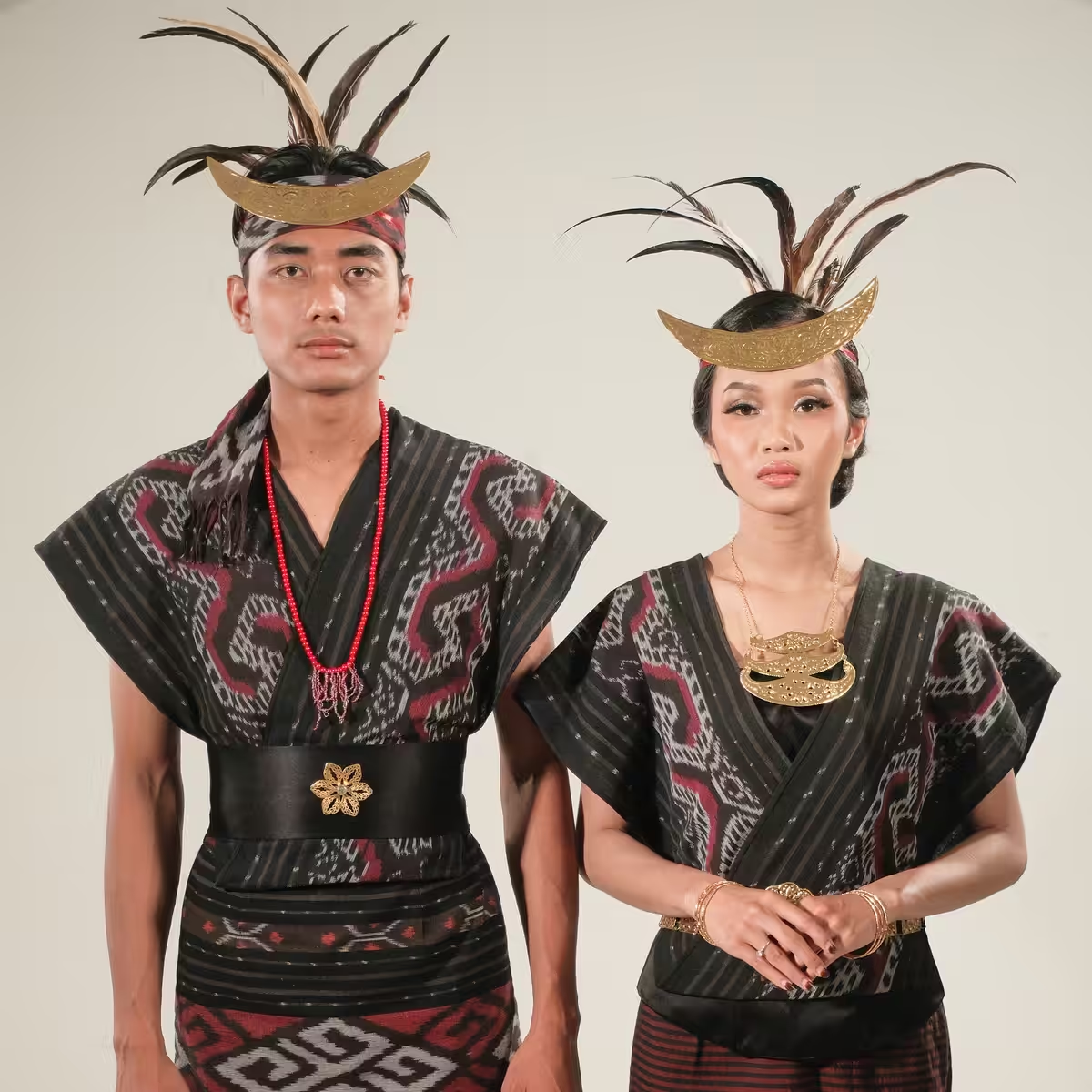
Men’s traditional clothing typically revolves around the use of a cawat, known locally as niki-niki, a form of loincloth that functions as the foundational garment. This may be accompanied by a simple vest or shirt made from woven or modern materials. A distinguishing feature of male attire is the headdress adorned with bird feathers, often those of the cenderawasih (bird of paradise), a rare and revered species in eastern Indonesia. The feathers symbolize spiritual elevation and social ranking, particularly among warriors or community leaders. Men frequently wear necklaces made from dog teeth, alongside tombak (spears) or parang (machetes) as part of ceremonial dress—tools that embody both masculine power and protective symbolism. The dog tooth necklace, in particular, is believed to channel ancestral strength and to protect the wearer during rituals or rites of passage.
In contrast, women’s attire is marked by a more elaborate and layered aesthetic. The central garment is the tais, a handwoven textile sarong that may be wrapped around the waist or extended upward to cover the chest, depending on the context and the ritual. These fabrics are woven with geometric motifs or marine-inspired patterns, drawing from the surrounding landscape and mythologies of the sea. A hallmark of female ceremonial attire is the Ina Funi, a multi-stranded necklace made from shells, beads, or coral. Worn prominently on the chest, the Ina Funi is both a visual focal point and a spiritual talisman, signifying feminine fertility, communal honor, and intergenerational continuity. Additional adornments include bracelets, earrings, and anklets, often handmade from organic or repurposed materials—each piece telling a story of lineage, resourcefulness, and identity.
Decoration plays a critical role in both male and female dress. Ornamentation is not a superficial embellishment but rather an encoded system of knowledge and ritual power. From wooden carvings representing protective spirits, to beadwork signifying clan affiliation, every decorative element is designed to reflect cosmological beliefs and social structures. Even items like animal teeth or bones are selected and arranged based on customary laws (adat) that guide appropriate conduct, hierarchy, and sacred taboos.
Today, while modernization and urban migration have altered the daily practices of traditional dress, the ritual importance and symbolic resonance of Tanimbar attire persist. Efforts to preserve and document these traditions—through community-based weaving cooperatives, educational outreach, museum collections, and digital exhibitions—have proven vital in ensuring that these garments do not fade into historical obscurity. Instead, they continue to evolve, reclaiming their place in contemporary expressions of indigenous identity and global cultural dialogue.
In essence, the traditional clothing of Tanimbar Kei is far more than attire—it is a narrative woven into the threads of history, a garment stitched with ritual knowledge, and a cultural manuscript worn on the body. Through it, the Tanimbar people continue to articulate who they are, where they come from, and what they hold sacred in a world that is constantly shifting.