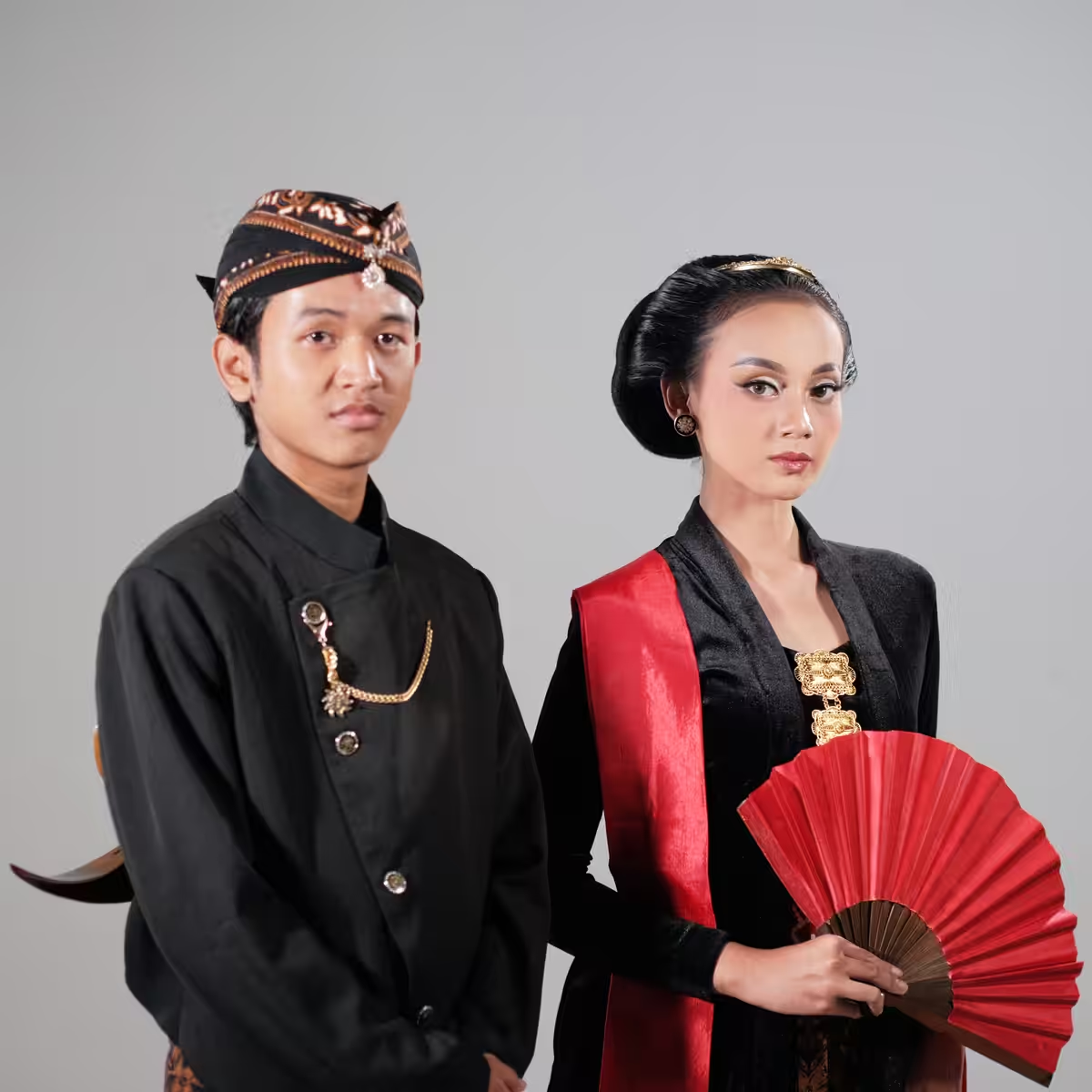
The Digital Revival of Nusantara Fashion: Jawi Jangkep – The Noble Attire of Javanese Male Ceremony
The Jawi Jangkep is a quintessential form of traditional male attire from Central Java, Indonesia, often worn during significant cultural and ceremonial occasions such as weddings, royal court events (keraton), traditional inaugurations, and formal rites of passage. The term “Jawi Jangkep” can be translated literally as “complete Javanese,” signaling not only the completeness of the ensemble but also its embodiment of a holistic Javanese identity—one that integrates physical appearance, spiritual symbolism, and ethical philosophy.
Far beyond its aesthetic value, the Jawi Jangkep attire is imbued with deep cultural meanings that reflect core Javanese values such as keselarasan (harmony), kesopanan (modesty), and martabat (dignity). As such, wearing this garment is an act of aligning oneself with a philosophical and ethical framework grounded in Javanese cosmology and social conduct. The attire is not simply clothing—it is a codified cultural statement and a performative expression of moral refinement.
The male ensemble of Jawi Jangkep consists of several elements, each carrying symbolic significance. The beskap, a long-sleeved, high-collared jacket, is traditionally made from dark-colored velvet or other rich fabrics and represents discipline, formality, and inner strength. It is tailored in such a way that it emphasizes straightness and symmetry, reflecting the Javanese principle of tata titi tentrem—order, precision, and tranquility.
Worn beneath the beskap is the jarik, a long batik cloth wrapped around the lower body in an elegant fold. Commonly bearing motifs such as sidomukti, parang, or kawung, the jarik communicates philosophical messages. For instance, sidomukti symbolizes hope for happiness and spiritual fulfillment, while parang implies strength and resilience. These batik motifs are more than artistic patterns; they function as visual texts within the Javanese symbolic system.
A blangkon, the traditional headgear made of batik fabric, crowns the ensemble. It is meticulously folded and knotted in a manner unique to the region and reflects not only local identity (such as Yogyakarta or Surakarta styles) but also spiritual containment. The blangkon is thought to help the wearer maintain inner composure and self-control, essential virtues in Javanese thought. On the back, the keris—a traditional dagger known for its spiritual power—is tucked into the waistband. The keris is not merely a weapon, but a sacred object imbued with ancestral energy, protection, and prestige.
Completing the outfit are selop, or soft-soled slippers, which subtly signal humility and grace in movement. Every component is designed to maintain the wearer's decorum and refined behavior. Together, the Jawi Jangkep outfit turns the male body into a site of cultural discipline and ethical performance, guided by the aesthetic of restraint (alon-alon asal kelakon—slowly but surely).
The female counterpart to this male ceremonial dress is equally refined. The woman typically wears a kebaya, an elegantly tailored blouse that follows the lines of the body without revealing it excessively, preserving both sensuality and modesty. The kebaya is paired with a jarik or kain batik, wrapped tightly around the waist and hips, forming a sleek silhouette. Accessories include sanggul (a traditional hair bun), intricate hairpins, and perhiasan such as necklaces, bracelets, rings, brooches, and selop. Altogether, the female ensemble represents kehalusan budi (noble character), keanggunan (grace), and kehormatan (honor), completing the visual and symbolic dialogue between male and female attire in Javanese tradition.
The union of these two costumes—Jawi Jangkep and Kebaya—is not merely a sartorial pairing but a visual and ethical manifestation of Javanese cosmology, in which rwa bhineda (duality) and manunggaling kawula lan Gusti (unity between human and divine) are harmonized. Together, they embody the balance of masculine and feminine energies, public duty and inner devotion, and worldly poise with spiritual grounding.
In today’s increasingly globalized and digitized world, the Jawi Jangkep continues to function as a potent symbol of Javanese resilience and refinement. Through exhibitions, academic documentation, and now digital platforms, the attire not only preserves heritage but also adapts to new cultural contexts.
Ultimately, the Jawi Jangkep is more than clothing. It is a visual language, a repository of cultural ethics, and a ceremonial interface between individual identity and collective memory. Through its continued use and evolving reinterpretation, it affirms that tradition is not static—it is dynamic, reflective, and ever-relevant to the lives of those who continue to wear it with pride and purpose.